Showing posts with label Ash Wednesday. Show all posts

Wednesday, February 14, 2024

Telling the truth and living the truth

Once people learn that you are even the least bit intentional about following Jesus, you are done. Finito. You can’t win. You can give up trying to manage how other people see you. It is a lost cause.

When you try to do as the prophet Joel proclaims—to proclaim a fast, to get people to drop everything and turn their hearts to God—you will be seen as some kind of fanatic.

If you do the right thing today and come to church (and you’re here, aren’t you?) and choose to carry even a small sign of your mortality and penitence around with you on your forehead, then someone, somewhere will say “Ha! You have your reward!”

Even if someone at work or in the store or in your household doesn’t remind you that Jesus just told us not to do this in public, I will bet that there is inside of you a little, chiding voice that is just waiting to rub it in and make you feel small.

We want to live right, in the way God wants; and to live well, in a way that has dignity and purpose. And yet as soon as we begin to get serious about being faithful we end either feeling guilty or being misunderstood. Or both.

Even Paul reminds us that Christians are a universally and consistently misunderstood lot. Look at his list: we Christians are treated as imposters (liars!), as unknown (as ones without celebrity!). We are seen as punished—beat up by others! — and as a sorry, sorry lot. We have nothing to give and treated worse than the poor.

It should be no surprise that Christians are misunderstood. I mean, we spend so much time trying to straighten each other out, it’s no wonder than the culture at large does not know what to make of us.

So Jesus is right. Beware of practicing our piety before others — it is dangerous and uncontrollable!

When Jesus warns us not to be smug in our spiritual practices, does that mean that we should not practice them? Of course not. He is saying to be careful.

Here is the truth. We cannot help but practice our piety before others! What we do and who we are is there for all the world—and God-- to see. The challenge is for whom we show it. It is to make others think better of us? Or does what we do somehow show off the truth of who and whose we are?

A good place to start is to get the relationship between our outer world (what might be called our treasure) and our inner world (our heart) lined up. Make sure that one flows out of the other.

Our treasure and our heart are attracted to each other like iron filings are attracted to magnets. Jesus says we have a choice. We can leave our hearts in a stuck place beholden to the outside stuff; or we can put our heart where we want to come out and organize everything else around it.

Jesus’ remedy for those of us who might be addicted to some degree of public approval when we do the right thing is to make sure we start by putting our heart it belongs.

So we have a choice. On the one hand, we can stay mired in the everyday and the hum-drum, reacting to one crisis after another, we can fret and worry about how much money we wish we had; we can let all these things dictate our actions and choices.

We can live out of our scarcity and let our fear run us—but put on a good game face. That’s one choice. But that’s the kind of person Jesus is warning us not to be: the person who makes the biggest fuss over their gift, the biggest show of their prayer. Why? Because for some people, all that show is hiding something; the loud and bright presentation is meant distract us (and even themselves!) from the truth.

The other choice is to admit who and whose we are, and to put our heart where we and God wants it to be. To say out loud that right now, in this moment, I will give my heart to God and put my heart where God wants and I will let everything, my treasure, my priorities, my self go to it.

It is really simpler—and harder—than it sounds. The first step is to tell the truth. The second step is to experiment with living with that truth, even for a short time. Tell the truth and live the truth.

Say the truth: “I don’t have my act together. But I want to pray more.” Then just for a moment, live the truth: in this moment, pray as much as you are able.

Say the truth: “I don’t have my priorities straight all the time.” Then just for a moment, live the truth: right now, right here, I will do this one right thing.

Say the truth: “There are days when I live out of fear and reactivity, but I want to be present to God, my neighbor, and creation.” Then live the truth: right now, just for a moment do something as simple as a deep cleansing breath that pushes out all that old stale air you didn’t even know you had down there and breathe in as deeply as you have ever breathed. For just this moment, know what that feels like to be here, in this place, in this body, in this community.

Say the truth: “I define my life by all the stuff I have and all the stuff I wish I had.” Then, right now, in this moment, live the truth: give something out of our incomparable abundance so that someone else might have a meal, or a roof, or a book or a companion that they did not otherwise have.

Say the truth: “I am wretched and broken and I am not the person God made me to be.” And then live the truth: know that you are forgiven; that you are an adopted member of God’s family, Christ’s body, the Church and know that you are blessed. Right now. Right here.

By telling the truth and then, even just for a moment, even experimentally, even gracefully, living the truth we put our heart where it belongs—where God wants it to be—and then right now, in this moment we let everything organize itself around that.

But be careful. This is not simply an act of the will. It is a response to grace. When we tell the truth and then live the truth, we are in fact listening to the Holy Spirit who goes before us, and prepares us and makes us ready to receive God. We don’t do this to impress. We do this because it is true.

And be prepared to be misunderstood. Once we give our hearts to God; once we tell the truth and put our heart there, and once we live the truth and begin to organize our stuff, our relationships, and our priorities around where your heart actually belongs, people will not understand.

Heck, we might not understand! But we will be changed. We will experience God’s transforming love and power.

The Apostle Paul says that “We are treated as impostors, and yet are true; as unknown, and yet are well known; as dying, and see-- we are alive; as punished, and yet not killed; as sorrowful, yet always rejoicing; as poor, yet making many rich; as having nothing, and yet possessing everything.”

There are only a few liturgies in our Episcopal tradition that requires us to come to the altar more than once in a single liturgy. Today is one of them. We come forward to receive ashes; and we come twice for Maundy Thursday (footwashing) and we come forward during a public service of healing. I believe this action of coming to the altar twice suggests that the action telling the truth and living the truth. That telling the truth and living the truth is necessary for real repentance, real service and real healing.

Telling the truth and living the truth is also the action of coming to the cross. There is hope in meeting the truth of Christ’s suffering. It is on the cross that all of our hard, often unpleasant truths are crucified and given back to us in the truth of new life unfolding right here, right now.

This Lent, this forty days, this tithe of our year, we are called once again to experiment in telling the truth to ourselves and to God and then, with God’s grace, living the truth.

The truth is that we can’t tell the truth alone. The truth is that we cannot live the truth alone either. But God has not left us alone. Jesus walks this path with us. We have the very breath of God, the Holy Spirit, praying in us and with us, even when we can’t find the words. We will encounter God’s truth and ours in scripture and in worship and in community.

One thing for sure: once you give your heart to God, and even for one moment organize your life around that, nothing will be the same. Once we tell the truth and live the truth, even for a little bit, we cannot go back. Today is the acceptable time. Today is the day of salvation. Today is the day to tell the truth. Today is the day to live the truth.

+ + +   + + +   + + +

Bulletin for Worship for Ash Wednesday, February 14, 2024 at St. John's, Clearwater, Florida.

Here are the Scripture Lessons for Ash WednesdayFebruary 14, 2024

Here is a video of the Sermon at St. John's, Clearwater, Florida on February 14, 2024.

Here is a video of the Liturgy at St. John's, Clearwater, Florida on February 14, 2024

Wednesday, March 02, 2022

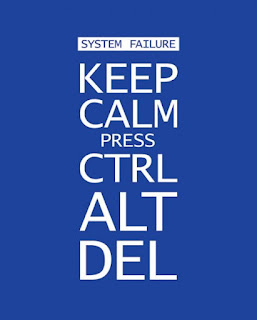
Ctrl-Alt-Delete

It seems to happen every Thursday. I try to work around it, but it happens anyway. I arrange for it happen while I am sleeping, but usually it greets me as soon as sit down at my desk. And when it does, I just have to wait. I can moan. I can groan. I can plead that I have a really important job to do and can’t this just wait?!! 

But it is going to happen. It needs to happen. Just get over it.

What I am talking about is, of course, the weekly Windows upgrade and the need for my computer(s) to accept it and reboot. And then there is the weekly and sometimes daily virus check and update that my anti-virus software requires.

I don’t know about you Mac people, but thanks to the nice people in Redmont, Washington, it is just a fact of life.

So, I can count on it. Every Thursday—or the first time I open my machine on the days following-- there I will sit, staring at my screen while the little spinney-thing spins away on my screen.

I used to resent it. (Well, okay, sometimes I still do.) But it just is. And you know what? I need it.

Every now and then, I come across a person who has never, ever given permission for the weekly update, or who puts it off. Or who has never upgraded their operating system. They say “nope, not today! I’m just too busy to stare my screen for three or five minutes, even if it runs in the background.  I’ll do it later.” Only “later” never comes, and then they discover that their system is no longer supported, or the various apps and software will no longer talk to each other, or to you, or (God forbid!) your machine catches a virus.

Sometimes we go into Lent doing the same thing. We think we can put it off. Or that Lenten updates are for weenies. Or, if we decide to go ahead and take the plunge, we go for total a do-it-yourself overhaul. You know… Completely new innards—a whole new me, but all by myself! Perhaps with the help of a self-help book, maybe an on-line course, and snippets of the Bible. 

But that doesn’t always go according to plan. 

Other times we might think that all that stuff about “giving up something for Lent” (which of course means making room for something new like prayer, or reading, or study, or care for the poor or needy) or that Bible stuff or that weird little book your priest has recommended is just too much. Who has time? Besides, I’ve got this covered! I can do this! I'm fine!

Once, many years ago, a colleague of mine, an ER nurse told me that she was going to have the best Lent ever. She had thoroughly planned for her spiritual make over. Diet, exercise, readings, and going to Mass every day, the whole megillah. A total new me (in Jesus)!

Then life happened. As she was leaving church on Ash Wednesday morning, and about to cross the street to her car, one of her brothers or sisters in Christ had gotten to their car, gunned the motor and sped out of the parking lot, driving through a big puddle and drenching my friend with muddy water and half-frozen winter muck. My friend, reverted to her natural state and loudly let the driver know what she thought of their driving. Then she stopped, embarrassed. She came into work feeling sad, and when I asked why she looked so sad, she told me what happened.

“My whole Lent is ruined!” she said. “It didn’t even last fifteen minutes!”

After standing with her in her sadness for a bit, I said “That’s great!” 

She looked at me like I had just grown two heads. 

“No, really! Because now that your wild expectations are out of the way, you can have a real, useful, renewing Lent.”

So maybe what we need isn’t a systems overhaul. Just a simple re-boot.

I think that this is a useful way to think about Lent and what we are doing for Ash Wednesday today. Rebooting. Doing a mild, annual, systems check and update. Nothing drastic, mind you. Just maintenance.

So when we decide to focus a little more on prayer, we are rebooting.

Or when we decide to give up certain foods or set aside certain practices, we are trying for an upgrade.

Or when we choose to do something to care for the poor or the outcast or the lonely, we are attempting to reorient our thinking and our doing.

It’s not just our phones or devices that need a periodic update. We all do. It’s just that it takes time. Sometimes we can reboot and still go on with our living. But sometimes we are need to just stop, listen to the silence. Do without for a moment. Think about who and whose we are. Upgrade. Reboot.

This is what Lent is. During this forty-day tithe of our time, are invited to take the time let God in, clean out the old useless code, er, way of being, and try something new. And in this way we make our selves ready to let in Jesus and walk with him through his passion.

+ + +   + + +   + + +

Here is the Ash Wednesday liturgy for St. John's Clearwater.

Wednesday, February 17, 2021

Dust

Think about dust.

We think about dust as something you clean up. If something sits around too long, it gets dusty.

My grandmother kept a really, really clean house. Not spec to be found anywhere. And I can remember that even in her house, on a bright sunny day, when the rays of light just poured into the room, I could see little bits of dust floating around in the air. I was little, so I didn’t get it but when I would point this out, she was not a happy woman. To her this was bad news, these little points of light floating around. To me, it was wondrous.

Think about dust.

It’s everywhere. Not just on our bookshelves but in the air. Have you ever seen a forest fire or a brush fire? What one notices is the smoke rising in the air and eventually the wind dissipates that smoke, but the ash and the unburned material in that smoke is blown about and goes everywhere.

Archeologists can look at layers of rock and find whole epochs that change from one era to another. And those dividing lines in the dust are defined by layers of ash.

It is said that the very building blocks of life might have arrived on this planet as dust that hitched a ride on some comet or meteor that then struck the earth. The meteors and comets themselves are nothing more than the dust and debris from the big bang itself.

When you think about dust, the image in Genesis of God forming us out of the dust of the earth and animating us with the breath of life is not so hard to imagine. We really are made of dust.

Typically on Ash Wednesday, Christians put ashes on our foreheads. But not this year. Everywhere the drawing of ashen crosses on foreheads is discouraged because of the COVID-19 pandemic. In some places, people are sprinkling ashes over the head and shoulders of penitents (in manner once done in the middle ages), in other places the celebrant draws the cross on her or his own forehead on behalf of the people, and in still other places, people are given little containers filled with ashes to impose on themselves.

I am kind of taken with the last choice. It seems to me that if we are going to sit, even for a day in the ashes of our truth, then it seems right that we should own it and do our own smudging. 

But the idea of dust raining down on us puts me in mind of that cosmic dust ball that may have caused life itself to spring up, and this intrigues me, too.

Ritual notes for this day aside, putting on ashes is an old custom. At one time, not everyone in the Christian congregation placed ashes on their head, but only those who were acknowledging and confessing egregious sins. They made public their confession with these ashes. But in the Middle Ages, it became the practice for every Christian to submit to the ashes. The season of Lent became a time of public penitence for the whole church.

Today, the ashes mean these things, but many more. The ashes are a reminder of our origin from the earth. “Remember,” we say, “that you are dust, and to dust you shall return.” We are not the self-assured, comfortable, live-forever people that we try so often to look like. We are going to die, all of us; we know that. Ashes are a sign of that ultimate reality.

The ashes are also, of course, a sign of sin. We are tainted, stained, by our constant falsehoods and wrong actions. We are a people who know better, but who make wrong choices. It was not someone else who made us do it. It was not the fault of Satan. We were not possessed by demons. It was not the fault of our parents. It was not the fault of society. It was not our peer group or the culture around us. It was us.  

We are responsible. We have sinned by our own fault in thought, word, and deed; by what we have done, and by what we have left undone.

But today, I propose another meaning for these ashes. Out of these ashes, these signs of our mortal nature, comes something else. Once we recognize our own responsibility for wrongdoing, once we acknowledge our mortal and dusty nature, the ashes also become a sign of fertility.

If we are truly repentant, and truly cleansed, and open to the reality of God around us, then we are also fertile, ready to give growth to greatness.

When fires rage through a forest, everything is devastated. After a bad fire, everything is ruined. But over time, something miraculous happens. Trees that were thought to be dead sprout branches. Ground thought to be dead, brings out flowers and ferns and mosses and animals and birds. Soon a forest or a grassland devastated by fire becomes even more fertile and prosperous than before. The very ash makes for a richer soil. What was destroyed becomes the food for new life.

Ash Wednesday and Lent are, likewise, the burning and clearing of our Christian lives. We enter a time for confession, for penitence, for realization of our earthly nature. But this is also a fertile day, a time for self-examination and self-preparation. Today is getting us ready for something.

Just as ground is prepared in the Spring for luscious growth, today the ground of our lives, the soil of our souls, is being prepared. Maybe through our confession and mortal acknowledgement, we are emptied, opened, made ready for something. We will mark our lives with ashes, but they also point us to the resurrection we are preparing for this season. These ashes point to death. They also point to new life.

We are preparing our souls for the presence of God. We are going to do that by walking with Jesus to Jerusalem, by sharing in His passion and death, by sitting in the darkness of the tomb, and we will prepare for the new life to come.

But it takes time. It takes cultivation. The dense forest of our complicated lives is too thick. It is time to burn it away and make ready the fields for new growth.

Our God awaits our openness, our fertile ground. God comes into our lives with forgiveness, with deep love. Christians walk to the altar twice on Ash Wednesday.  Once when we receive ashes, signs of our mortality and penitence. And Christians receive bread and wine, the fruit of the earth and the work of human hands, the signal and presence of Christ who has risen from the dead. We receive the sign of our mortal nature, but we also receive the sign of fertile and abundant life.

Asserting My Rights

Asserting My Rights

Ash Wednesday, 2021


What is it about Lent and me?
I just can’t give up.

When I give up coffee, I eat more chocolate.
When I give up fast food, I watch more TV.

When I put my loose change in the mite box,
I expect the box to be grateful.

Every Lent, I am an errant driver in a field
Striking the tree that I was determined to miss.

Forty days seem like forty years
When I know I will fail in forty seconds.

So this Lent, I am going to give up giving up.
Instead, I will assert my rights.

I will focus wholeheartedly on my rights.
I will hold closely to myself the things that I know are mine.

I will have a good time this Lent
because I will take on what I know to be true.

But, knowing my track-record in past Lents,
I will start with the right to keep my expectations low.

I will insist on the right to be wrong.
For forty days I think I can live with not always being so right.

I will assert my right to flawed.
Do you think for six weeks, I can be free of seeming so terrific?

I will ascent to my right to be uncertain
For a month, perhaps I will discover faith.

I will claim my right to be ignorant
After a season of knowing less, maybe I will know mystery.

I will act on my right to be weak
And, for a moment, I won’t pretend I own what strength I have.

I will revel in my right to be foolish
And catch a glimpse of how I am seen.

I will rest in my right to be a creature
And enjoy for a second my part in the creation.

I will exercise my right to surrender
and live, for now, in my right not to be God.


Wednesday, February 26, 2020

Time for a re-boot


It seems to happen every Thursday. I try to work around it, but it happens anyway. I arrange for it to occur while I am sleeping, but usually it greets me as soon as sit down at my desk. And when it does appear, I just have to wait. I can moan. I can groan. I can plead that I have a really important job to do and can’t this just wait?!! But it is going to happen. It needs to happen. Just get over it.
I don’t know about you Mac people, but thanks to the nice people in Redmond, Washington, all this is just a fact of life for us PC people.
What I am talking about is, of course, the weekly Windows update and the need for some of those to make my computer(s) reboot. Even when I give permission the night before for the reboot to happen while I sleep, it will sometimes hit some step that will require my permission to proceed. Which is very polite, I must admit, but it is hard not to feel annoyed.
But what can you do? Nothing. Just sit back, take a sip from your coffee (or, in my case, my keg’o’iced tea), and just wait.
So, there I’ll sit, staring at my screen while the little spinney thing spins away on my screen, thinking that this can’t be very productive.
I used to resent it. (Well, okay, sometimes I still do.) But… it just is. Get over it. And besides, I need it.
Every now and then, I’ll come across a person who has never given permission for the weekly update, or who always puts it off. They say “nope, not today! I’m just too busy to stare my screen for one or three or five minutes, and even if it runs in the background, I don’t care. I’ll do it later!”
Only “later” never comes, and then some day when they really need to machine to work, they will discover that the various apps and software will no longer talk to each other or to you, their system is no longer supported, or (God forbid) your machine catches a virus and if it runs at all, it runs as if it trying to run through wet concrete in snow shoes.
So, like it our not, every now and then we need an update and a reboot.
This might be a useful way to think about Lent and what we are doing for Ash Wednesday today. Rebooting. Doing a mild, annual, systems check and update. Nothing drastic, mind you. Just maintenance.
As I was contemplating Paul’s Second Letter to the Corinthians assigned for Ash Wednesday: he talks about all the hardships and calamites that were happening to him and those early Christians and that through it all they have endured. But it wasn’t by accident: it took “purity, knowledge, patience, kindness, holiness of spirit, genuine love, truthful speech, and the power of God.”
And this doesn’t come by the push of a button. It takes practice and it takes focus.
When think about Lent, what do you think about? Do you think about giving something up or deciding to change a habit… and do you live in fear (or in the certainty) that you will fail? Maybe even after a few days or even hours? Do you look at Lent as a six-week New Year’s resolution?
Lent is, instead, a tithe of our time when choose to get ready to remember and observe Jesus’ life, his passion, his execution, and his resurrection. We are getting ready for the Passion and to celebrate Easter. It is a big party, worthy of quality preparation.
Besides, we need it. Just as our bodies need sleep or else we go a little cuckoo, or exercise or else we get achy, flabby, and tired, or relationships or else we become self-absorbed. That’s why nearly every religious tradition has some way of setting aside time to pray, reflect, listen, and… re-boot. If we don’t do this, our faith becomes at best a to-do list, a thing to fill up time, maybe even a mere entertainment.
Have you ever met someone who never bothered to do that Lenten reboot or anything like it? Maybe they have a spirituality that never challenges but reinforces their deepest assumptions. Or they are allergic to anything that requires them to look beyond themselves. Maybe they are only going from one day to the next in a kind of lifelong reactivity-fest. Or maybe they just can’t imagine life being any different, or better, or that they have responsibility for the people or world around them, so why bother? Maybe it comes from a deep skepticism that anything other than rock-solid, material living matters so to them we have no choice but to just look out for number one and too bad for all the others.
Or maybe they’ve become so immersed in their pain that all they can do is just swim in it, perhaps numbing themselves with substances, or work, or experiences as they go.
Don’t ask me how I might know about any of this! But that’s why it’s important for us to stop, listen, look around, and if necessary, re-boot. Jesus said elsewhere in the Gospels that he came that we might have life and have it in abundance, and that life starts when we choose to stop doing the things we are doing in the way we’ve always done them.
Still, we’ll forget things. Something will slip our mind. We will have great intentions and even if things went as perfectly as we can imagine, there will still be some “oops,” a forehead-slapping, face-palm moment, where we’ll say “I can’t believe that happened….”
But don’t give up. The very failure you fear is an occasion to set things aright. Remember, the measure of success is not that we a flaw-free Lent, but that our hearts, our minds, our souls, are ready to walk with Jesus to the Cross, sit in the darkness of the tomb, and celebrate His resurrection in joy. It will be a time to cheer on those who are being baptized, and give thanks in the companionship of this and other Christian communities. It is a time to discover again that the Lenten journey leads to Easter living, and it is a journey of both grace and intention.
So when we decide to focus a little more on prayer, we are rebooting.
Or when we decide to give up certain foods or set aside certain practices, we are trying for an upgrade.
Or when we choose to do something concrete and personally challenging to care for the poor or the outcast or the lonely, we are attempting to reorient our thinking and our doing.
It’s not just our phones, computers, or devices that need a periodic update. We all do. It’s just that it takes time. Sometimes we can reboot and still go on with our living. The rub is that it’s not done by clicking on a radio button. Sometimes we need to just stop, listen to the silence. Do without for a moment. Think about who and whose we are. Upgrade. Reboot.
This is what Lent is. It is a tithe of our year which allows us to practice letting God in. During Lent we clean out the old useless code, er, uhm, our old way of being (!), and experiment with something new. And in this way of living we will make ourselves ready to let in Jesus, who has already lived, died, and rose again, and to walk with him through his passion so that we may discover, live, and share the love we know as his friends and apprentices. Have a happy and holy Lent, and above, relish the re-boot!
Ash Wednesday sermon, February 26, 2020 at Trinity Episcopal Church, Easton, PA.

Thursday, February 01, 2018

This is no time to be cute.

When I was a kid, I was taught to sail a boat. It was at a summer camp off the Penobscot Bay in Maine, and we learned the basics of sail-handling, working as a team, and navigation. It was great fun and it was also no time to fool around. One could get clonked on the head by the sail when coming about, or fall in the water, or burn your hands on the line. It was a blast, but one of the lessons I learned at nine years was focus on what one was doing. To be present, attentive, and disciplined.

As one of the wise “old” college-aged camp counselors would say while navigating the sail boat across the bay, “this is no time to be cute.”

I am remembering that lesson because this is one of those strange years when Ash Wednesday falls on Valentine’s Day and when Easter is also April Fool’s Day. This is no time to be cute.

One must tread carefully on Ash Wednesday, because what is called up on this day most centered on penance is at once deeply personal and at the very core to our being and identity. We are acknowledging that we can’t go it alone. We recognize our limitedness. Together we will stare into our mortality. We will face the fact that we are broken. We will recall, I hope, with sadness and chagrin how we mistreat each other and the evil that we do. Ash Wednesday is all about sin.

There. I said it. Ash Wednesday is all about sin.

There is nothing cute about it. But it is very necessary.

And if it feels hard or scary to enter into, it's because the process we are invited into is both. What we are dealing with is both immediate and eternal, a grace that we don't earn but always learning to live.

I have to admit that it took me a while to warm up to the idea of mimicking basketball brackets to think about saints and the nature of holy discipleship as we move through Lent. It's a balancing act, for sure, popularizing contemplation. What we don't want to do is to fall into the temptation to mute the depth, the hurt, the pain, and the implications of human sin with an excess of cleverness.

When I was a clinical chaplain, we'd take ashes around our hospital to patients and their loved ones keeping vigil, This was punctuated by a liturgy in the chapel, and accompanied by an act of confession, absolution, and prayer at each bedside. I was always fascinated that even in the most American Protestant town as you could find, where this hospital was, everyone wanted "in." People would walk up to us and ask for "their" ashes.

Last year, I tried my first "Ashes to Go" at the local park-and-ride and I felt myself leaning over the precipice of the cute. Doing this in the hospital and at the bus stop was, well, different. One was for the sick, and the other was for the busy.

There is a tension between taking pastoral ministry and the Gospel to where people are and the place where it gets cutesy, covering over the rough, uncomfortable spaces. I suspect that this was one reason that Martin Luther got so riled at Tetzel five hundred years ago.

So, I would hope that we avoid the temptation to get cute and draw heart shaped ashes on each other’s heads on Ash Wednesday instead of the smudged cross or to distribute candy along with the Sacrament. And, come Easter morning, it will be interesting to see how we use the most obvious punchline ever handed to every preacher on the planet, but we should probably leave the joke to the professional comics.

Giving in to the temptation of the cute distracts people from the core task of Lent, Holy Week, and the Triduum: that “God proves his love for us in that while we still were sinners Christ died for us (Romans 5:8).”

We will also miss the irony that while the world is passing out chocolates or playing pranks, it is also revealing-- and trying to cover over-- our deep need for love, our brokenness of heart and spirit, the depth of our division and loneliness, and our powerlessness. One day, the world will be dripping with sentimentality and on the another, crazy with cheap tricks. And on those very days, we will know precisely where the discomfort comes from and can offer God's answer to it.

That doesn’t mean we can’t use the days to talk about what’s really going on. We should never pass up the opportunity to speak about God’s love for us in the person of Jesus. After all, everyone else in the room will be noticing the coincidence along with the preacher. But this is not a moment for cuteness, it is moment of humility. And six week and a half weeks later, it won’t be a time for pranks, but for awe.

God loves us, and through the incarnation, death, and resurrection of Jesus, God is going to the depth of human sin, and into the reality of the human heart, the contrast between what the world values and how God responds could not be plainer. Underneath secular Valentine’s Day is a search for connection and love. And certainly on the first day of April we will discover again that in the resurrection God has turned human wisdom into folly and what will seem foolish to the world is God’s gateway to life.

It might be a good time to crack open the forgotten Inkling, Charles Williams, and think about how romantic love points us to divine love. There might be a chance to think about the contrast (and tension) between God’s foolishness and our own.

See? There’s plenty to contemplate without resorting to heart shaped candies with clever sayings or lame pranks in the hope that we will seem cool. We don’t need to belabor the irony to get the joke.

As for me, I plan to transfer the feasts. We Episcopalians are pretty good at that. I will take my beloved out the weekend before Valentine’s Day, and I will save the foolishness for after Easter dinner (and the liturgical nap).

Wednesday, February 13, 2013

Ash Wednesday Poem: Asserting My Rights


Asserting My Rights

What is it about Lent and me?
I just can’t give up.

When I give up coffee, I eat more chocolate.
When I give up fast food, I watch more TV.

When I put my loose change in the mite box,
I expect the box to be grateful.

Every Lent, I am an errant driver in a field
Striking the tree that I was determined to miss.

Forty days seem like forty years
When I know I will fail in forty seconds.

So this Lent, I am going to give up giving up.
Instead, I will assert my rights.

I will focus wholeheartedly on my rights.
I will hold closely to myself the things that I know are mine.

I will have a good time this Lent
because I will take on what I know to be true.

But, knowing my track-record in past Lents,
I will start with the right to keep my expectations low.

I will insist on the right to be wrong.
For forty days I think I can live with not always being so right.

I will assert my right to flawed.
Do you think for six weeks, I can be free of seeming so terrific?

I will ascent to my right to be uncertain
For a month, perhaps I will discover faith.

I will claim my right to be ignorant
After a season of knowing less, maybe I will know mystery.

I will act on my right to be weak
And, for a moment, I won’t pretend I own what strength I have.

I will revel in my right to be foolish
And catch a glimpse of how I am seen.

I will rest in my right to be a creature
And enjoy for a second my part in the creation.

I will exercise my right to surrender
and live, for now, in my right not to be God.

I wrote this in 2005. Someone in my parish asked for a copy. So I posted it again. -- atg+

Wednesday, February 22, 2012

Asserting My Rights


What is it about Lent and me?
I just can’t give up.

When I give up coffee, I eat more chocolate.
When I give up fast food, I watch more TV.

When I put my loose change in the mite box,
I expect the box to be grateful.

Every Lent, I am an errant driver in a field
Striking the tree that I was determined to miss.

Forty days seem like forty years
When I know I will fail in forty seconds.

So this Lent, I am going to give up giving up.
Instead, I will assert my rights.

I will focus wholeheartedly on my rights.
I will hold closely to myself the things that I know are mine.

I will have a good time this Lent
because I will take on what I know to be true.

But, knowing my track-record in past Lents,
I will start with the right to keep my expectations low.

I will insist on the right to be wrong.
For forty days I think I can live with not always being so right.

I will assert my right to flawed.
Do you think for six weeks, I can be free of seeming so terrific?

I will assent to my right to be uncertain
For a month, perhaps I will discover faith.

I will claim my right to be ignorant
After a season of knowing less, maybe I will know mystery.

I will act on my right to be weak
And, for a moment, I won’t pretend I own what strength I have.

I will revel in my right to be foolish
And catch a glimpse of how I am seen.

I will rest in my right to be a creature
And enjoy for a second my part in the creation.

I will exercise my right to surrender
and live, for now, in my right not to be God.


Ash Wednesday, 2012
 Copyright The Rev. Canon Andrew T. Gerns, 2005