Showing posts with label Mission. Show all posts

Friday, May 01, 2026

Living and doing miraculous good in difficult times

Every week, we say together that line in the creed “We believe that he will come again….” We’ll say it again in just a few minutes. So, what exactly do we mean by that?

In the Gospel of John today, Jesus tells us he is going to prepare to a place for us and that God’s house is made up of many rooms. And before that, in Acts, we heard that Stephen, the first Deacon of the Church and its first martyr, who was being confronted by his angry neighbors, describes a vision of Jesus coming to earth from his throne in heaven to come get him. Saying that vision out loud was the last straw for the otherwise respectable religious folks who seized him and picked up stones to kill him.

The Book of Acts tells us that the Church was growing in leaps and bounds. Stephen got into trouble for doing "wonders and signs." He is hauled into court for telling people about Jesus. You can read his testimony in Acts chapter 7. But before he launches on his re-telling of the history of God and Israel and the unflattering account of the people’s response to God, we hear that before he speaks, "his face was like the face of an angel."

But an angelic countenance did not save Stephen from trouble. In those days, when someone said something outrageous, they did not drag him before John Stewart and the internet for ridicule. Nope, in those days when someone said something like “God requires us to change,” or “In Christ, there is no nationality or gender or race” and so on, they did not make jokes or post snarky memes on social media. They took him out and killed him in the most up close and personal way possible.

Notice that Stephen’s message of salvation through Jesus Christ was intimately tied to mercy. He helped the Church give to widows and orphans--people who were tossed aside to fend for themselves with no family, no identity and no hope. His vision of Christ coming in glory was also a vision of God ready to forgive everyone, even those who were about to kill him.

There is another vision of heaven in today's lessons. In the Gospel of John, Jesus is talking to his disciples, in particular Thomas and Philip, about where Jesus is going. But he’s not talking about GPS coordinates but the way we make the journey...and what God has in mind for us when we make it. Jesus says something outrageous: that when we see Christ, we see God. If we want to know what God is like, look at Jesus.

But if you want to see what Jesus is like, look at the people who follow him. Now, if that doesn’t leave a lump in your throat, it should. Because, well, I don’t know about you, I’m not terribly good at this imitation of Christ thing. It’s stumble, get up, stumble again, get up again, stumble some more and getting up once again, all the way for me. As Saint Benedict says, “Always, we begin again.”

So it’s okay that we aren’t there yet. We are “on the way.” That’s what some people called early Christians… people “of the (or on the) way!”  Not there yet. On the way. And where are we going? To the place God is preparing for us. We are going to a home inside of God's home. When Jesus says "in my father's house there are many rooms" he is saying there is room for all of us. 

Our lessons today give two startling visions of God; and in both, it is Jesus who comes to us, not we to him. Jesus tells us that God is making room for us. Stephen saw that God is ready to forgive. In both lessons we learn that God is present to us even when things are going wrong. God is bringing heaven to earth.

For a long time, there was (and still is) a whole industry dedicated to telling us not only that Jesus is coming again, but that we should get our reservations in for one of those rooms in the Big Jesus Mansion in the sky. Too often, the image is that place Jesus is preparing for us is a fancy, gilded country club in heaven, where we’ll be waited on hand and foot by angels while Jesus will go back to earth to knock heads and take the names of everyone outside the club. And who are they? Well, that’s easy: it's everyone who looks different from ""us, or loves differently, or lives in the wrong country or neighborhood, or who doesn’t do religion "our" way! The list of who’s not in “our” Jesus Club is long -- if we choose to go there. All we have to do is focus on our grievances and deficits to write our own little book of judgement. Of course, this kind of pop theology fixes nothing but instead blesses our worst tendencies all while missing the whole point of why Jesus comes to us in the first place, which was to bring God down to earth…to be God is with us.

Retired Bishop and New Testament school, Bishop Tom Wright, described heaven this way:

… in the Bible ‘heaven’ isn’t ‘the place where people go when [we] die.’ In the Bible heaven is God’s space while earth (or, if you like, the ‘cosmos’ or ‘creation’) is our space. And the Bible makes it clear that the two overlap and interlock. For the ancient Jews, the place where this happened was the temple; for the Christians, the place where this happened was Jesus himself, and then, astonishingly, [in] the persons of Christians because they, too, [are] ‘temples’ of God’s own spirit.

In Christ, heaven comes to earth. God’s space and our space meet. And as Christians, as God’s people, we are the ones who show off God’s presence in the world. As people who are baptized into Christ’s body, we are ones who discover and communicate God’s transforming love.

We think of judgement kind of like a celestial wrecking ball and power shovel, knocking down creation on piling it in a dumpster. But God is not out to destroy an irretrievable creation and replace it with a new, improved model. And creation isn’t buffering while we wait for the new creation to download. No, God—who called the cosmos ‘good’ at creation—is right now restoring humanity and creation to what God made it to be. Instead, I think that Jesus’ preparation of a place for us looks more like an episode of “This Old House.” Taking something ramshackle and making into something both beautiful and useful.

As we meet Christ in the sacramental life, as we yearn to know God more and more, as we look for Christ in the face of the people we meet, we develop a different kind of vision of heaven; vision that knows that in Christ God is with us, and as we see Christ at work in us and in the world we live in, that vision that changes us and makes a real difference in a world desperately in need of healing.

Instead of waiting to be snatched up to heaven in a second, most believers do great things and often unnoticed things that show us how heaven and earth intersect every day.

Look at what Jesus did and what we do: Jesus taught; we teach. He healed, we heal. He fed, we feed. He transformed, we are being transformed. He challenged, we challenge. He reached out to people beyond his own cultural, ethnic, and religious circle, we reach out. He made faith real to people who were lost by showing them the way, and we make faith real to people who are lost as we learn to live and walk the way, a step at a time.

Every week, we witness a miracle—if we choose to look. Every we see Good Neighbors make sure hungry people all over Tampa Bay are fed through feeding programs and food banks by gathering up food other people might throw away. It’s just as amazing as if we took two fishes and five barely loaves and fed a multitude. In our case, it’s sometimes cans of tomato sauce and lots of pasta.

Every week, we witness another miracle—if we choose to look. Addicted people walk into our building and support each other in the AA/NA meetings here as they reach and maintain their sobriety and look to their Higher Power in the process.

We witness a miracle—if we choose to look, in the ways you assist your partner school,Belcher Elementary in providing a safe, nurturing school and, with every lunch partner and story read out loud, show kids that people care for them as they are..

Every week, in great and small ways, there are people who give themselves to prayer, service, who visit the sick and care for the homebound, who care for the environment, work for justice, who study and listen for God and support each other as they transcend life’s everyday challenges and discover the transforming love of God.

Are you an ethical and just employer? You’re doing a great thing! Do you do your work with integrity and faith? You are doing a great thing! Do you make the hard choices to raise your children well? You are doing a great thing! Do you care for your neighbor, or your sick friend, or give of your substance to forward God’s kingdom? You are doing a great thing! Do you find ways to help people, young or old, express themselves musically or artistically? You are doing a great thing! When you see an injustice, even as small as a person being treated badly because of their race, gender, ethnicity, their place in society, or how they dress or who they love? Your voice has done a great thing! Of course, all these things seem small. Conventional wisdom says that they are insignificant in the Grand Scheme of Things. But you know what? I think that these acts, however small, are the grand scheme of things! And taken together they become a mighty force for good that repairs the breach, transforms creation, and shows that Christ is alive and well and living in our community today.

The temptation is to sit on our thumbs until Jesus returns. The implication is that we are helpless until Jesus can ride down on a cloud and straighten things out. The challenge for we people of faith is to trust God enough to put aside the distractions and get past our hesitations so that what we all do, both great and small, demonstrates the transforming power of God in the everyday lives of people like us. We won’t always get it right, but even when we mess up, when we tell the truth, take responsibility, and start again, we demonstrate how God’s transforming power works.

In the Gospel today, we discover that Jesus’ promise is kept. We followers of Jesus are also his friends and apprentices—every one of us—and in reality, we do greater things than even he did because we are doing what Jesus does. Jesus is telling us that we are all the useful, living signs of God’s love and power right here, right now. If people want to know what Jesus is up to—look at the many ways that his followers are learning and doing the work of Jesus every day.

+ + +   + + +   + + +

Here are the Scripture Lessons for 5 Easter Sunday, May 3, 2026.

Learn more about the Diocese of Southwest Florida here.

Learn more about Good Neighbors here.

Saturday, December 28, 2024

The Word is Best Spoken When Imitated

It is said that in some cultures and in some places, the taking of a photograph is thought to take away a piece of the soul of the subject. 

Which is why, if you ever find yourself among the Amish of Central Pennsylvania or Southeast Ohio. they tell tourists not to take snap shots or videos of the locals. 

Well, I don’t know about that, but I do know that when one sees a portrait of a person that is done well you’ll see that the artist has somehow captured in pigment and paint something of their personality, something of the essence of the subject. 

So when the Gospel of uses the word “Word” or “Logos” in describing Jesus, it is much more than simply a phrase. Nope. John’s Gospel is saying that Jesus is the very image, the perfect expression of the Living God, in human form. Not a disguise, not a ghost, nor a projection… Jesus is the living fullness of God and the fullness of humanity in a single person, undiluted. 

Jesus is the fullness of God and the fullness of humanity in a single person, undiluted.

John’s Gospel says that since before Creation, Jesus is the perfect expression of the living God and in his distinct identity co-equal and of the same substance as the Father and the Holy Spirit,. That’s why the Gospel of John deliberately echoes the opening line of the Book of Genesis in what Deacon David just read for us. 

Whew!

But wait! There’s more! John’s Gospel came from an age where the written word was seen as having such power as to actually represent the presence of the writer, so John chose his words carefully. Jesus is the perfect Logos, the perfect Word, but without transcription error. And the Light that Jesus brings into the world did not stop with Jesus. 

When John says that the Word was made flesh and lives among us, that the Word brings light to where there was darkness, he is talking about not only the person of Jesus but the work of the Holy Spirit through the continuing witness of the people who believe and follow Jesus. Like you and me and everyone else who is a follower of Jesus.

Yup. You and me and all Christians everywhere reveal the Logos… the Word… of God! 

What does it mean to reveal the Logos, the Word, to the world? What does it take for people to come to belief and know the life that Christ brings? How is the Gospel communicated especially in hard times?

It turns out that we Christians are at our very best when we move heroically and confidently through difficult times. The season of Christmas celebrates the generosity of God, and entering that generosity is the key to keeping our spirits up when times are down.

Have you ever asked yourself why it was that Christianity grew so fast in its early years? It wasn’t because the emperor Constantine semi-converted in the year 313—Christian numerical growth had already happened, and he merely counted heads and bowed to that fact. It certainly wasn’t because Christians all had one set of clear doctrines—those first Christians were centuries away from agreeing about how to talk about God, and what books were in their scriptures. Yet in the midst of incredible religious imprecision, the Church grew like wildfire. How come?

The reason that Christianity grew so fast was mostly because Christians were known for their unusual compassion for those around them, especially toward those who were not members of their faith communities. The Book of Acts shows us how they raised money on one continent to aid those on another continent, never for a moment presuming to think that mean little thought, that “charity begins at home.” They knew that charity does not begin at home. It begins with helping the people you don’t know and might not even care for, just as the Good Samaritan did, just as Jesus did by leaving his heavenly home for our sake. 

The first Christians let the gospel train them, as St. Paul said in Titus 2:14 (which we read on Christmas Eve), to be a people zealous for good deeds. That’s a religious way of saying that they were really and truly into serving the world, the whole world. They knew that God’s taking flesh in Jesus for the sake of the whole world wasn’t an event in the past. It was the pattern for their own lives every day. 

What does that look like? Cast your mind back to about the year 250 when a plague struck Alexandria, Egypt, and actually killed more than half of the population. The people who had resources got out of Dodge as fast as they could—except the Christians! In a time of panic and danger, they stayed in town and cared for the sick and dying, and some of them paid for that generosity with their lives. People joined the church.

Throughout the empire, Christians were known to patrol the garbage dumps, but they weren’t looking for antiques. Those dumps were where people placed infants they didn’t want, and the church got a reputation for saving lives that others had put in the trash. People joined the church.

Again, in the Alexandrian community, those who lived on the church’s dole would often go entirely without food one day a week so that they, too, would have something to give others. People joined the church. 

In 1873, a group of Episcopal nuns from the Sisterhood of St. Mary went to Memphis, Tennessee, to start a school for girls at the Cathedral. Instead they landed in the middle of an epidemic of yellow fever and so they began to care for the sick. Yellow fever returned in 1878, this time with a vengeance. While everyone who could fled the city, the sisters stayed behind to continue to minister to the sick. Sister Constance and six other Sisters of St. Mary, and a number of Memphis clergy ministered to the victims of the deadly disease. More than 5,000 people died, including several clergy and laity along with Sisters Constance, Thecla, Ruth, and Francis. Known as the Martyrs of Memphis, they are commemorated in the Episcopal calendar every Ninth of September.

It turns out the Word is best spoken when it is imitated. If you want to encounter the Word made flesh then we must imitate the Word made flesh. And the way we imitate the Word made flesh is to do acts of kindness, mercy and generosity—especially when times are hard! 

I know a parish… can you guess which one?... that routinely takes over a laundromat in a less than fashionable neighborhood of our city, to wash the clothes of people who don’t have even the small change to do that for themselves. You know who you are.

Once a month, another group of Christians, Episcopalians and other flavors of Jesus’ people, gather in parking lot across of the Clearwater City Hall at Peace Presbyterian Church, to provide a free breakfast and a boxed meal to the homeless and anyone else who shows up… no questions asked. 

Sometimes this parish turns your sanctuary into a Carpenter’s workshop (get it?) so that church and community volunteers can build, assemble and deliver beds so that children in the Tampa Bay area who are currently sleeping on the floor can have a cozy, comfy bed of their very own, along with the bedding, mattresses, and even teddy bears to go with them.

Nearly every parish in this county, and many across the Diocese, have adopted a local school, as you have adopted Sandy Lane Elementary School, a local Title I school. The backpacks, school supplies, coats, uniforms, and classroom supplies and the messages of gratitude that you provide to the teachers and staff, along with the staff luncheon you put on, are a tangible support and “thank you” to the teachers, educational professionals, and staff at that school.

The list can go on and on, (just look at the website!) and it will. In a parish known for generosity and caring, we discover that in our prayer, our worship, our study, our life together, that the way we know the Word made flesh to be dwelling amongst us is when we imitate the Word made flesh in great and small ways, every day. And the more we imitate the Word made flesh, Jesus Christ, the more we discover a life full of grace and truth and light.

+ + +   + + +   + + +

Scripture for The First Sunday after Christmas, Year C, December 29, 2024.

Website for Holy Trinity Episcopal Church, Clearwater, Florida

Here is the livestream of the December 29, 2024 10 a.m. liturgy at Holy Trinity, Clearwater, Florida.

Here is a reflection on the Gospel for 1 Christmas C, John 1:1-18 by Bishop Nicholas Knisely of Rhode Island.

Friday, August 25, 2023

"Handle with Care!"

When I was a teenager, after I passed my driver’s test, my Dad finally gave me the keys to his car (an ivory ’66 Corvair with a four-speed!) with the following words “Handle with Care.”

I think that when Jesus handed Peter the keys to the Kingdom, he slapped on the same warning label: “Handle with care.”

In today’s Gospel, we find Jesus is in the closest place in the Holy Land to foreign territory, Caesarea Philippi, on the northern coast of 1st Century Palestine.

The place was a super-market of foreign religions! It is a place where people who came from all over the Roman Empire, who travelled between Europe, Asia Minor, and Africa, could come and worship, rest, and play in familiar surroundings. Kind of like an American hotel in a faraway city, where you could get a Big American Breakfast just like at home.

The Jewish people in the holy land considered the place to be something like ‘sin city.’ It was a sign of their occupation, filled with foreigners, interlopers, and the base for an invading army. So why did Jesus choose this particular place to quiz his disciples about his Messianic identity? Well, maybe, if you fast forward to the time when Matthew’s Gospel was written, it might make more sense because Caesarea Philippi was also the site of one of the earliest known Christian churches.

It is in this foreign outpost that Jesus asks his disciples “who do people say that the son of man is?” This is more than a straw poll. Yes, knowing what people “out there” think is important. And their answers reveal that people—including his closest disciples-- were still trying to figure out who Jesus is. A prophet? He’s a lot like that John the Baptist fellow... maybe him? Some said that he's Elijah, the forerunner to the Messiah.

But Jesus doesn’t stop there. He asks his friends and apprentices: “who do you say that I am?” Of course, Peter (who still was known as Simon) speaks right up. You can almost see him raising his hand like a student in class “Oh! Oh! I know the answer! Pick me!” And like the smarty pants he is, he gets the answer right. He says, “You are the Messiah, the Son of the Living God.”

Jesus gives him a gold star… and a new name. Simon is now Cephas or Peter or “Rock” and he will be the cornerstone upon which the new church will be built. And he is handed the keys… the keys to the kingdom of heaven. These figurative keys will give the Church the ability to let people into the Kingdom of Heaven or keep people out.

But to paraphrase Spider-Man’s Uncle Ben whose dying words to Peter Parker was… (say it with me now!) “with great power comes great responsibility.”

It takes courage to stand up and confess Jesus as the Messiah and Son of the Living God. To stand up in the most secular of ancient cities in first century Palestine is a taste of what the disciples would be sent to do when the Risen Jesus sends them into all the world, proclaiming, teaching, and baptizing.

The problem with keys is that they are used on locks. We use locks to secure things, to keep them safe. We use locks to keep doors closed. The temptation of holding keys to the Kingdom is that we will tend to focus more on who we want to lock out and than on who we will let in.

It is so easy to put conditions on God’s grace. We have all heard the stories: People who have been refused communion because of their marital status or who they love. People who are excluded from the fellowship of the church, or told to worship in a separate space, because of their race. There are churches who seat men in one place and women in another. There have been people kicked out of churches because their pastor or church leaders didn’t approve of them, they asked pesky questions, or are simply ‘inconvenient.’

There is a big temptation to use this passage as permission to act as God’s chief gatekeeper. Different traditions squabble over who really holds the keys —Rome! Constantinople! Geneva! Canterbury! My Church here but not Yours around the corner! Why? Because we think that the one who holds the keys gets to make the rules.

If you’ve been around our own Episcopal Church even for a short time, you know that we’ve not been immune to the misuse of keys. We have divided up along the lines of worship style, what edition of the Prayer Book we like, whether we think women and LGBT persons or people of color ought to be deacons, priests, bishops or even communicants! Only in the last few years have we come out of a tough period of controversy that some have called “The Anglican Wars” as we sorted these issues out. Some people were kicked out of one parish or diocese or another, some picked up their marbles and simply left, either because we were too strict or not strict enough!

We think of ourselves as very inclusive and welcoming, but getting here was neither easy nor simple. All of this sorting is natural and very human, and every religious tradition will go through it every few generations. This problem is that all too often we close the lock the doors and pocket the key and justify it by saying “hey! It’s not my fault. After all, they are Jesus’ keys!”

At least in this country, locking someone out is mostly a matter of inconvenience or shame. But in other places around the globe, it can kill.

Remember, keys not only lock doors they open them, too.

What if what Jesus wanted these figurative keys to be used to open doors instead of locking them? What if these keys are meant to push back the power of death, not simply hold it at bay? What if we have gotten the purpose of these keys backwards?

Which is why we need to remember the warning label: “Handle with Care.”

I believe that the reason this Gospel story happens in a city of outsiders and interlopers, and the reason Jesus cares about how people understand him, is that we who confess Jesus as Lord have a job: to open the barriers and unlock the doors to God’s reign, just as Jesus did throughout his earthly ministry and through the cross and resurrection.

The keys of Jesus open the way of life to all people! We know what it looks like to lock, bolt and chain the door against outsiders—against the threats “out there.” But what if we used Jesus’ figurative keys to open doors that were once locked?

In looking back on forty years of ministry, I recall that many (most?) of the weddings, and a lot of the baptisms, and funerals I’ve been a part of were for people who were refused these in other churches. And, I have to admit that it took me a while to change my own heart about this. I can’t say when it was, but at some point I woke up and realized that I, as a Christian who functions as priest and pastor, can easily erect hurdles and hoops that can lock people out of the kingdom. So I have changed my practice: these days more and more I want to help people honor their desire to be married and let go of controlling the outcome—even if they never set foot in these four walls again, I want us to demonstrate Christian community, to use the keys Jesus gives us to let people in, even if it doesn’t go the way we expect or if it causes us to change our habits, even a little.

Sometimes, I imagine putting out an ad or putting up a billboard on busy intersections that said “if you have ever been turned away, abused, beat up or tossed out of a church” because, well, life happens, we are truly sorry, and now we are opening our doors to you. Or I fantasize about doing a “y’all come as you are” baptism… no classes, no forms, not even an offering plate, just a pool of water and maybe a big feed afterwards. It’s just a thought but I fantasize about how that might look. Why? Because God once unlocked our hearts and brought us into the Kingdom.

It is said that there are only two reasons everyone is not a Christian: (1) They either do not know a Christian or (2) They do. All of us were given our own set of keys to the kingdom of God at baptism and by our words and our actions we show people who Jesus is. But "handle with care!" Because it's on us! We can show people a Jesus who is indifferent or a Jesus who is engaged. We can show people a Jesus who can be a bully or a Jesus who is compassionate. We can show people a Jesus who is defensive and or we can demonstrate a Jesus who invites and embraces.

You see? What we bind or loose everyday really does make a difference!

Jesus took his friends and apprentices to a city of strangers, interlopers and foreigners and got them to say out loud that Jesus is the messiah and the son of the living God. Jesus entrusted us with keys and invites us to do the same…with a warning. With these keys we may lock people out; or with these keys we may, with God’s grace, open up locked places of the heart and let Jesus in.

I believe that we learn and do the work of Jesus, we will invite, embrace, and graciously, humbly open doors.

We all have been handed the keys to the kingdom! ”Handle with care!”

+ + +   + + +   + + +

Here are the Scripture Lessons for the 13th Sunday after Pentecost, August 27, 2023.

Here is a video of the Sermon at St. John's, Clearwater, Florida on August 27, 2023.

Here is a video of the Liturgy at St. John's, Clearwater, Florida on August 27, 2023.

Saturday, July 02, 2022

Called, sent, empowered

There is a scene in the 1970 film “Patton,” when, in the winter of 1944, the Third Army has wheeled north from its advance towards Germany in the center of France to relieve the troops who have been surrounded in Bastogne by the German Army during the Battle of the Bulge. But the weather is awful, with constant snow, rain, and fog preventing any air support.

In the film, General George Patton, played by George C. Scott, calls for the Chaplain. The Chaplain reports to the General who demands a prayer. A weather prayer. The Chaplain is confused. A weather prayer, sir? he asks. Patton says: “Let's see if we can't get God helping us with this thing.” The Chaplain in the film says, “It'll take a pretty thick rug for that kind of prayer.” To which the General replies, “I don't care if it takes a flying carpet.”

The prayer is written, the General reads it, the skies clear, and the enemy is defeated. In the movie, the General tells his assistant to put the chaplain in for a medal because “That chaplain stands in good with the Lord and I want to give him a medal.” 

[Here is another account of the chaplain and the General.]

Whenever I see that scene, I chuckle. We live in a world of specialization. When you want to fix something in a house, there are few handy-folk out there… but most often you must have a plumber, a carpenter, an electrician, a roofer, a mason to deal with whatever particular problem is in front of you. Nothing wrong with that. But when you want to do a small job that crosses specialties, it can get pretty big pretty fast! When I was in hospital ministry, I really saw this in action. There were nurses, respiratory therapists, x-ray technicians, and so on. Everyone had a specialty. So, it stood to reason that the Chaplain was the paid, professional, God-person.

Lessons like today’s gospel tend to reinforce this notion. Luke’s is the only Gospel that tells of Jesus sending out 70 disciples into the surrounding villages. They are to travel light, but they are armed with special powers to confront evil and heal the sick. When they return, they are ecstatic at their success! 

But who were these folks? Of course, they are followers of Jesus. Some of them, scholars think, became Apostles. We tend to think of apostles as clergy, because apostles ordained bishops and through them priests and deacons, we tend to think that the point of this story is to inspire the clergy to do a better job for us.

Besides, when Jesus sends out the 70, we can’t help but think of how Moses also called 70 people to assist him in his task of shepherding Israel as it moved through the desert. Like Moses, Jesus created a team to assist him and sent them into the world. But does that necessarily mean that this team was the first clergy? Is it really only the ordained who carry out Jesus’ mission?

Not in the least!

Certainly, there were pastors, preachers, celebrants of the sacraments, among those who led these emerging Christian communities. But we are wrong if we think that all those called and sent filled that description, or were a first-century version of specialized, professional God-people.

And this is just as true today. All the baptized are called and sent today. Today’s gospel is about you!

The gospel tells us two things about every baptized Christian.

The first is that we all have the task of telling the Good News to others and we all do that in many different ways! We might communicate the Gospel quietly or spectacularly, with our words or through our actions, through our intellect or through our behavior. No matter how we go about it, all of us share the same purpose and that is to communicate the love of God to a world in deep pain and craving purpose, hope, comfort, and direction. In an age of specialization, Jesus is a magnificent generalist!

The second thing the gospel tells us is that we have the power to communicate Good News. Sometimes we don’t believe it. We need that power because we often say things like “I’m an introvert,” “It’s not in my nature,” “I get embarrassed,” “I don’t want to be pushy or rude,” and these feelings can get in our way.

The Gospel assures us that we are all have been given the power, through the same Holy Spirit that descended on the whole church—not just the apostles! —on Pentecost, to witness in the world. The power that God gives is not the same as natural talent.

Imagine that one day you are visiting a friend in the hospital, standing, or sitting by a sick person’s bed. It can feel uncomfortable. Everything in you tells you to cut and run because you may not know what to say, feel inadequate and weird. And yet you stay, maybe holding a hand and just sitting there, or making small talk. And even though you have had no special training, even though it feels strange, you have brought comfort and cheer to a sick person. How? Through the Holy Spirit’s power given to you in baptism and reinforced every time you receive Holy Communion.

Or maybe you find yourself in line at the store; and in front of you is an irate customer is yelling at the cashier. It’s not her fault. She is close to tears. When you get to her, your notice her name, speak it to her, smile and offer her silent comfort. You say, “thank you” and “I hope that you have a better day.” See? Without any particular training you have used the grace given to you in baptism to care for a person in pain!

It takes no special training to be kind, to listen, to help a young mom in the Thrift Store, to feed a person in a community meal, or deliver a meal or communion to a shut-in elderly person, or to help a child learn to read in an after-school program.

In all these moments, you communicate Good News. You are living out the very commission that Jesus gave that first group of 70: the power to cast out evil by offering goodness, a measure of kindness in the form of practical, everyday love.

The film “Patton” did not tell the whole story about the Chaplain and his prayer. The movie made it seem like magic…a good prayer led to clear skies…but there is more to the story and it’s even better than the movie!

In the weeks before the Battle of the Bulge, Patton (an Episcopalian, by the way) did in fact call in Father James Hugh O'Neill, a Catholic priest, and asked for a prayer. The Third Army was getting ready in early December for a direct invasion of Germany through Luxembourg and the Saar. According to Father O’Neill, Patton wanted to give every soldier a prayer card…because the General believed that it was not enough for just the chaplain or even Patton himself to pray…but that each soldier should take the time to pray. Patton told O’Neill that he wanted more than the prayer of desperate men under fire, but a prayer meant to focus on the purpose behind the mission ahead. A copy of the famous prayer was in fact given to every soldier as a Christmas greeting from the General. The troops had these in their hands five days before their famous turn north to the Ardennes to come to the aid of the troops of 101st Airborne Division who were surrounded in Bastogne.

So, it wasn’t some magic prayer said by a specialist or a General that saved the day, as the movie implies. It was the common prayer said by common soldiers, sometimes under great stress, that turned the tide. I imagine that some read that prayer fervently, some perfunctorily, and others indifferently. Whatever the case, it made all the difference. Not because the prayer magically won the battle or actually invoked God's favor for "our side," but because of how it reminded everyone who read it of their common bond and common cause. Fr. O’Neill may have won a Bronze Star, but it was ordinary people, who perhaps had no idea that they had any special gifts who were empowered to do the unimaginable.

Jesus continues to call us, send us, and empower us. We all have a vocation to ministry. And this week, in our quiet times, take the time to reflect, or even to pray. God has given you the grace that will take you beyond your strength or talents, allow you to leave your comfort zone, to do the work that Jesus has sent us to do and communicate the Good News of Jesus in everyday ways that brings extraordinary grace to the people who need it the most.

+ + +   + + +   + + +

Here is a link to the bulletin for the Fourth Sunday after Pentecost  at St. John's Episcopal Church, Clearwater

Here is a link to the Scripture readings.

Here is a link to a video of the sermon.

Here is a link to a video of the liturgy.

Sunday, February 06, 2022

Going into deep waters

I remember a book that I used to read to my kids when they were young (and I can’t wait to read to my granddaughter!) called Alexander and the Terrible Horrible No Good Very Bad Day by Judith Viorst. In the story, (which I understand is also a film, but the book is, to me, the "canonical" text!) Alexander goes to sleep with gum in his mouth and wakes up with gum in his hair; he dropped his sweater in the sink while the water was running; Alexander’s two older brothers both find toys in their cereal boxes when Alexander just finds cereal. They don’t have the shoes he wants at the shoe store; he messes up in class in front of the teacher and his classmates; and his friend Paul tells Alexander that he doesn’t want to be his best friend anymore because he found two new best friends, and that now Alexander was only Paul’s third best friend.  At the dentist, Alexander was the only one of his brothers with a cavity. His brother pushes him in the mud, then he got scolded by his mother for being muddy. That night, he gets soap in his eyes during his bath, which was way too hot. 

Alexander is exasperated and wants to move far, far away… to Australia! 

Alexander is truly having a terrible, horrible, no good, very bad day... and no one seems to care! 

The punch line of the book has become something of a catch phrase for me: at the end of the book, as his mother is tucking him in, she says, “Some days are like that. Even in Australia.” 

In our Scripture lessons today, everyone seems to be having a terrible, horrible, no good, very bad day!

Isaiah says “Woe is me! I am lost, for I am a man of unclean lips, and I live among a people of unclean lips; yet my eyes have seen the King, the Lord of hosts!"

The Apostle Paul says “I am the least of the apostles, unfit to be called an apostle, because I persecuted the church of God.”

In the Gospel, when Jesus tells Peter and his friends, who have been fishing all night without so much as a nibble, to put the net down on the other side of the boat, Peter says says in exasperation to to Jesus “[But] Master, we have worked all night long but have caught nothing!”

“I’m having a no good, horrible, very bad day!” is our scriptural theme of the day. Have you ever had a day like that? Have you ever felt like that in life? Have you ever felt that way In your ministry?

If there is one word that describes the feelings of all the scripture writers this morning, it’s futility. We can hear discouragement in their words and feel their exhaustion. They are about to give up and throw in towel.

And I get it! I mean, here we are entering year three of a pandemic, there are tensions brewing around the world, and at home division and ill-humor up against one another is served up as entertainment.

I don’t know about you, but it sure seems to me as if we are all having one very long, continuous terrible, horrible, no good, very bad day!

And that puts us in a spiritually fragile time! 

Futility is a dangerous state. It robs us of hope, of possibility, of faith that looks forward. And this is exactly the situation where, in today's Gospel, we find Peter early one morning on the Lake of Gennesaret. He and his companions have been out fishing all night long and have caught nothing. Nothing to eat and nothing to sell… zip, zilch, nada! They’ve tried every fishing trick in the book and come up empty. I wonder if they were beginning to doubt their skills and capability as fishermen. I wouldn't be surprised if they were muttering to themselves that maybe being a sandal salesman might be a better occupation than breaking your back fishing for nothing!

Futility does that to a person. We don’t just begin to doubt what we can do; we begin to doubt who we are.

Then along comes Jesus, and everything changes!

Jesus says to a tired, dejected Simon, “Put out into the deep water and let down your nets for a catch.” You can almost hear Simon’s exasperated whine in reply: “Master, we have worked all night long but have caught nothing.” Still… it’s Jesus. The rabbi. Maybe out of grudging respect, or maybe to show this land-lubber a thing or two, he sighs and rows out and lets down the nets.

And then, where there has been nothing, now there are so many fish that their nets were beginning to break! Where there had been scarcity, now there was abundance!

They called over their partners in the other boat to come and help. And soon both boats are filled to the point of sinking!

But this wasn’t dumb luck or mere perseverance. Jesus told them to “put out into the deep water.” And that’s where they went. Deep water.

Jesus’ invitation when we are feeling swamped by futility, is to go deeper. When you can’t figure out what to do next, go deeper. When you are mad at everybody and everyone is mad at you, go deeper. When the tasks placed before you seem insurmountable, go deeper. When you feel like you have nothing but failure to show for your very best effort, go deeper.

“Put out into the deep water and let down your nets,” Jesus says.

What is the difference between simple, every day craziness—you know, doing the same thing over and over again and expecting different results—and following Jesus’ advice to go deeper?

Two things. Jesus asks us to return to the place where we feel stuck, stymied, and sad, as the place to go deep. Fish beneath the same assumptions and habits and patterns that we have used before. Ask ourselves harder questions. Give ourselves and others more time and more commitment.

And all the while, do something radically different. Take Jesus with us. That is what changes the disciples’ action from “doing the same thing and expecting different results” into a sudden and bountiful harvest.

When Jesus is with us—in our minds, in our hearts, in our conversations, in our discernment, in our priorities—two things happen. First, we are empowered to go out into the deep water; we are able to take risks and stretch ourselves and each other toward something new.

And then, we can let down our nets and actually find fish! What was once the site of futility becomes the site of abundance, discovery, and sustenance.

I think that it’s significant that as they “filled both boats,” they were so full “that they began to sink.”

They began to sink? That’s not good, right? But look again! They are pretty far from the shore. They’ve left their safe zone, and we also know that the disciples don’t have the “walking on water” skills that Jesus has. The moment has activated all their skill, and all their teamwork, so that the abundance of the miraculous catch, has also transformed and energized what they knew best, but had been pretty hum-drum. Their very work has been changed!

Somehow, we don’t’ know how, they manage to bring the boats ashore; but even before they get there, Peter is so excited, so astounded, and so overcome by the miracle that he either doesn’t notice or doesn’t care about the sinking boat. He falls to his knees before Jesus and says, “Go away from me, Lord, for I am a sinful man!”

But not only does Jesus not go away, Jesus invites Peter, James, and John to join his ministry. Jesus says, “Do not be afraid; from now on you will be catching people.” Jesus offers them both peace and a purpose. And so, “When they had brought their boats to the shore, they left everything and followed him.”

To follow Jesus, they will leave behind everything they knew--their boat, those fish, even their families. Most of all they will also leave behind their old worldview, their old tools, their old ways of living their lives. The call of Jesus will take them way beyond “Business as usual.” Saying “yes” to Jesus will mean giving up the familiar security of the everyday, to find true security and true freedom in Christ.

Jesus’ call to Peter and his friends was to become fishers of people. To share their abundant bounty of grace with others. They are called to share “good news!”

Is it odd how evangelism sprang out of futility? Peter and his pals were sad, frustrated, afraid, and almost hopeless. They don’t believe there are any fish, and they don’t believe that they have what it takes to catch them.

But Jesus told them to “Put out into the deep water, and let down your nets for a catch,” and when they listened, even grudgingly, even half-heartedly, everything changes! Those tired and discouraged fishermen became courageous new evangelists and followers of Jesus!

All the time, we encounter places where we find futility! Some days are and some places are just like that! But that is exactly where Jesus takes us: to the places where we feel like a failure and the most hopeless… and is into those deep waters where he urges us to let down our nets.

In our baptismal living and in our daily living and ministry together, Jesus calls us to do as the disciples did: to do something crazy and fearless for God. To “Put out into the deep water” and “let down your nets;” to “not be afraid” and, from now on, to “be catching people.”

Jesus meets us and all his followers where they are those most tired, the most dejected, the most ready to give up, the most vulnerable… and he invites us to go deeper, and in saying “yes” to Jesus—no matter how confidently or grudgingly or skeptically—we experience abundance!

+ + +   + + +   + + +

Here is a link to the bulletin for the 5th Sunday after the Epiphany.

Here is a link to a video of the liturgy at St. John's Episcopal Church, Clearwater

Here is a link to a video of the sermon.

Sunday, January 16, 2022

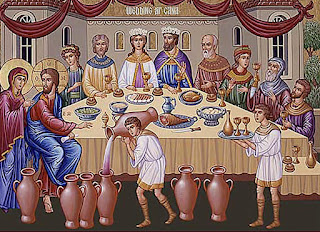
The Wedding Feast of Heaven Come to Earth

I wonder. Of all the stories about Jesus, why start the Gospel of John with this miracle?

In John’s Gospel, the first of Jesus’ signs—what the other Gospels call “miracles”—was turning water into wine.  John’s Gospel story of Jesus begins differently that the other Gospels, not with the healing of a sick person, or raising someone from the dead, or forgiving sins, or casting out a demon. Instead, Jesus’ ministry starts out a lot of really good wine, about one hundred fifty gallons of wine, that made a party last longer. And the really funny thing is, that the partygoers don’t even know the miracle happened! Only the servants, a few of Jesus’ followers, and his mother know about it. The party went on as if everything was normal.

But there’s more going on here than Jesus’ love of a good party! A quality, by the way, that drove Jesus’ opponents crazy. Because it drove them wild that he ate and hung out with all the wrong people.

The Gospel of John includes other “signs” that Jesus did including healing the sick, raising people from the dead, feeding a multitude on five loaves and two fish, and appearing, resurrected from the dead, among his amazed disciples. So “signs” are big, important, meaningful, reality-shifting events.

But how is making a ridiculous amount of wine at a small-town wedding reception on par with raising the dead, feeding the hungry, walking through locked doors to show the scars on his hands and feet and side and proclaiming that death has been defeated? As a “sign,” what does turning water into wine point to? What makes this wine so important?

Think about weddings or another big family celebrations. They were then, as for many of us now, a time for good wine, a time to enjoy the rarer things of life—a time to share food and drink that was special, not everyday stuff. Jesus is showing us that these special times and celebrations, also point us to the heavenly banquet—when all God’s people are gathered for a big feast at the end of time.

The prophet Isaiah’s described it this way:

On this mountain the Lord of hosts will make for all peoples a feast of rich food, a feast of well-aged wines, of rich food filled with marrow, of well-aged wines strained clear. And he will destroy on this mountain the shroud that is cast over all peoples, the sheet that is spread over all nations; he will swallow up death forever. Then the Lord God will wipe away the tears from all faces, and the disgrace of his people he will take away from all the earth, for the Lord has spoken. It will be said on that day, Lo, this is our God; we have waited for him, so that he might save us. This is the Lord for whom we have waited; let us be glad and rejoice in his salvation (Isaiah 25:6-9).

When the Rev. Dr. Martin Luther King, Jr., preached his last sermon on April 3, 1968, in Memphis, Tennessee, the night before his martyrdom, it was his famous “mountaintop” sermon. As he closed the sermon, he said:

We've got some difficult days ahead. But it doesn't matter with me now. Because I've been to the mountaintop. And I don't mind. Like anybody, I would like to live a long life. Longevity has its place. But I'm not concerned about that now. I just want to do God's will. And He's allowed me to go up to the mountain. And I've looked over. And I've seen the promised land. I may not get there with you. But I want you to know tonight, that we, as a people, will get to the promised land. And I'm happy, tonight. I'm not worried about anything. I'm not fearing any man. Mine eyes have seen the glory of the coming of the Lord.

Throughout the sermon, the Rev. Dr. King combines a number of Biblical stories: first, the memory of Moses who having led the Hebrew people out of Egypt and through the Exodus, died just short of entering the Promised Land. Next, he talks about Isaiah’s image for the end of time, when all is brought to its fulfillment: when tears will end, and a great feast for all peoples, that will include really good meat, rich, fatty food, and wine better than the best you’ve ever tasted will be enjoyed in the presence of God.

There are many images of God’s promised fulfillment to all God’s people in the Bible. Like our first lesson today, where God’s joy over God’s people, and God’s deep love for people, is like the love a bride and a bridegroom share in a marriage celebration.

So, when Jesus makes gallons and gallons of fine wine at the wedding reception in Cana, it is a sign­ that points to the promises of God that will bring all people to Godself, that God will pour down God’s love and joy on all people, that the perfection that lies in God’s great future is real. God’s abundance and grace and joy has begun in Jesus Christ. The future is now, the glory and grace and love of God are available now.

That’s why turning water into wine is the first of Jesus’ signs in John’s Gospel, and like the rest of the signs that follow, it says, “look! God’s future is here, it has begun in Jesus!” I kind of imagine this being like ordering a burger, fries, water or even soda pop at the drive-thru and then getting home and discovering that what we have is gourmet meal and fine wine. That somehow, God has transformed our ordinary--even hum-drum!-- expectations into something grand! Something spectacular! Certainly unexpected and transforming.

The folks at the wedding in Cana knew they were going to a party. What they didn't realize-- except for the servants, the disciples, and Mary--was they they were taking part in the banquet of the triumphant reign of God breaking right in to where they were. The ordinary had become extraordinary. The secular had, right before their eyes, became holy! This was God's future come to earth.

What else does God’s future look like? It looks like hungry people being fed, sick people being healed, it looks like justice rolling down like the rivers as he cleanses the Temple, it looks like people being raised from death because through Christ death itself is defeated.

God’s future is here now. In the present. In this life. We don’t have to wait to experience hope. We can trust that God will keep God’s promises for the end of time, because Jesus already brought the possibility of joy and hope and new life now, where we live. Perfection is not yet fully present; perfect wholeness still lies ahead. But trust Jesus, walk with Jesus, listen for Jesus—we find over and over again that God is keeping God’s promises. God’s future has already broken into the present in Jesus.

So, how do we participate in this new life, God’s perfect, joy-filled future available now?

Mary gives the answer: do whatever he tells you. Seek life at its source. Seek joy at its source. Seek to know what Jesus Christ asks of you. This is the essence of discipleship. This is the key for joining Jesus in his new way of being in the world. This is the key: do whatever he tells you.

Remember the Servants? They were the ones who knew where the water turned into wine had come from, who grasped firsthand and saw with their own eyes the amazing thing happening in their midst. They were the ones who did what Jesus told them to do. While everyone else around them was caught up in whatever was going on at the party, the servants got to witness a miracle.

And they got to participate. They got to have a hand in Jesus’ first sign. They just did what Jesus told them to do:

“Fill the jars with water” and they do.

No arguing, “We need wine, not water.”

“Now draw some out” and they do.

No complaining, “What’s that going to achieve?”

“And take it . . . So they took it.”

No, “Hey, Jesus, I have a better idea . . .”

They just do the simple, straightforward things Jesus tells them to do and they get to participate in a miracle.

Do whatever Jesus tells you. Water becomes the finest wine. The mundane becomes miraculous.

Jesus tells us all some very simple, straightforward things to do. Jesus: he tells us to love, share, give, serve, listen, learn, worship, pray.

God even gives us particulars, contexts and jobs and families, a community, and a church family in which to be obedient. Love him. Love her. Love them. Share your money, your time, your particular gift, your ability with that child, with that elder, with that family. Worship with this parish family. Pray at your desk, at your bedside, with your child, with your teenager, for your spouse, your partner, your parent, this world. Listen for what Jesus tells you to do. Do it. You may participate in a miracle, you may get a glimpse, a sign of God’s perfect future, a sign of God’s heavenly feast, even you are a part of it, right here, right now.

Tuesday, May 19, 2020

When will we gather again and when we will receive Communion?

(Updated Tuesday, May 19, 6 p.m.) Yesterday, I got an e-mail from a member of my parish. It raises a number of questions that I know have been floating around my congregation (and others). I have decided to post his note and my response.

We are in this for the long haul.Our pastoral and liturgical response to this unfolding pandemic will require theological inquiry, community reflection, and liturgical creativity. 

Here is part of the letter that started this:
Andrew, 
...Do you plan to celebrate Morning Prayer only until we have in-person worship?  Is there a date for the return to in-person worship?Trinity Wall Street returns June 1.  St. Paul's, Doylestown returns June 14. Why haven't we done online Eucharist?
Here is my response:

Thank you for your e-mail and for your questions. I will try to answer them as best as I can. 

When will we re-open and gather for in-person worship?

Before I start, I would like to refer you to Bishop Kevin Nichols' pastoral letter to the Diocese of Bethlehem "A Phased Approach to Regathering." Following what Bishop Kevin has written, we are still in Phase I across the whole diocese of Bethlehem. As a result, we are limited to the following protocols:

• Gathering for online worship, formation, and community
• Limiting service ministries to safe protocols dedicated to essentials such as feeding ministries  

Bishop Kevin's "Phased" approach roughly corresponds to the Commonwealths Color-coded scale. Northampton, Lehigh, and Bucks counties are all "Red" according to the Commonwealth.  The description that the Diocese of Bethlehem has laid out follows the Commonwealths nearly word for word. 

There are several  questions I don't have answers to. For example, does that mean that the whole diocese will move through the phases together or will we move through regionally depending on how the situation unfolds in different areas? I can foresee the rural northwest of our diocese reaching "green" (following the State's scale) well ahead of us in the Lehigh Valley, but Bishop Kevin could decide to have the whole diocese re-open at once rather than by region as an act of unity and visible communion. That will be up to him in consultation with the Diocesan Council and Standing Committee. 

As for the June 1 date at Trinity Wall Street and June 15 for Doylestown (Diocese of Pennsylvania) that you mention, as I read their websites, these are tentative dates. I can't say what TrinWall's criteria is, but if Doylestown follows the protocol laid out by the Diocese of Pennsylvania, their reopening will depend on how new cases develop in their county.

Even in places that have reopened, the requirements for physical distancing, hand-washing, masking, etc. might rule out Communion as we know it. Many places are also prohibiting (or at least discouraging) congregational singing. (For example, the Royal School of Church Music has suspended the King's College Course normally held at St. Stephen's Wilkes-Barre in mid- to late-July because singing blasts the droplets that might carry the contagion.) 

Keep in mind that the virus is passed along from people who are asymptomatic, and because of the scarcity of testing supplies, asymptomatic people are generally not tested. That means that by the time a person pops symptoms and tests positive, they may have been conveying the virus for 14 or more days before a definitive diagnosis. This is why the isolation and physical distancing is the required (and wisest) protocol. 

As for our own Diocese, when the Lehigh Valley reaches "Yellow" we'll see if that moves us to Phase II on the DioBeth scale. I don't know when that will be, so I don't know when in-person worship will return. (Update: Bishop Kevin has distributed guidelines as to how we'll enter "Phase II" of our COVID-19 response in the Diocese of Bethlehem.)

Right now, at Trinity, Easton, I know of at least five people who have either tested positive for COVID-19 or have been exposed to someone who has. One parishioner has died from COVID-19. So I have opted for an assertive approach to handling this crisis.

Will we only be doing Morning Prayer for On-Line worship?

Right now, we have no specific guidance from Bishop Kevin as to the do's and don't's of on-line worship. If the Cathedral sets the norm for the diocese (and this is the only place where I've seen Bishop Kevin preach and/or lead worship on-line), then the norm is Morning Prayer. I suppose that Ante-Communion is also an option. 

My approach has been to assemble worship with as many people as possible reading or leading prayers from either home or on-camera from church while practicing safe physical distancing. Our virtual choir happens as members record their singing and then the voices are mixed into a single recording and then edited into a Power Point. All of this is saved mixed as an MP4 video and published on YouTube. After publication, it is posted on our web-site, our social media, and a link is sent to folks on our e-newsletter list. 

Again, my goal is to involve as many people as possible rather than have a point-and-shoot worship (which is how we do Wednesday and major Holy Day services via Facebook Live) focusing only one or two clergy in a largely empty room.

This is where my read of Anglican theology of worship comes into play. One Episcopal parish in the LV is doing an on-line Eucharist, but the reception is only by the presiding priest and there is no congregation present either in actuality or on-screen. As you will see below, in my mind this does not meet the minimum criteria for Eucharist 

The concept of spiritual communion in our tradition has been reserved to special circumstances such as those sick or infirm to receive by mouth, or, interestingly, to soldiers in battlefield situations. Older editions of the Armed Forces Prayer Book (an Episcopal document in origin) first set out the prayer that we reprint in the e-newsletter for spiritual communion.

I am also informed by my work in Catholic Healthcare. From 1994-2002, I was the director of pastoral care in a Catholic hospital. We had an extensive ministry by both deacons and extraordinary ministers of the Eucharist. When we had Mass in the hospital's chapel, the LEM's and/or Deacon would fan out immediately after Mass. On days when we did not have Mass in our Chapel, we'd time their work--- utilizing pre-sanctified elements-- so that it would take place immediately after the televised mass on EWTN at mid-day. The point was to connect the communicant with the community in communion. 

Before the extent of our physical distancing was announced mid-Lent, I considered doing something very much like that: small groups in the presence of an LEV or Deacon who would then receive from pre-sanctified elements, while I would lead a liturgy via Livestream or Facebook Live. But this is not possible (nor advisable) in the current situation. The virus is just too virulent and too communicable.

On Private Masses and Distance Consecration

I believe that our Anglican tradition discourages both private masses and "distance" consecration. 

A private mass is when the priest celebrates the mass without a congregation present. 

Another approach, suggested by Dr. Diana Butler Bass (a lay theologian who migrated from Evangelicalism into the Episcopal church) and others, is that I could say the words of consecration on my end of a TV or Livestream broadcast and you could hold a piece of bread and cup of wine, and we could say that it was somehow consecrated and then you could receive... this is what I mean by "distance consecration...." I believe that this pushes us in a direction where we don't want to go: the Eucharist is a Sacrament, and Sacraments are not magic. The prayer of consecration is not an incantation but a work of the people of God in community. 

At the same time, the Sacrament is not a point of personal privilege nor a private possession. It is an act of community that communicates Christ and mediates grace. 

Dr. Butler-Bass has suggested that not having even a televised/live-streamed Mass is an act of "hoarding" by the clergy who are keeping the laity from the Sacrament, a view that I strongly disagree with. Reducing the question into a faux justice issue is, in my view, unhelpful, and misses the point of how sacraments function in Christian community.

Sure, God can do whatever God wants! Who is to say that the One who lives in Kairos (God's time) can't transcend Chronos (human time) and consecrate the elements across a TV or the internet. But Sacraments are not magic and the Eucharistic Prayer is not an incantation. I personally believe that the gathering of community is an essential element at the heart of the Eucharist. 

Short of specific guidelines from the Episcopal Church (except for the general guidance of the Presiding Bishop, Bishop Kevin, and various other diocesan bishops), I have fallen back on the guidance I lived under during my time in Catholic healthcare nearly twenty years ago. The United States Conference of Catholic Bishops set out useful guidelines for televising the Mass, (updated in 2007) which in my view covers the issues of televised and live-streamed Mass in much greater detail in a very helpful way. A key passage says:

Since the liturgy is the work of Christ and the work of God's people, the televised Mass should always be celebrated within a living community of God's people whose presence reveals the full, conscious and active participation of the faithful. Even when the liturgy to be televised is taped apart from a regularly scheduled parish liturgy, there should always be a group of people who participate in the liturgy as fully as possible by their prayer, song, and presence.  

Because the present Coronavirus situation precludes the gathering of a group of people who can fully participate in the liturgy, even for the purposes of video recording, I am wary of doing a broadcast mass that would seem to reduce the Eucharist to mere performance. 

This week, I will be meeting with Fr. Raymond (a fine liturgist), Deacon Fran, and members of our parish's worship committee to discuss the possibility and limits of doing Eucharist on line and how we can do that according to the guidelines I've noted above. When Bishop Kevin issues guidelines for Phase II, we'll also meet as a Vestry to make some decisions. 

Fortunately, we have inherited the traditional monastic offices in our Anglican tradition. Thomas Cranmer sought to apply the monastic pattern of frequent daily prayer. Before the consecrations of Samuel Seabury, William White, and William Provost as our first bishops, the Anglican (later Episcopal) Church in America functioned quite well not only without bishops but with very few priests. For almost a century and a half (or more!) before our church was formed in 1789, congregations in North America lived and thrived on the pattern of Morning Prayer, metrical psalms, and preaching (often by lay preachers reading from pre-printed sermons). They did this in a frontier church in a new country building new communities. 

We are in a new frontier right now. We will have to think about mission, liturgy, community, and formation in new, creative ways. I think that we can mine those resources and our Anglican and Catholic tradition deeply and to good effect. When the day comes that we do find a way to more formally express ourselves Eucharistically, I don't know what it will look like, but it will be different and it will be wonderful! Right now, we are in an in-between time of waiting,  experimentation, exploration, innovation, and prayer.