Showing posts with label Poetry. Show all posts

Sunday, May 30, 2021

How big is God?

How big is God?

From time to time, I would ask this question of kids. And sometimes they’d shrug, and sometimes they’d shout back “Big!” 

Hmm, I’d say. “This big?” (holding my fingers and thumbs apart) 

Bigger!” 

“Ok, this big?” (holding hands apart) 

No! Bigger!” they’d all shout.

“Okay, then. How about this big?” (hold arms wide apart) 

Bigger!” …. you get the idea!

This exercise reminds of that last scene in the 1997 film Cosmos, where astrophysicist Dr. Eleanor Arroway, played by Jodie Foster, meets a group of school kids in front of the deep space array of radio telescopes in New Mexico, talking about how big space is and about the possibilities for intelligent life "out there." A lot of Christians, especially Episcopal ones, love that film because it asks all the Big Questions and shows pretty well how scientists go about answering it with a sense of awe and mystery and respect, which we Episcopalians deeply share. To paraphrase (in a way that the original author, the late Dr. Carl Sagan, might object): for me, God is there, and God is real, because if God weren’t, “it’d be an awful waste of space.”

So how big is God? And how would you go about describing God? I have nearly a truckload—literally! -- of books on that subject, but in the end not even all those books even scratch the surface!

In ancient times, cultures dealt with this in a variety of ways. Some divided up God into bite-sized chucks. Some cultures had a particular god for a particular locale or tribe. Others, like the Greeks or Romans, divvied up their gods by function: a god of love, a god of evil, a god of thunder (with or without the hammer!) and so on.

Some limit God solely to the luminous or transcendent, who is so far away that if the divine is knowable at all… it is only through certain specific skills or disciplines, or perhaps for the very few with some kind of "special" knowledge.

As Seinfeld once said “Not that there’s anything wrong with that…” but, these only scratch the surface.

The Hebrews had the triply scandalous notion that there is only One God; that the One God is both holy and at the same time immanent (a fancy word for "not far away") living in a covenant relationship between God and God's people; and that it is the job of God’s people is to make God known to the world by following God’s ways. In some Jewish circles, it's understood that the observance of the law and the prophets is really for and on behalf of us all!

Of course, Christianity holds this concept too, but with a different emphasis on the syllahble.

Christians believe that the One God came to earth and joined with humanity in the person of Jesus Christ and his incarnation, and that the One God is made present to us in the person of the Holy Spirit, and that the One God creates and reigns over all creation God, in the Christian context, is at once accessible, complex... and busy! It is by the grace of God combined with our God-given curiosity and imagination that brings it all together.

I know a lot of folks who just can’t wrap their minds around the Trinity: it’s either too big, too esoteric, or because—no matter how much you reassure them that it’s not—it sounds to them like Tri-Theism. But here it is: there is One God, undivided. And we see all of the fullness of the One God and all of the fullness of all of humanity in the person of Jesus Christ; we see all the Fullness of the One God in the Father; and we see all the fullness of the One God in the Holy Spirit.

But wait! There’s more! 

The One God is with us, near and immediate, involved in everything we do and experience while, at the very same time, setting us free to think, make choices, and to act, in response to God or to our impulses or both…!

The One God has a moral and ethical core which is at the heart of our own moral and ethical longings, our own sense of meaning, but is at the heart of creation itself, which is once free and subject to the laws of physics and nature, but also endless its minutiae and its expansiveness.

We see the One God expressed in a Trinity—a Unity of persons—and where each person of the Trinity each witnesses to the One God in the integrity of their persons. Where God is at once transcendent and knowable by us who are created and living in God’s own image.

I know: Ka-boom! Mind blown. 

Wasn’t that fun?

Once, many years ago, a friend of mine, who is a Unitarian Universalist minister, invited me into his church in Southeast Ohio on Trinity Sunday to talk about, or debate with him, the Trinity before his congregation, remember, of Unitarians in all their variety. My point was that in the early church, when these things were being debated, it was the Trinitarians who were the true Unitarians by emphasizing this dynamic unity!

I don’t think I changed any minds, but it was a whole a lot of fun!

So how do you get at it… how do we make sense of the Trinity? Well, the theology helps even if it is a little, uhm, complex. And we have a wonderful Catechism in the Book of Common Prayer that can walk us through that. 

Some people choose to ignore the whole subject… by glossing over the complexity. Others dodge the intellectual bullet by making the debate about something else, misrepresenting the Trinity and then, presto!, refuting the very silly idea that they just made up.

Other try to defend it by just going to the Creeds; but in a bland kind of “The Creeds say it, I believe it, that settles it!” way. To me, this is kind of the theological equivalent of plugging your ears and saying “la la la!”

I mean, look, it's hard. If I only heard some of things people have been told about the Trinity from various pulpits and Sunday school classrooms over the years, I wouldn't believe it either!

Okay. So how do we get at it?

In participation. We get at the Trinity by living faithfully every day with an inquiring and discerning heart.

I have discovered in prayer, holy silence, and meditation, that an open mind and heart helps. And yes, meditating on the Apostles and Nicene creeds line by line, is a good thing to do. I’ve done it in retreat and as a prayer and journaling exercise.

I have found in art, literature, dance, theater, cinema, music, and science that imagination also helps.

Imagination invites us and allows us to experience the fullness of God… and imagination opens us to hear and be challenged by God’s call. To open our minds, our hearts, our wills, and our imagination to fullness of God, is to hear God’s voice just as God called out to the young Samuel while he was trying to sleep.

I think that we need to let the artistic and poetic side of the brain in on the conversation when we contemplate the Trinity: this is a place for poets, musicians, and artists as much as it for systematic theologians, scientists, and apologists.

The Holy Trinity, through the sacramental life, scripture, life in community, prayer and contemplation, invites to a life steeped in holy imagination. Not making things up... but resting in God, listening to the traditions of the Church and paying attention to world around us.

Allow me to demonstrate.

Think of your favorite hymn.

Got it? Terrific!

Now think about the text of that hymn… how does it speak to you? What aspect of God does that text activate in you?

One hymn that stands out for me is an American hymn called “Wondrous Love” which begins:

What wondrous love is this, O my soul, O my soul?
What wondrous love is this, O my soul?
What wondrous love is this that caused the Lord of bliss
to bear the dreadful curse for my soul, for my soul,
to bear the dreadful curse for my soul?

The third verse goes:

To God and to the Lamb I will sing, I will sing,
to God and to the Lamb I will sing,
to God and to the Lamb who is the great I Am,
while millions join the theme, I will sing, I will sing,
while millions join the theme, I will sing.

I think that meditating on your favorite hymns is one way for you to know how God best makes Godself known to you… and to know how you might most easily approach God! It isn’t foolproof—but when it come to meeting the God of all Creation, what is?

It’s still a very good place to start.

So let’s try it. Turn in your hymnals to Hymn 409 (in the Episcopal Hymnal 1982). This is another one of my favorites. First of all… the tune. What can top this magisterial score by none other than Franz Joseph Haydn? This hymn paints a picture of in music and text of the wonder of creation, evoking “the spacious firmament with all the blue ethereal sky….” Let’s sing the third verse, which is the punchline:

What though in solemn silence all
move round the dark terrestrial ball;
what though nor real voice nor sound
amid their radiant orbs be found;
in reason's ear they all rejoice,
and utter forth a glorious voice,
for ever singing as they shine,
'The hand that made us is divine.'

Oh, yeah! It’s oh so very 18th Century, isn't it? But then so were the folks who wrote our constitution! When you sang it, did you see a picture, painted in your minds eye, of God revealed in… and the source of… everything? Or, as we might say, God the Father!

Turn to Hymn 435. King’s Weston is a marvelous tune by the great Ralph Vaughn Williams, describing and extolling the Lordship of Christ. In six verses, the hymn sums up how we understand who Jesus is and what God is doing in and through him. The hymn invites us to come to him in love, wonder, and joy.

Let’s sing verses 2 and 5:

Humbled for a season to receive a name
from the lips of sinners unto whom he came,
faithfully he bore it spotless to the last,
brought it back victorious, when from death he passed.

In your hearts enthrone him; there let him subdue
all that is not holy, all that is not true;
crown him as your Captain in temptation's hour:
let his will enfold you in its light and pow'r.

A lovely little hymn about the Holy Spirit is hymn 513, written by Father Carl P. Daw, Jr., an Episcopal priest, it appeared for the first time in the Hymnal 1982. It beautifully evokes both the power and the intimacy of God the Holy Spirit. Let’s sing verse 1:

Like the murmur of the dove’s song,
like the challenge of her flight,
like the vigor of the wind’s rush,
like the new flame’s eager might:
come, Holy Spirit, come.

Finally, let’s contemplate the fullness of the One God in Trinity of Persons through this well known and magnificent Reformation hymn Nun danket alle Gott, “Now Thank We All Our God,” Hymn 396, singing verse 3 together:

All praise and thanks to God
the Father now be given,
the Son and Spirit blest,
who reign in highest heaven
the one eternal God,
whom heaven and earth adore;
for thus it was, is now,
and shall be evermore. 

Trinity Sunday is the first Sunday of what some call “ordinary time” or the Sundays after Pentecost. But there is nothing ordinary about our Creating, Redeeming, and Empowering God, Father, Son, and Holy Spirit! 

We have now entered a season of contemplation and action. We will spend the summer and next fall learning to follow the teachings of Jesus. We listen for the Spirit to move us to do them! Day by day we stand in awe and humility before the presence of God, as we learn to know and walk with God. We do that in lots of ways: Baptism and Eucharist, Scripture and prayer, Holy Service and Holy Companionship. We do this in concert with the Church Catholic in all time and places. God has given us imagination, intellect, art, music, science, and more to bounce off the witness of Scripture and the life of the whole Church and see God working and alive… and then we only catch the merest glimpse of God’s love, God’s power, God’s majesty….

Blessed with holy imagination, we find that in all that we do, in all whom we love, in all our creativity and inquiry, and in all our care for each other and creation, that our loving, living, Triune God is active in all of us and in our world.

In the Trinity, we see that the fullness, the love, the intimacy of God is bigger than the universe, and as near as our hearts.

+++ +++ +++

A sermon for Trinity Sunday, May 30, 2021 at St. John's Episcopal Church, Clearwater, Florida

Here is a video of the Liturgy for Trinity Sunday (Facebook)

Here is a video of the Sermon only. (Vimeo)

Friday, July 19, 2019

A Martyr’s Song in An Age of Rage

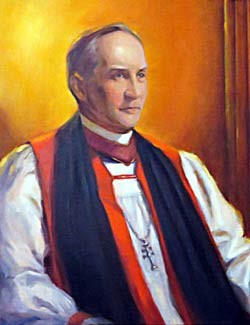
Last month, Peg and I went to worship at Grace Episcopal Cathedral in Charleston, South Carolina, and we were privileged to witness the commemoration of an Episcopal saint, a bishop, a witness for racial equality and a martyr: Bishop Alexander Guerry.
Guerry was a South Carolinian and was consecrated bishop coadjutor on September 15, 1907 and later became the eighth diocesan bishop of the Diocese of South Carolina on April 22, 1908. Before that, he served as a parish priest and then as Chaplain and Professor of Homiletics and Pastoral Theology at the University of the South in Sewanee, Tennessee.
Bishop Guerry believed that Gospel of Jesus Christ was Good News for all people, and this led him to believe that the Church must reflect the visible unity of all God’s people. In 1914, he proposed that his Diocese elect a black bishop suffragan for South Carolina to be responsible for the ministry to African American Episcopalians. He wanted to ensure that all people, regardless of race, were full participants in the community of Christ’s people in the diocese. His proposal failed. Instead, the majority white (and all male) convention chose to separate the African American community into a “Missionary District for Negroes” within the Diocese. This arrangement continued through the mid-20th century when that segment of the Christian community was finally given an equal place in the diocese.
But that is not the end of the story.
On June 2, 1928, an Episcopal priest of that diocese entered Bishop Guerry’s office at St. Philip’s Church in Charleston, and, enraged at the Bishop’s message of racial equality and reconciliation, pulled out a pistol and shot Guerry in the chest, before killing himself.  The priest had previously publicly attacked the bishop’s position on advancing racial equality in South Carolina, and especially on his proposal to install a black suffragan bishop in the diocese. The priest who shot the bishop had written that the bishop, given his way, would root out the principle of white supremacy in the south. 
The martyrdom of Bishop Guerry is rarely talked about in the Episcopal Church.  June 7th is not an official feast or commemoration in this church. Still, Guerry has been listed by the Archbishop of Canterbury as one of the church’s modern martyrs.
At the Cathedral, we sang a hymn and dedicated a portrait and Chapel to Bishop Guerry.
(1)    The martyr’s song still sings every day, every day.
The martyr’s song still sings every day.
The martyr’s song still sings as heaven’s echo rings
So none will miss the sound of that song every day
So none will miss the sound of that song.

(2)    Hate’s raging ways live on, every night. Every night.
Hate’s raging ways live on, every night.
Hate’s raging way live on and kill the prophet’s song.
Will we not right the wrong with our song, with our song?
Will we not right the wrong with our song?

(3)    The Shepherd’s witness lives every night. Every day.
The Shepherd’s witness lives every day.
The Shepherd’s witness lives in all who dare forgive.
Like One who long ago sent from heaven did come down.
Now wears the martyr’s crown every day.
As a person who has dedicated his life to doing public theology in the public square, as well as pastoring and teaching faithful people in everyday living, I found Bishop Guerry’s example and witness profoundly moving and humbling. As I work through the realities of the concurrent sins of racism, sexism, homophobia, and classism, and confront my own tendencies towards these within myself, I am guided by his example.
As I write this, I am struck by the ugliness of our present public discourse. The unrepentant coarseness emanating from the highest levels of leadership dismays me. I expect our civic and religious leaders to call out the best in us, instead they cultivate the worst. It is awful enough when people cheer on the bad behavior of a tv character, but when people—in my experience, good ethical people, with good character—line up behind these antics perpetrated by an elected official, it makes me tired, sad, and worried.
I know I am not alone. As I talk to people around the parish, around the City, and even (on-line) from around the country, this whole season has been a massive trial. What’s an everyday Christian to do?
I am not against debate or divergence about complex issues among people in good faith. When deciding big things, disagreement, even debate, ought to be expected. But when the goal becomes “my side wins at all costs” and even worse, our argument should utterly destroy the opposition and to leave them humiliated, then not a lot is going to get done. And if we can’t disagree with civility, then we cannot compromise, and if we can’t compromise then we are frozen, and all we have left is our frustration and anger.
Christian witness in this atmosphere does not arise from mimicking or blindly aligning with the culture’s values. Mindless chants and group The Apostle Paul reminded the Christians in Rome that not being conformed to the world means allowing God’s Holy Spirit to transform our minds (Romans 12:2).
The first we can do in response to this tense and crazy season is to remain calm even when the air is filled with cruel and fear-fueled words. And to do that, we must pause. When you’re angry, pause. When you’re scared, pause. When you’re tempted to join the angry mobs of people who don’t quite know what to do with all their valid emotions, pause.
Pause. Pray. Give yourself a little bit of space to invite the Holy Spirit into these very valid concerns that an election like this one will bring up in our hearts, and see what God would have us do….
I found a prayer by Pope Francis based on the famous prayer of St. Francis of Assisi to be especially helpful. It was written for World Communications Day, which is always right before Pentecost, in 2018:
Lord, make us instruments of your peace.
Help us to recognize the evil latent in a communication that does not build communion.
Help us to remove the venom from our judgements.
Help us to speak about others as our brothers and sisters.
You are faithful and trustworthy; may our words be seeds of goodness for the world:
where there is shouting, let us practice listening;
where there is confusion, let us inspire harmony;
where there is ambiguity, let us bring clarity;
where there is exclusion, let us offer solidarity;
where there is sensationalism, let us use sobriety;
where there is superficiality, let us raise real questions;
where there is prejudice, let us awaken trust;
where there is hostility, let us bring respect;
where there is falsehood, let us bring truth.
Amen.
It is important that we listen in our hearts and minds to what is going around us and the meaning it creates for us. No human politician anywhere—and no cleric, public figure, nor anyone else in society—is the Messiah. Jesus is our Savior and Messiah. No human leader will ever solve all our problems. God is the source of our hope and calling. And certainly no human leader can give us inner peace, that come through the grace of the Holy Spirit.

But we are not passive by-standers. Jesus calls us to love the world, the sick, the wounded, the outcast, the lost, and the least. That neither begins nor ends at the ballot box. It begins at the foot of the cross, gathers us around the font and the Eucharistic table, and sends us into the world in love.

Monday, May 28, 2018

On Trinity Sunday: an exercise in holy imagination

Trinity Sunday, 2018 

What is your way into God? What opens the door to the divine for you? Is the vastness and wonder of God’s creation? Is it sense of meaning and redemption that you have found in your relationship with God? Maybe you were a person who suffered addictions, or abuse, or stuck in a cycle of really bad choices and found healing and wholeness when you came to faith. Perhaps there was a time when you sought meaning, hope, or direction, and it came to you in an encounter with God. Maybe the door opened for you when you came to sobriety, to health.... or just to your senses!

However it is that you meet God, I’ll bet that there is hymn for you.

The Trinity, the Christian doctrine that we contemplate today, says that the oneness of God is expressed in a trinity of persons and a unity of being. The One God is manifested in a Trinity of persons. This is much more than metaphor, and we must avoid the temptation to reducing our language of God to mere "base three" thinking. The Trinity tells us several things about the very nature of God. Not only do we know the One God as a unity of persons, Father, Son and Holy Spirit, but the Trinity also tells us that: 1) God is complex to the point unknowing; 2) God is relational; and because of that, through God's grace and action, 3) God is knowable.
So, among other things, the Trinity also tells us that God offers us a variety of ways “in” to our relationship with God. We can contemplate the majesty and wonder of the God of All Creation in God the Father. We can enter in to intimate, healing relationship in God the Son. We can enter in to the mystic power and mysterious movement of God in God the Holy Spirit. These "ways in" should not be confused with the "roles" or "functions" of each person of the Trinity, and remember each person of the Trinity all contain the fullness of the One God. The Trinity shows us that God is complex, mysterious, and knowable all at the same time.

Of course, God is so big and beyond our knowing that the best we can do is use analogies to describe the fullness of God. This is a start but it can get us into trouble. What we need is holy imagination, grounded in prayer, scripture, tradition, and in the worship of the church.

Now, I am not a musician, nor do I play one on television, but I do sing and I have found that one way that we can discover how each of us activate holy imagination is to look at our favorite hymn.

So... What is your favorite hymn? What piece of music makes you say, when it pops up in church, “Oh! Good!”

I have a hunch that your favorite hymn is not only your favorite because it makes you tap your toes but that there is something about that hymn that is pointing you to how you enter into your relationship with God. Something about that hymn stirs something in you, pulls you, and takes you beyond yourself.

Let me demonstrate by sharing with you some of my favorite hymns.

As it happens, one of these is the one we sang this morning at the start of our liturgy. It is a classic that shows up nearly every time we celebrate the Trinity. Using imagery from the Book of Revelation, it talks about the time we hope and pray for, when Earth and Heaven will be joined and all creation will ring out in praise to God (In the Episcopal hymnal, H-362):

Holy, holy, holy! All the saints adore Thee,
Casting down their golden crowns around the glassy sea;
Cherubim and seraphim falling down before Thee,
Who was, and is, and evermore shall be.
Holy, holy, holy! Though the darkness hide Thee,
Though the eye of sinful man Thy glory may not see;
Only Thou art holy; there is none beside Thee,
Perfect in pow’r, in love, and purity.

Another favorite of mine talks about how all creation points to The Creator. Written by Joseph Addison (H-409), in our hymnal it is set to a marvelous tune by Franz Josef Hayden.  It presents a stirring image of God the Father as both creator and one who can be known through creation. Be warned: this is a very seventeenth century hymn because it also makes the case for a unitarian approach to God through the window of reason. I am pretty sure that Addison didn't mean to do this, but the hymn is also a description of one way that prevenient grace works. 

The Spacious Firmament on high,
With all the blue Ethereal Sky,
And spangled Heav’ns, a Shining Frame,
Their great Original proclaim:
Th’ unwearied Sun, from day to day,
Does his Creator’s Pow’r display,
And publishes to every Land
The Work of an Almighty Hand.
If I were to pick a hymn that sums up for me the meaning of Jesus’ redemptive love, it is this American folk hymn (H-439), whose authorship is unknown but whose words speak of an eternal, saving love:
What wondrous love is this, O my soul, O my soul!
What wondrous love is this, O my soul!
What wondrous love is this, that caused the Lord of bliss
to bear the dreadful curse for my soul, for my soul,
to bear the dreadful curse for my soul.
There is a lovely hymn to the Holy Spirit written by an Episcopal priest, Carl P. Daw, in 1981 for our Hymnal 1982 (H-513), and it is also one of my favorites:
Like the murmur of the dove's song,
like the challenge of her flight,
like the vigor of the wind's rush,
like the new flame's eager might:
Come, Holy Spirit, come.
To the members of Christ's body,
to the branches of the Vine,
to the Church in faith assembled,
to our midst as gift and sign:
Come, Holy Spirit, come.
So what’s your favorite hymn? And what does it tell you about your walk with God?
Maybe it’s something like “Amazing Grace” written by an Anglican priest who came to faith in Jesus and repented from a life as sea-captain of slaving ships.
Or maybe it’s a Christmas carol like “O Little Town of Bethlehem” which talks of God breaking in to our world for our redemption in the new-born Jesus. Written by another Episcopal priest named Philips Brooks, the original poem had five verses. 

It is a subversive little hymn, and on some level our inner Scrooges must sense this because the fourth verse of his original poem is almost always dropped out. It is even asterisked in our hymnal (H-79), indicating that it is optional, but to me this verse is the heart of the text. Singing it just might turn your heart at Christmas just as old Scrooge's heart was turned in A Christmas Carol:
Where children pure and happy
Pray to the holy Child,
Where misery cries out to thee,
Son of the Mother mild,
Where charity stands watching,
And faith holds wide the door,
The dark night wakes, the glory breaks,
And Christmas comes once more.
Part of what I hope you get out of this exercise on this Trinity Sunday is not only a sense of the complexity of God in Three Persons, but also God’s marvelous accessibility. 

In the beauty of this music, I hope and pray that your imaginations will be activated to see all the ways that God is inviting you—all of us—into a living, holy, and transforming relationship with God.
In activating our holy imagination through prayer, music, art, and liturgy, we begin to discover that, among other things, that the Trinity is not some esoteric, dry as dust dogma, nor a game of theological trivial pursuit. The Trinity shows us that our complex God is at once relational, knowable and intimate.
These hymns, I think, are but one clue as to how you are attracted to God, and how God invites us—all of us—in all our particularity, and with all that we bring, into living relationship with The One God, Father, Son, and Holy Spirit.
One last hymn tells a story that moves us from contemplation to action, and reminds us that discipleship is at once freeing and costly. William Alexander Percy wrote this little hymn in 1924 that contemplates the cost of discipleship (H-661), describing those first fisherman who heard Jesus’ call and followed him:
Contented peaceful fishermen
Before they ever knew
The peace of God That fill’d their hearts
Brimful and broke them too.
And verse 4:
The peace of God, it is no peace,
But strife closed in the sod,
Yet, brothers, pray for but one thing–
The marvelous peace of God.
So what’s your favorite hymn? What hymn speaks to you? Look it up. Read the text. Pray the text. And listen to how the Triune God is as close to us as our hearts, and is as near to us as the song on our lips.

Wednesday, February 13, 2013

Ash Wednesday Poem: Asserting My Rights


Asserting My Rights

What is it about Lent and me?
I just can’t give up.

When I give up coffee, I eat more chocolate.
When I give up fast food, I watch more TV.

When I put my loose change in the mite box,
I expect the box to be grateful.

Every Lent, I am an errant driver in a field
Striking the tree that I was determined to miss.

Forty days seem like forty years
When I know I will fail in forty seconds.

So this Lent, I am going to give up giving up.
Instead, I will assert my rights.

I will focus wholeheartedly on my rights.
I will hold closely to myself the things that I know are mine.

I will have a good time this Lent
because I will take on what I know to be true.

But, knowing my track-record in past Lents,
I will start with the right to keep my expectations low.

I will insist on the right to be wrong.
For forty days I think I can live with not always being so right.

I will assert my right to flawed.
Do you think for six weeks, I can be free of seeming so terrific?

I will ascent to my right to be uncertain
For a month, perhaps I will discover faith.

I will claim my right to be ignorant
After a season of knowing less, maybe I will know mystery.

I will act on my right to be weak
And, for a moment, I won’t pretend I own what strength I have.

I will revel in my right to be foolish
And catch a glimpse of how I am seen.

I will rest in my right to be a creature
And enjoy for a second my part in the creation.

I will exercise my right to surrender
and live, for now, in my right not to be God.

I wrote this in 2005. Someone in my parish asked for a copy. So I posted it again. -- atg+