Showing posts with label Everyday Holiness. Show all posts

Friday, May 22, 2026

Spiritual energy put to work

A Sermon on the Second Anniversary of the Partnership between St. John's Episcopal Church and St. Paul's Lutheran Church, Clearwater, Florida

My first encounter with these machines happened on the highway. One day about twenty years ago, I was motoring up the Pennsylvania Turnpike in the Pocono Mountains, when I passed a convoy of extra-long trucks escorted by vehicles with flags and flashing lights. Each flatbed truck had a huge white piece of equipment on it, gleaming like a modern sculpture. What these trucks were carrying was the finished parts for a huge wind-turbine…high-tech windmills. Today, if you drive south out of Wilkes-Barre, PA, through a town called Bear Creek, you will catch a glimpse of a few rows of these huge white propellers on tall towers sitting on top of a mountain ridge slowly turning as they produce electricity. Amazing, isn’t it? That we can take the energy of the wind and turn it into electricity!

Equally amazing are the number of homes and businesses around here that have solar panels on their roofs turning the energy of the sun into electricity or hot water or both. In fact, recently, driving across Florida on Route 60, I saw rows of solar panels sitting on top of one of those mountains of trash where the big green trucks empty their dumpsters! These panels were not only providing electricity, but they were powering the process that was turning the methane from all that trash we throw away into fuel that goes back to homes, schools, hospitals, and other places, powering generators making even more energy.

Everyone is talking about energy…where to get it and how to use it. Whenever I fill up my car with the gas made from the fossils of ancient plants and animals, I am made aware that the cost of energy has gone up. But something else occurs to me. 

Just as cats always find the sunniest spot in the room to warm themselves and plants always lean towards the sun, humans are pretty good at harnessing energy. One of our human ancestors took the potential energy in wood and either with help from a random lightning strike or from learning to bang together two pieces of flint, made a campfire for cooking. Someone first harnessed the energy of the wind to sail a ship or used a rushing river to turn a wheel to grind grain into wheat or drive a loom for cloth.  We’ve unlocked energy from gas and coal to make things go. Now we’ve come full circle, with these great wind turbines that use the wind to make electricity.

Energy is all around us.  But how do we put it to work?

Our lessons today give us three pictures of energy put to work. In one, we see potential spiritual energy. In another we see spiritual energy put to work. And in another we hear about the spiritual engine that makes it all go “vroom!”

In the Gospel of John, the disciples are in the upper room on that very first Easter evening, when the Risen Jesus gives them the breath of the Holy Spirit and the authority to use it. That’s the first picture.

In Acts, we see the second image. The disciples along with other people from throughout the world were gathered in Jerusalem to celebrate the Jewish festival of Pentecost when “Fiery tongues appeared on them, and all of them were filled with the Holy Spirit." The Spirit ignited a new movement and a new people. The energy of the spirit was released and suddenly these people had power to reverse the curse of the Tower of Babel to overcome the languages of division and competition with a new language of God's love and Spirit. The potential energy of the spirit was released and the church was born!

In the third image, the Apostle Paul reminds us that everyone of us, no matter how different, no matter our differing skills, experiences, and gifts, are brought together of the Holy Spirit for God’s work where we live, work, study, and pray. And when we’re in tune, this spiritual energy really goes “vroom!”

One of the most ancient hymns of the church goes like this, "Come, Holy Spirit, our souls inspire...and lighten with celestial fire." It’s too bad that we generally reserve this hymn to ordinations, because it is a prayer that the energy released on that first Pentecost day might continue to burn within the whole church. It is a prayer that God's spirit will continue in each of us and in the whole Body of Christ, so that we might live our faith with zest and commitment and do the work of mission boldly and imaginatively.

The promise of Pentecost is the potential spiritual energy that every person of faith carries is ignited by the Spirit into a deeper, more powerful, more effective Christian living.

One of my favorite stories of potential spiritual energy turned to the actual work of God is of John Wesley, a priest of the Church of England in the 18th century. (You’ll pardon me if on a day we celebrate this partnership between Lutherans and Episcopalians, if I talk about the founder of the Methodist movement?) Anyway, Wesley was a faithful but cautious minister. He studied. He prayed. He wrote. He was thoughtful and earnest. He went to Georgia to minister to English colonists in that rough and wild colony. And you what else he was? Boring! Not to mention stiff and judgmental. The folks in Georgia were so impressed with his earnest, serious preaching that they took an offering... and bought him a one-way ticket back to England!

On the ship, a dejected Wesley, sad and perplexed that his sober, thoughtful, and very earnest ministry had been such a flop, he remembered meeting another group on the way to Georgia when he was coming to America. They were Moravians, and he remembered their energy and fervor. So, on returning to London, he sought them out. And he found them in prayer and song in a little storefront in London, on Aldersgate Street, when something happened. As Wesley recalled, He felt his heart "…strangely warmed...," set afire in a new way with the very Spirit of God. His faith and imagination for the Gospel were ignited for a new beginning of ministry, a ministry of teaching and preaching to ordinary people in the places where they lived and worked, proclaiming a Gospel of renewal and service that extended throughout England and abroad. This new energy brought a new reformation and awakening throughout the cities, mill towns, and mines that had sprung up during the industrial revolution and was changing England.

I suspect that it was the same energy that caused Martin Luther to post his 95 theses on the cathedral door in Wittenburg, or Thomas Cranmer (inspired by Luther!) to turn the ancient prayers of the Church into language that ordinary folk could use and understand. That same spiritual energy inspired revolutionaries and reformers from Katharina von Bora (Martin Luther's spouse and a sharp theological mind in her own right) to Frances Perkins (The Episcopal lay woman who was FDR's secretary of Labor through the Depression and WW2, and the architect of the New Deal and Social Security) to the Rev. Dr. Sister Helena Barrett (first openly LGBT person to be ordained to the priesthood in the Episcopal Church) and the Rev. Dr. Pauli Murray (first black woman-- and probably the first trans person-- ordained to the priesthood, an attorney, and a founder of the National Organization of Women) —women whose names don’t usually appear in confirmation catechisms or seminary textbooks—to shake up the church and move us forward into new Godly territory.

I don’t know if you realize this, but we are experiencing that, too. Right now. Besides showing us that the Holy Spirit can speak both Lutheran and Episcopalian, you along with Christians all over the globe, are turning potential spiritual energy into amazing acts of courage, hope, and compassion that makes a real difference in the lives of people and communities.

You might accuse me of hyperbole. I mean what difference can a hundred or so Christians sitting on the border between two Florida cities possibly make in the mission of the whole Church, let alone in our cities? Well, for starters, all of us can take the wind and fire of the Spirit that was ignited in our faith and baptisms, which is fed and banked as we practice the sacramental life, and put it to work. The same Creating Spirit that brooded over creation, spoke through the prophets, and lit up the Church still guides, inspires, nudges, directs, renews, and advocates, re-making us into the people God meant us to be, bringing mercy and compassion and hope to the people we encounter every day.

And that brings us to today’s third image of Pentecost in Paul’s letter to the Corinthian Christians. Here we learn what makes the whole thing go “vroom!” What makes the potential energy of John’s Gospel become the spiritual work of that first Pentecost in Acts is this turbine called the Body of Christ? “There are varieties of gifts,” Paul teaches, “but the same Spirit; and there are varieties of services, but the same Lord; and there are varieties of activities, but it is the same God who activates all of them in everyone.” We are the ones God uses to turn spiritual energy into holy work, and we are the ones whom God uses to make the lights go on in people’s lives.

Look at what happened when two different faith communities confronted by different yet daunting issues with their buildings, not to mention working through visions for ministry that would inevitably lead them outside the boundaries of conventional denominational wisdom, decided to come together to experiment with something different. Needless to say, we had to work past some skeptical side-eyes from the folks in both our judicatory’s home offices who each proposed more, shall we say, “time-tested” solutions.

But along the way, you’ve demonstrated that what Paul told the Christians in Corinth is true: we have a variety of gifts, activated by the same Holy Spirit, that builds up the whole body of Christ. Every day the Gospel is communicated to a hurting world in creative and new ways by two communities who are choosing to live out Christ’s love experimentally, inquisitively, and faithfully. In a world that thrives on division and is motivated by self-interest and the interest of our chosen in-group, this is a very big deal! The coming together of St. John's and St. Paul's in partnership demonstrates how the power of the Holy Spirit is unlocked and becomes new vision, new energy, and new hope.

For a long time, the task of uniting churches was mainly about bringing people in the same traditions together that for a variety of reasons has gone their separate ways. In America, traditions split over slavery, the Civil War and Reconstruction, or which had different ethnic or national roots even if they shared the same theological tradition, needed to be brought back together. The ELCA itself is a product of that… bringing together the descendants of a variety of nationalities, all Lutheran, into a new American church. Even so, not all Lutherans signed up for the project.

The Episcopal Church, along with Anglicans around the world, had other fish to fry. Was the church going to high or low? Urban, suburban, rural or frontier? Privileged, middle, or working class? Catholic or Evangelical? And we, like many of sister and brother traditions, needed to work out that ordained leadership did not, after all, have to be exclusively straight, white, or male. 

And we weren't alone. There were other uniting projects over the last century, among them Presbyterians, Methodists, and the United Church of Christ, to name a few.

But more recently, we’ve discovered a different path: instead of building a new super-church; we've discovered the power of creating partnerships and practicing mutual recognition. We are learning that different churches from different traditions don’t have to chuck their heritages or even their denominations… the important thing is that we work together, pray together, share communion together, but to do that, we need to stop arguing about whether “our” sacraments, rituals, and ministers are more “real” than "yours." 

Lutherans, in my opinion, led the way, choosing to celebrate 500 years of Reformation by entering into communion relationships with as many traditions as possible. Episcopalians have joined in and now count full communion relationships with not only Lutherans, but Moravians, and (God willing) Methodists, and are in conversations with other groups, and such as Presbyterians and other Reformed traditions. Recently, the new Archbishop of Canterbury, Sarah Mullally went to Rome to meet and pray with Pope Leo XIII. We've got a way to go, because it's long hard work to knit together a fabric that has been torn for centuries, but for the sake of mission it's work worth doing.

Along the way we are finding that instead of needing to be one big blanket church, we are like a quilt lovingly stitched together out of a variety of cloths.

The truth is that none of us can go it alone, either as individuals, congregations, or traditions. We still pray the ancient prayer of Pentecost, "Come Holy Spirit, our souls inspire and lighten with celestial fire...." We all have in us the energy, the power, of the Holy Spirit. The Risen Jesus breathed on the disciples on that first Easter and gave them and us the Holy Spirit as well as the authority and mandate to go into the world and get to work. That same spirit is given to each of us and is sealed in us at baptism. 

No matter the path that brought us here, our prayer is that this spiritual energy will be unleashed. We yearn for God’s power to be let loose and light up our hearts and all creation to make a real difference in the world. It turns out that God has a turbine, an engine, to make that work real and alive, and that is us! We, the body of Christ no matter our flavor or tradition, are the ones whom God uses to let loose God’s energy and make it all go “vroom!”

Friday, May 01, 2026

Living and doing miraculous good in difficult times

Every week, we say together that line in the creed “We believe that he will come again….” We’ll say it again in just a few minutes. So, what exactly do we mean by that?

In the Gospel of John today, Jesus tells us he is going to prepare to a place for us and that God’s house is made up of many rooms. And before that, in Acts, we heard that Stephen, the first Deacon of the Church and its first martyr, who was being confronted by his angry neighbors, describes a vision of Jesus coming to earth from his throne in heaven to come get him. Saying that vision out loud was the last straw for the otherwise respectable religious folks who seized him and picked up stones to kill him.

The Book of Acts tells us that the Church was growing in leaps and bounds. Stephen got into trouble for doing "wonders and signs." He is hauled into court for telling people about Jesus. You can read his testimony in Acts chapter 7. But before he launches on his re-telling of the history of God and Israel and the unflattering account of the people’s response to God, we hear that before he speaks, "his face was like the face of an angel."

But an angelic countenance did not save Stephen from trouble. In those days, when someone said something outrageous, they did not drag him before John Stewart and the internet for ridicule. Nope, in those days when someone said something like “God requires us to change,” or “In Christ, there is no nationality or gender or race” and so on, they did not make jokes or post snarky memes on social media. They took him out and killed him in the most up close and personal way possible.

Notice that Stephen’s message of salvation through Jesus Christ was intimately tied to mercy. He helped the Church give to widows and orphans--people who were tossed aside to fend for themselves with no family, no identity and no hope. His vision of Christ coming in glory was also a vision of God ready to forgive everyone, even those who were about to kill him.

There is another vision of heaven in today's lessons. In the Gospel of John, Jesus is talking to his disciples, in particular Thomas and Philip, about where Jesus is going. But he’s not talking about GPS coordinates but the way we make the journey...and what God has in mind for us when we make it. Jesus says something outrageous: that when we see Christ, we see God. If we want to know what God is like, look at Jesus.

But if you want to see what Jesus is like, look at the people who follow him. Now, if that doesn’t leave a lump in your throat, it should. Because, well, I don’t know about you, I’m not terribly good at this imitation of Christ thing. It’s stumble, get up, stumble again, get up again, stumble some more and getting up once again, all the way for me. As Saint Benedict says, “Always, we begin again.”

So it’s okay that we aren’t there yet. We are “on the way.” That’s what some people called early Christians… people “of the (or on the) way!”  Not there yet. On the way. And where are we going? To the place God is preparing for us. We are going to a home inside of God's home. When Jesus says "in my father's house there are many rooms" he is saying there is room for all of us. 

Our lessons today give two startling visions of God; and in both, it is Jesus who comes to us, not we to him. Jesus tells us that God is making room for us. Stephen saw that God is ready to forgive. In both lessons we learn that God is present to us even when things are going wrong. God is bringing heaven to earth.

For a long time, there was (and still is) a whole industry dedicated to telling us not only that Jesus is coming again, but that we should get our reservations in for one of those rooms in the Big Jesus Mansion in the sky. Too often, the image is that place Jesus is preparing for us is a fancy, gilded country club in heaven, where we’ll be waited on hand and foot by angels while Jesus will go back to earth to knock heads and take the names of everyone outside the club. And who are they? Well, that’s easy: it's everyone who looks different from ""us, or loves differently, or lives in the wrong country or neighborhood, or who doesn’t do religion "our" way! The list of who’s not in “our” Jesus Club is long -- if we choose to go there. All we have to do is focus on our grievances and deficits to write our own little book of judgement. Of course, this kind of pop theology fixes nothing but instead blesses our worst tendencies all while missing the whole point of why Jesus comes to us in the first place, which was to bring God down to earth…to be God is with us.

Retired Bishop and New Testament school, Bishop Tom Wright, described heaven this way:

… in the Bible ‘heaven’ isn’t ‘the place where people go when [we] die.’ In the Bible heaven is God’s space while earth (or, if you like, the ‘cosmos’ or ‘creation’) is our space. And the Bible makes it clear that the two overlap and interlock. For the ancient Jews, the place where this happened was the temple; for the Christians, the place where this happened was Jesus himself, and then, astonishingly, [in] the persons of Christians because they, too, [are] ‘temples’ of God’s own spirit.

In Christ, heaven comes to earth. God’s space and our space meet. And as Christians, as God’s people, we are the ones who show off God’s presence in the world. As people who are baptized into Christ’s body, we are ones who discover and communicate God’s transforming love.

We think of judgement kind of like a celestial wrecking ball and power shovel, knocking down creation on piling it in a dumpster. But God is not out to destroy an irretrievable creation and replace it with a new, improved model. And creation isn’t buffering while we wait for the new creation to download. No, God—who called the cosmos ‘good’ at creation—is right now restoring humanity and creation to what God made it to be. Instead, I think that Jesus’ preparation of a place for us looks more like an episode of “This Old House.” Taking something ramshackle and making into something both beautiful and useful.

As we meet Christ in the sacramental life, as we yearn to know God more and more, as we look for Christ in the face of the people we meet, we develop a different kind of vision of heaven; vision that knows that in Christ God is with us, and as we see Christ at work in us and in the world we live in, that vision that changes us and makes a real difference in a world desperately in need of healing.

Instead of waiting to be snatched up to heaven in a second, most believers do great things and often unnoticed things that show us how heaven and earth intersect every day.

Look at what Jesus did and what we do: Jesus taught; we teach. He healed, we heal. He fed, we feed. He transformed, we are being transformed. He challenged, we challenge. He reached out to people beyond his own cultural, ethnic, and religious circle, we reach out. He made faith real to people who were lost by showing them the way, and we make faith real to people who are lost as we learn to live and walk the way, a step at a time.

Every week, we witness a miracle—if we choose to look. Every we see Good Neighbors make sure hungry people all over Tampa Bay are fed through feeding programs and food banks by gathering up food other people might throw away. It’s just as amazing as if we took two fishes and five barely loaves and fed a multitude. In our case, it’s sometimes cans of tomato sauce and lots of pasta.

Every week, we witness another miracle—if we choose to look. Addicted people walk into our building and support each other in the AA/NA meetings here as they reach and maintain their sobriety and look to their Higher Power in the process.

We witness a miracle—if we choose to look, in the ways you assist your partner school,Belcher Elementary in providing a safe, nurturing school and, with every lunch partner and story read out loud, show kids that people care for them as they are..

Every week, in great and small ways, there are people who give themselves to prayer, service, who visit the sick and care for the homebound, who care for the environment, work for justice, who study and listen for God and support each other as they transcend life’s everyday challenges and discover the transforming love of God.

Are you an ethical and just employer? You’re doing a great thing! Do you do your work with integrity and faith? You are doing a great thing! Do you make the hard choices to raise your children well? You are doing a great thing! Do you care for your neighbor, or your sick friend, or give of your substance to forward God’s kingdom? You are doing a great thing! Do you find ways to help people, young or old, express themselves musically or artistically? You are doing a great thing! When you see an injustice, even as small as a person being treated badly because of their race, gender, ethnicity, their place in society, or how they dress or who they love? Your voice has done a great thing! Of course, all these things seem small. Conventional wisdom says that they are insignificant in the Grand Scheme of Things. But you know what? I think that these acts, however small, are the grand scheme of things! And taken together they become a mighty force for good that repairs the breach, transforms creation, and shows that Christ is alive and well and living in our community today.

The temptation is to sit on our thumbs until Jesus returns. The implication is that we are helpless until Jesus can ride down on a cloud and straighten things out. The challenge for we people of faith is to trust God enough to put aside the distractions and get past our hesitations so that what we all do, both great and small, demonstrates the transforming power of God in the everyday lives of people like us. We won’t always get it right, but even when we mess up, when we tell the truth, take responsibility, and start again, we demonstrate how God’s transforming power works.

In the Gospel today, we discover that Jesus’ promise is kept. We followers of Jesus are also his friends and apprentices—every one of us—and in reality, we do greater things than even he did because we are doing what Jesus does. Jesus is telling us that we are all the useful, living signs of God’s love and power right here, right now. If people want to know what Jesus is up to—look at the many ways that his followers are learning and doing the work of Jesus every day.

+ + +   + + +   + + +

Here are the Scripture Lessons for 5 Easter Sunday, May 3, 2026.

Learn more about the Diocese of Southwest Florida here.

Learn more about Good Neighbors here.

Friday, April 03, 2026

Just Another Day

Good Friday, 2026 

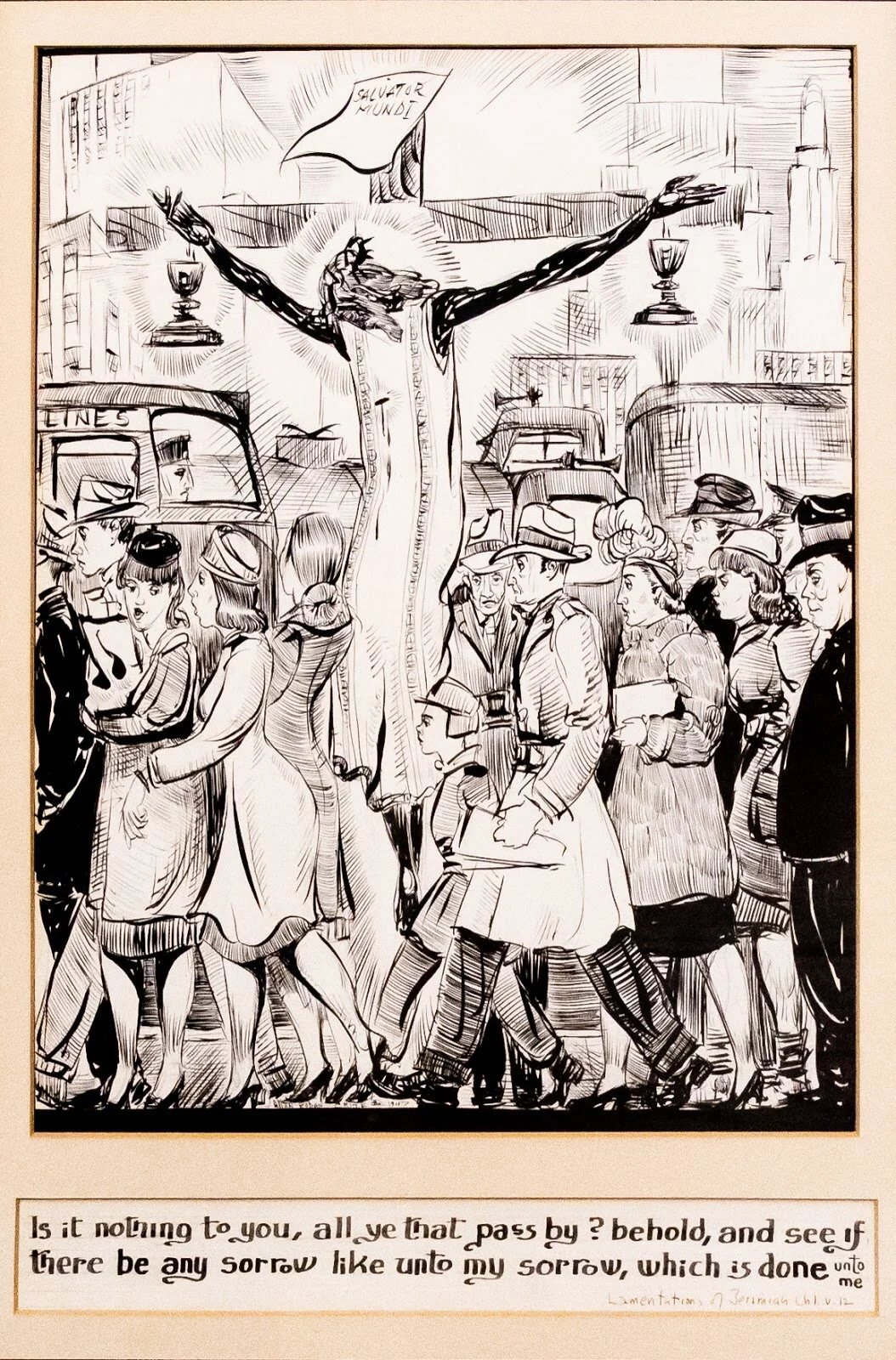
Do you want to know what I find so startling about today, Good Friday, in the middle of most important three days of the Church’s year? It is startling just how normal today is compared to other days. Sure, the stock markets closed today in New York. It's not a bank holiday. The mail was delivered and I see that the UPS and FedEx trucks are out and about. But in my journey to church, traffic was the same, minus the school buses because, yes, the schools are closed. 

In short, life is pretty much going on right around us, with hardly a thought as to what day today is.

Good Friday is important to us Christians, sure; but as far as the culture at large is concerned, it's just another Friday... neither Good, bad, nor indifferent. In our culture, try to go to the mall on Christmas Day. Good luck with that. But today, everything is open for business.

I know that not every big day on the Christian calendar means that everything in the world has to shut down. I get it. But if something is big enough, things just change... maybe not stop, but they'll just feel different! I remember when 9/11 happened in 2001. I was living about 800 miles away from Ground Zero in Marietta, Ohio. And what I remember most about that day and the weeks that followed is that everyone seemed to be equally affected by the enormity of what took place. Flags were everywhere. Respectful silences were observed. People talked in hushed tones.

But Good Friday is not like that. Not at all. Everyone is resolutely going about their business. People are buying…ironically, they are buying Easter baskets and Easter dresses. There have even been Easter egg hunts going on to keep the kids who are home from school busy.

Now some of us may be shocked by that. Those of us who have twinge of nostalgia for the old days…those of us who remember Blue Laws and such…may think of this as bad news. But the news is neither good nor bad. It just is. It is how the world works. It is just this kind of busy, distracted, workaday world that God sent his son into.

There are other moments in our lives when our personal clocks stop but the world just keeps humming along. I remember when my father died, and then six months later, my mother was dying. Both times meant a long drive from southeastern Ohio to New Hampshire, where my parents moved to be near my oldest brother. Both times it meant going through the rituals of hospital visits, funeral home, funerals (in my Dad’s case in two places…one in the parish where he was a deacon, and one at the church where he was being interred), of meeting people—some of whom I had not seen in ages if ever—and then going from place to place and then the long drive home.

And during all of that, when my world was so focused on my parents and my family and each loss, the normalcy of the world around me seemed out of sync with the very small, very slow world I was living in with my brothers and our families. Both times it felt like I was inside a bubble where time, even light itself, seemed to slow to almost nothing, while the world around us sped as if they were on fast forward. 

I think that it was just that way for the people who walked that first way of the cross, when Jesus was crucified. To the locals, the parade of prisoners on the way to Golgotha was probably a nuisance, holding up traffic. The wailing women were a public disturbance. The practiced urbanites of Jerusalem probably saw demonstrations and spectacle (and marches to the gallows) all the time, so they just averted their eyes and walked past as if it weren’t there.

Besides if you stopped to stare at the spectacle, you might be unlucky enough to be picked out by one of the guards and forced to carry one of those gawd-awful filthy crosses. Like that poor Simon of Cyrene. As if the guards were saying, you wanna look? I’ll give you a real close look! Now wouldn’t that just ruin your day?

But even the guards, except for a few who had eyes to see, saw this as just another day at work.

No, the world just went about its business when Jesus was crucified. Time only stood still for those who were most deeply involved. Jesus’ mother and the women who stayed with Jesus through it all, the disciples who watched from a distance: they were inside the bubble. They were the ones that saw the rest of the world in Fast Forward, if they noticed the world all.

For us in here, we who have come into this church and are gathered in darkness at the foot of the cross, it may have something of the same quality. Like being inside a bubble, an alternative world from the rest of life “out there.”

But come to think of it, there is that quality about living life in Christ, isn’t there? That we are aware of something that others might miss. We’d be tempted to hold it over them. To hold it against them. 

Except that I have this strange feeling that if I found myself along the Via Dolorosa before it was called that, that I would be looking at my smart phone, drumming my fingers, averting my eyes waiting for the parade to pass by. Maybe I’d shake my head and mutter a “poor sap” at the poor fellow with the thorns around his head.

This procession, this execution, might have been just another execution of just another prisoner. Just another man without a name, another prisoner without a number, except for the people who did witness was going on and who did understand.

They did not stay inside their bubble for long. The resurrection would burst their bubble, and they would step out of the slow time of grief, and enter, not into the Fast Forward time of the world, but into God’s time. They would come out and first tell each other that this death was like no other death, and this man like no other man. Soon they would be telling a very busy world, that God was there among them and they didn’t even know it and he was killed and he is alive. And through his death, we are made whole. Their seeing allows us to see.

When we walk to the cross, we are not in a different time. We are in God’s time. And when we step out of here, we who have witnessed the cross will through our words and story help others see the cross for themselves.

+ + +   + + +   + + +

Lessons for Good Friday, April 3, 2026 

Here is the link for the Church of the Good Shepherd, Dunedin, FL

Here is the link to the Episcopal Church's Good Friday offering, supporting the work and ministry of the Anglican Province of Jerusalem and the Middle East

Friday, February 27, 2026

Location matters

Location matters.

A long time ago, I was a young priest seeking a new cure, and I dutifully sent my resume and profile to wherever the church’s computer said that I might be a decent match. One of those churches was in Virginia. They called me up for an interview. Now they were polite, but they were not really interested in a newbie priest from Connecticut, no matter how nice I was. 

That is, until I mentioned that I was born in Virginia and was baptized at an old, historic parish there. My, did their tone shift! It did not matter that for all practical purposes I had not set foot in the Old Dominion since I was two, my pedigree had clearly improved.

On the other hand, I only grew up in Massachusetts and Connecticut, which never made me a true New Englander. I once asked a parishioner of my first parish in Northeast Connecticut (a woman who could trace her ancestors back to the first Puritans in New England) about this and she said “Well, if a cat has kittens in an oven, does that make them biscuits?”

Now, I’ve lived in Southwest Florida for five years and all I know is that because I live here year round and don't make the annual trek up and down either I-75 or I-95, I am no longer a “snowbird,” but does that make me a Floridian? Who knows? Whatever the case, where we are raised has an effect on us. Location matters.

Jesus was not born in his hometown, either. In today’s Gospel he talks about something far more serious and he talked to Nicodemus about how our spiritual birth is far more important than our physical birth. Nicodemus came to Jesus with a sort of hesitant curiosity. Nicodemus was a leader of the Pharisees and he had questions.

Now, this may come as a surprise to you, but despite what you may have heard, the Pharisees were actually the good guys of Jesus’ day. Think of them as sort of first-century Episcopalians. Today, we think of Pharisees as legalistic, 'my way or the highway' kind of folks, maybe even fundamentalist. But of all the different movements and styles of Judaism in the first and second centuries, Pharisaism was probably the closest to what Jesus taught and what  Christianity became.

One of the great errors that many Christians make today is to assume that to be a good Jew meant (and means) following all these arcane rules and rituals strictly and by the book. It is one of the great slanders that Christians perpetrate on our Jewish sisters and brothers (and by extension our Muslim siblings): that their faith is all about rules and our faith is all about grace! You hear it all the time from pulpits and Christian radio, "They are all about "law," but we are all grace all the time!" And nothing ends an argument among Christians more quickly than when one side evokes a kind of theological Godwin’s Law by accusing their opponent of being “pharisaical.”

Amy-Jill Levine, a Jewish scholar who teaches New Testament and Jewish Studies at Vanderbilt University wrote about the bad rap that Pharisees get from many preachers and New Testament scholars and sums it up this way: "After two millennia, surely the time has come to stop bearing false witness against Pharisees and their Jewish descendants. Christianity does not need to bear false witness against Judaism in order to proclaim its good news." 

Okay, then, so just who were these guys, anyway? The fact is that the Pharisees sought to modernize things—to revise Jewish consciousness about faith and geography--to get Judaism out of the Temple in Jerusalem and into the places were Jews actually lived, all across the ancient world. They represented the working and merchant classes of 1st century Jewish culture, especially in the diaspora

Before the Pharisees, many (but not all) Jews whether they lived in Galilee or Alexandria or Rome or Ethiopia, may not have felt complete until they went to the Temple in Jerusalem at least once in their lives. The Pharisees, on the other hand, said that being Jewish is a matter of knowing who you are and about loving God with all our heart, soul, and mind and our neighbors as ourselves. They wanted the Jews of their day to live their faith from their hearts, and their ethics to grow out of that faith. Pharisees taught that the local synagogue—their local community—was the center of Jewish life, not the Temple. 

Jesus was deeply influenced by Pharisaism from a young age. I'll bet that the rabbis who taught him as a youngster were Pharisees (Luke 2:41-52). Pharisees set the stage for Judaism to survive the destruction of the Temple in 70 AD and their exile and dispersion outside of Palestine and into Europe, Africa and Asia Minor. In short, modern Judaism in all its forms (and Christianity, for that matter!) is a direct descendant of Pharisaism!

So Jesus and Nicodemus have a lot in common! Both wanted to relocate the heart of Judaism from a place to a people… not just of ancestry but of faithfulness. Both teachers agreed that our morals and ethics grow out of the heart of our faith… to love God with all our heart, soul, and mind and to love our neighbor as ourselves... that what we do shows who and whose we are. But while both Jesus and Nicodemus understand that the Spirit is not confined to a building, no matter how local, or even a nation, for that matter, Jesus takes it a step further when he says, "Very truly I tell you, no one can see the kingdom of God without being born from above."

I am sure that you’ve heard the phrase before. It’s usually translated as being “born again.” It could mean that, or "You must be born anew." But, basically, the word means "from above." When Jesus tells Nicodemus that one must be born from above, he is talking about a kind of spiritual awakening that is initiated and animated by God which enlivens and re-defines us.

Archbishop William Temple, the Archbishop of Canterbury during World War II, was once asked if he was born again. He said, “I’ve been born again, I am being born again, and I hope to be born again tomorrow.” He was not talking about salvation, but about sanctification. He was talking about the life of holiness. All of us have the chance to change, to grow, to deepen our life in Christ, as Jesus reminds us in John 3:8 that "The wind blows where it chooses."

Listening for that wind is one of the great disciplines of the Christian life. Awaiting the chance to be born again and again is one of the great disciplines of the Christian life. And a good place to start is in our Lenten discipline today.

The wind of re-birth is the wind of freedom and love, and it is far stronger than where we typically imagine where we find stability in life. It is stronger than the place where we were born, stronger than our ancestry, stronger than what Jesus calls the flesh. So, even though it may blow us to new places, we are – in the Spirit – more stable than ever!

One of things I’ve discovered since moving to Southwest Florida is that everybody here is from someplace. But, as Christians, we are natives of that place which Jesus calls the kingdom of God, which is a kingdom which we enter by faith and baptism. Life in God’s reign is the life of walking with Jesus and letting our identities be shaped and re-shaped by this marvelous wind, this breath of the living God.

The location that matters the most is our heart. In living our life in Christ, we have a choice: we can think of it as a punch-list of tasks we have to accomplish; or we can see the movement from baptism and Eucharist, of daily prayer and sacraments, as the places where we discover again and again our identity in Christ.

Lent is our time to discover again that no matter where we are or where we are from, God is always present to us and that our identity is found with Christ. As baptized people, we are always at home with Christ.

You have been born. By faith and baptism you have been born from above. And as you grow and mature in Christ, in your prayer, your encounter with Scripture, in your Sacramental living you are being born again and again and again. Every time we allow ourselves to follow the wind of God, the Spirit of God, we find ourselves located in the heart of God and that our identity is located in and consists of grace and power.

Saturday, February 14, 2026

Encountering the Fullness of God

Sometimes crisis has a way of revealing our true character. When things are moving so quickly that all we can do is react, our true selves sometimes come to light. While sometimes we are shocked and disappointed by what we see, there are other moments when we discover depths of strength and character that we never knew we had.

The purpose of the Epiphany season is to remind us, beginning with the arrival of the Magi after Jesus’ birth right up to the Transfiguration on the Mountaintop, of who Jesus is, what God is up to in the Incarnation, and how people recognize the fullness of God in the person of Jesus.

Of course, encounters with God aren’t new. Moses went up to the Mountain and received the law from God. His encounter with God literally left him aglow with the holiness of God.

The amazing thing is that these encounters go both ways. God reveals Jesus. And Jesus reveals to us the true nature of humanity—what God intends for us to be. Notice how in the Gospel today, how on the mountaintop both Moses and Elijah, who represent the fullness of the Law and the Prophets, come to Jesus.

Then in today’s Epistle, we hear Peter, one of the first apostles, talk about how his experience of meeting, knowing, and following Jesus changed him.

Sometimes, when we have these encounters, instead understanding them as the springboard they are, we want to hang on to the moment and to the feelings that come with it. I remember hearing about a man, a devout Christian, who every Sunday night for over forty years, would stand up at his Baptist Church and recount his salvation moment and quote the same passage, John 3:16. It is good to be saved, and good to give testimony, and I am convinced that God wants us to remember his saving love and grace. God also wants to grow and mature in our faith.

Jesus’ disciples also wanted to freeze their mountaintop moment in time by building booths, a kind of religious shelter, to commemorate both the moment and the spot where heaven and earth, law and prophet, God’s time and our time, came together. But just as they are ready to head to Home Depot and buy a do-it-yourself booth kit, a voice from heaven interrupts them and tells them that the way to understand and remember the moment is to listen to and follow Jesus, God’s beloved Son.

The transfiguration reveals Jesus’ true nature, that he is at once fully God and fully human, and also showed us God’s purpose to bring heaven to earth. But, camping out in a building or a shrine, Jesus’ true self is shown as he teaches, heals, and empowers ordinary people to take part in God’s work of reconciling humanity to each other, creation and to God.

In both Moses’ and Jesus’ encounters, our need for God and our need for reconciliation is put square in our faces.

As I said, crisis often reveals character, and we are seeing it again. On this celebration of the Transfiguration, I am mindful of the many people who, in the moment of decision, chose against all odds to do the right thing, for the right reason, in the right way.

One of those people was a man named Allan McDonald. You may not have heard of him, but he was an aerospace engineer for the company that built the solid rocket boosters for the space shuttle, back in the 1980s. Forty years ago, he got into trouble because he refused to certify the launch of the shuttle Challenger slated for January 27, 1986, because he knew that the unusually cold temperatures on the Space Coast that year would make the “o-rings” on the solid rocket boosters brittle and liable to fail. His bosses over-ruled him, and the launch proceeded where, as we all know, the shuttle exploded about 78 seconds into its flight killing the crew. During the investigation, McDonald did not keep silence, and was promptly demoted. It was only after members of Congress threatened to strip the company of all future space and military contracts, that they changed their mind and McDonald was put in charge of rocket engine safety protocols and engineering, and the changes he led allowed the shuttle program to resume.

In an interview after his retirement, McDonald said something which has become something of a mantra for me. He said, “always do the right thing for the right reason in the right way at the right time with the right people and you will never have regrets in your life.” He was a person whose character was revealed in a transfiguring moment.

The late Archbishop Desmond Tutu, who died four years ago at 90 years old, told the story of his own transfiguring moment. It happened when Tutu was 9 years old, while he and his mother were walking down the street at the height of the Apartheid era of his native South Africa. They were approached by tall white man dressed in a black suit. In those days in that place, when a black person and a white person met while walking on a footpath, the black person was expected to step aside, even into the gutter, to allow the white person to pass — and to bow his or her head as a gesture of respect. But that day, before unbelieving eyes of a young Tutu and his mother, it was this white man who stepped off the sidewalk. And as they passed, he tipped his hat in a gesture of respect to her!

The white man was the Rev. Trevor Huddleston, an Anglican priest (later a Bishop) who was bitterly opposed to apartheid. And that tip of the hat changed Tutu’s life. When his mother told him that Trevor Huddleston had stepped off the sidewalk because he was a “man of God,” Tutu found his calling.

“When she told me that he was an Anglican priest I decided there and then that I wanted to be an Anglican priest too,” he said. “And what is more, I wanted to be a man of God.”

Huddleston later became a mentor to Tutu; and he later said that encounter was his ‘transfiguration’ that led to the transformation of a people and eventually a nation.

In his review of Philip Yancey’s book, Rumors of Another World, Keith Parkins talks about the spirit of mercy that pervaded South Africa after Nelson Mandela was released from prison.

“As apartheid drew to an end and Nelson Mandela was released from Robben Island, Mandela could have called upon the blacks to rise up and seek vengeance on the whites,” Parkins wrote. “He did not; he showed grace and appointed Desmond Tutu to head the Truth and Reconciliation Commission. There was an understandable desire for [revenge and] retribution; instead, the path of forgiveness and reconciliation was chosen.”

South Africa’s Truth and Reconciliation Commission was a transfiguring moment for both that nation and the world. The rules were simple — the perpetrators needed to tell the truth, the whole truth; and their victims were given the opportunity to tell the truth of their experience as well. The victims would also be given the opportunity, but not be forced, to forgive. Many of the atrocities were truly horrific. A policeman called van de Broek told of how he and his fellow officers shot an 18-year-old youth, then burnt the body. Eight years later they went back, took the father and forced his wife to watch as he was executed then incinerated in front of her. Many years later, she was in a courtroom and the Commission to hear van de Broek confess. After he was finished, the judge turned to the woman and was asked by the judge what she wanted. 

She said she wanted van de Broek to go to the place where they burned her husband’s body and gather up the dust so she could give him a decent burial; van de Broek agreed. She then added a further request.

“Mr. van de Broek took all my family away from me, and I still have a lot of love to give,” she said. “Twice a month I would like for him to come to the ghetto and spend a day with me so I can be a mother to him.

“And I would like Mr. van de Broek to know that he is forgiven by God, and that I forgive him too. I would like to embrace him so he can know my forgiveness is real.”

Spontaneously, some in the courtroom began singing “Amazing Grace” as the elderly woman made her way to the witness stand. But van de Broek didn’t hear the hymn; he had fainted, overwhelmed. It was a transfiguring moment, where the true character of these persons was revealed. (Read more here.)

It is in moments like these, we see God’s transforming, transfiguring, transcendent love at work infusing our lives, and healing our relationships. In these moments, we see the character of God’s people as they make room for God’s restorative justice to flourish.  

The transfiguration shows us Jesus’ true nature. Here we see the lengths that God will go to reconcile humanity to Godself and to make us the people God meant us to be. He we see Jesus—100% God and 100% humanity, in the same person, undiluted-- on that mountain top. And it here that we see God’s true intention: to restore all people to unity with God and each other and creation, which is the Mission of the Church… our mission. [Look it up! It’s in our catechism (p. 855).] Over and over again, we discover that we can daily cooperate with God’s reconciling work whether it’s a small act of kindness, or a righteous stand for reconciliation, or a bold proclamation of the Gospel. And when we do, we, God’s people the church, shine with Christ’s radiance! And we show our true nature as baptized people whenever we go into the world living practical, useful, transforming acts of justice and love.

This is how we communicate the Gospel and reveal the breadth and depth of God’s love for us and all humanity. Our encounters with the Risen Jesus, on the mountaintop or in everyday life, shows that we have met God’s beloved Son, that we are listening to him, and displays the radiance of Christ for all to see.

+ + +   + + +   + + +

Scripture for the Last Sunday after the Epiphany, Year A, February 15, 2026

Here is the bulletin for Holy Trinity Episcopal Church, Clearwater, Florida for February 15, 2026

Here is the website for Holy Trinity Episcopal Church, Clearwater, Florida 

Here are the videos of the worship services (8 am here at about 17:05 & 10 am here at about 29:28) at Holy Trinity, Clearwater, February 15, 2026

Learn more about the Diocese of Southwest Florida here


Saturday, February 07, 2026

Light that pierces the darkness

Have you ever been outdoors in a totally dark place?  

When I was a kid, we lived on what was once a farm that was also just far enough away from the expanding suburbs and any streetlights that we could go out into the field behind our house, lie down on the grass and see not only all the stars but the Milky Way itself stretched across the night sky like a head band. It was here that I earned my astronomy merit badge with an old refracting telescope and the star chart that was published every week in the local newspaper. It was a amazing to think about how far a little dot of light travelled to reach our eyes and then from there to our imaginations. Every now and then, on a clear night, you can still look up in the sky and see the stars, especially if you shield your eyes from all the light that our streetlamps, headlights, and buildings generate every night.

We hardly think about it, but for us light is pretty cheap and readily available. We walk into a room and flip a switch. You don’t even have to do that much in many modern cars because when it gets dark enough, the lights just turn themselves on! But once upon a time, in fact for most of human history, lighting your way at night was pretty basic: a flaming torch, a campfire, a candle, or maybe a kerosene lantern. Moonlight was great when it was the right phase of the moon and if the weather was clear enough to allow farmers to get an extra few hours of planting or harvesting done.

The need for some kind of artificial light meant harnessing fire. This meant that from Biblical times right up through the advent of electricity, a basic skill that most women and girls learned, in addition to cooking, raising the children, sewing, milking the cows and all the rest, was how to dip a string (that they probably wove themselves) into a vat of hot wax that they made on stove, over and over again to make candles, as well as how to build and manage fire for cooking and heating water for washing.

Over time there were refinements: things like glass lenses, hurricane lamps, the kerosene lanterns, and so on, but in Jesus’ day the clay lantern that looked like a tea kettle with a wick stuck through the spout into a kind of paraffin was as fancy as you got. And if you didn’t make your own fuel from butchering animals for meat or maybe distilling some grain, you had to buy it. It wasn’t that long ago that ships sailed around the world hunting whales and harvesting the blubber all so that we could light our homes at night.

Getting light at night was a lot of work, which is why the invention of the light bulb and finding a way to reliably deliver electricity was such a big deal.

And then there was darkness.  We mostly think of darkness as an inconvenience at worst, but great for setting the mood for romantic dinners, or for watching movies. Mostly, though, darkness is something we sleep through. But there was a time that darkness was well… dark!

How dark was it? It was so dark that a little light could go a long way! Even a candle in a window could be seen for miles. Early lighthouses were nothing more than bonfires built on hills or towers. Towns had nothing but candles in windows and fires in fireplaces, but taken together, they could be seen from miles away because they stood out in cover of night.

So when Jesus said to his followers that “you are the light of the world,” people knew what he was talking about. He told them to “let their light so shine before others, so that they may see your good deeds and glorify your Father in heaven.” A little light pierces the darkness even over a great distance. Well, how exactly do we do that? I’m not talking about flashlights or candles… but in how we live every day, can we create light and where shall we shine? How will we focus our light?

The way we think about light makes a difference as to how we think about learning and doing the work of Jesus today. And when Jesus said that we are light, he didn’t mean that we could just flip on and off the discipleship light switch. He meant that we are the lamp… and even with all the work it takes to shine, our task is to bring light to dark places.

Jesus told his friends and apprentices, “You are the light of the world” he does not describe a light in isolation, but rather a light that exists for and within the world. He says, “Let your light shine before others,” not so that they may admire you, but “so that they may see your good works and give glory to your Father in heaven.” The light that comes from Jesus’s love is not meant to be hidden or hoarded. Light directs. Light reveals. Light shines so that others can see.

As baptized people you are a disciple, a friend and apprentice of Jesus Christ, and Jesus reminds us that we do this in community, not alone. Being a follower of Jesus connects us to God, creation, and each other. The early church theologian Tertullian said “that one Christian is no Christian.”

Which is a very good thing, because learning and doing the work of Jesus can sometimes feel heavy. It is impossible to do alone. Sure, we can turn the Word of Life into a shopping list, a mere spiritual to-do list. We may feel the weight of responsibility and effort pressing down on us. Actually, that’s pretty normal. We humans have a deeply ingrained impulse toward shame and secrecy that can make Christian living feel like we’re constantly failing a test, as if we are unworthy of grace and love because we haven’t done enough, or done well enough. And that feels tiring, lonely, and isolating. 

But our Collect today gives a hopeful antidote: “Set us free, O God, from the bondage of our sins, and give us the liberty of that abundant life which you have made known to us in your Son our Savior Jesus Christ….” Our prayer today speaks not of burden, but of freedom, liberty and abundance. 

Even within that tightrope walk of relationship and responsibility, there is freedom. The prophet Isaiah lays right into it. He calls out religious leaders who have leaned too far into obligation and legalism but forgotten the abundant spaciousness that comes from God. He calls out the timidity and caution of his peers who go along to get along with the oppression of his day. He names the fasting, self-inflicted oppression, and penitence that serve only one’s own self and reputation. He shows us that the spiritual disciplines of fasting, penitence, and daily prayer and reading scripture are the most healthy, meaningful, and life-giving onlywhen they point us to God, and the welfare of God’s people and creation.

The prophet Isaiah and Jesus both remind us not to perform righteousness for show. Don’t worry if people can see your good works, but pray that they see the good that happens, they give glory to God. Let your actions loosen the bonds of injustice. Let them feed the hungry, shelter the oppressed, clothe the naked, care for the sick, and companion the lonely, shut-in, or jailed.

The freedom we seek as Christians, as followers of Christ, is bigger than ourselves, and our own self-righteousness. The goal of our life isn’t to be free in the sense of being able to do whatever we want, without consequence. The freedom we seek—through our spiritual practices and prayers and worship and teaching and learning—is freedom from oppression for all.

What good is fasting if we ignore the hungry? What good is penitence if we ignore those who are tortured? What good is religious devotion if we turn away from the poor, the lonely, the sick, the forgotten?

The freedom we desire is that all people may know they are loved, safe, protected, and nourished—spiritually, yes, but also physically, emotionally, and mentally. Instead of living as a collection of loners all seeking to be king of the hill, we in fact live in a spiritual ecosystem even in—especially in! —this broken and hurting world, so one person oppressed affects each and every one of us. 

Jesus gives us the image of a city on a hill whose light guides us home and whose walls offer sanctuary. But just because we are salt and light, does not mean that God’s freedom is a free-for-all. Jesus reframes the Law and the Prophets of the Hebrew scriptures to remind us that our freedom, as well as our adherence to the traditions must always point to God, which is why Jesus says, “I have come not to abolish but to fulfill.” 

When times are filled with darkness and things feel very challenging, I am reminded of the late Rev. Dr. Martin Luther King’s observation “that darkness cannot drive out darkness, only light can do that. Hate cannot drive out hate, only love can do that.”

So we follow the commandments and we live the sacramental life. We say our prayers and read our devotionals not to make us look good but because they matter.

The funny thing is that when we do this stuff, people will notice but not in the way we think. What people will see is peacefulness, gentleness of heart, acceptance of people’s variety, our appreciation for the earth and all God’s creation. What they will see is genuine leadership that seeks the well-being of the people being served rather than being handed a gold-plated plaque. As we live the life of Christ, what folks will see emanates naturally as we grow in Christ and abide in Christ’s love and do Christ’s work serving Christ’s people with justice, peaceably and generously.

We live in a world where darkness happens. Sometimes it just happens. Sometime we bring it on ourselves. 

As Christ’s followers, we are people of light. Our task is to bring Christ’s light to even the darkest places even in the darkest of times. In all we do, the way of Jesus invites us to see the face of Jesus in everyone we meet, and we are invited to illumine the way of Jesus to the people God gives us, lighting the way to a life of grace and peace, and so that in all things, glory is given to God our creator, sustainer, and redeemer.

+ + +   + + +   + + +

Scripture for the Fifth Sunday after the Epiphany, Year A, February 8, 2026

Here is the bulletin for St. John's Episcopal Church, Clearwater, Florida for February 8, 2026

Here is the website for St. John's Episcopal Church, Clearwater, Florida 

Here is video of the worship service and the sermon at St. John's, Clearwater, February 8, 2026

Learn more about the Diocese of Southwest Florida here