Showing posts with label Holy Week. Show all posts

Friday, April 03, 2026

Just Another Day

Good Friday, 2026 

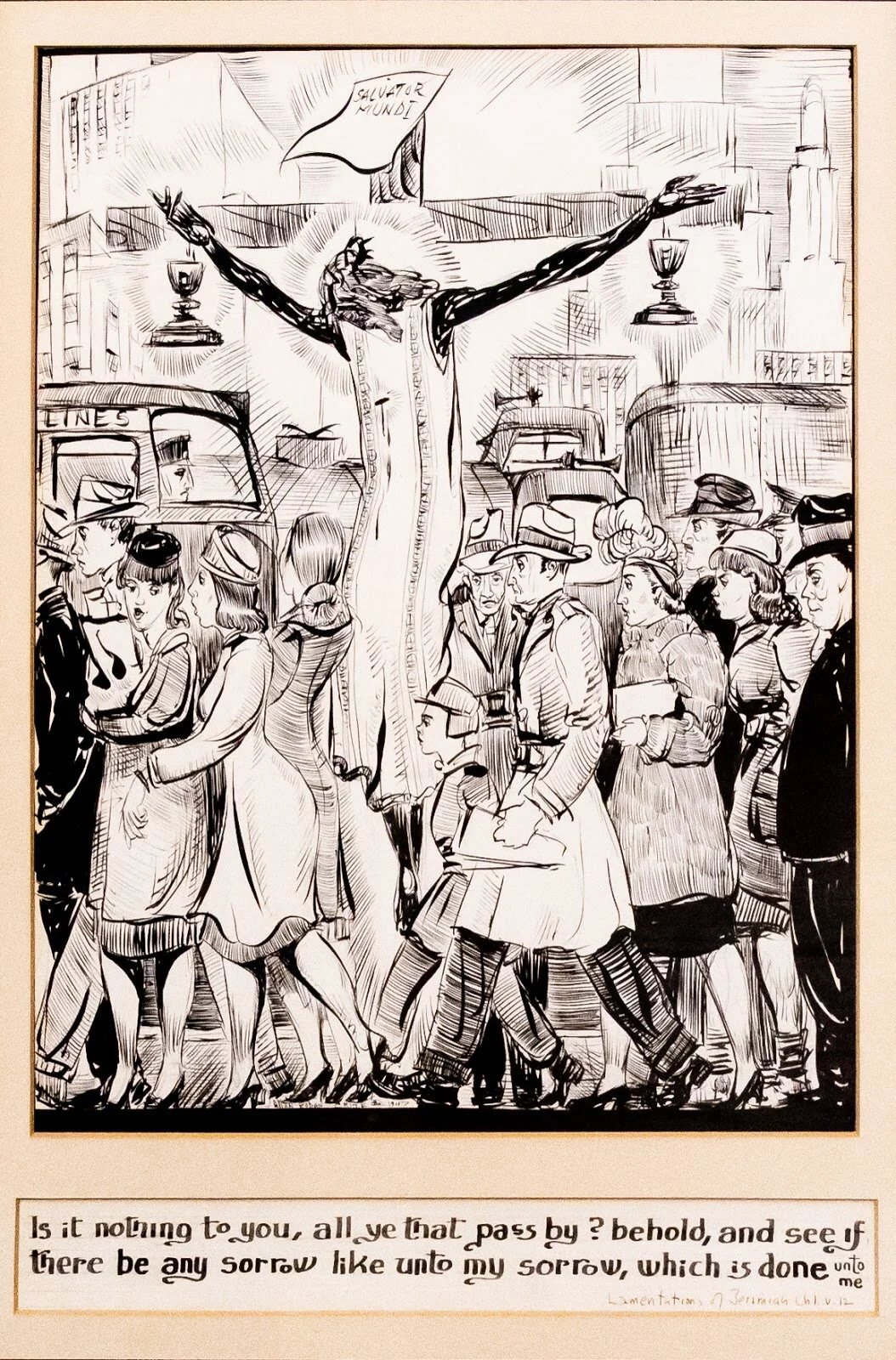
Do you want to know what I find so startling about today, Good Friday, in the middle of most important three days of the Church’s year? It is startling just how normal today is compared to other days. Sure, the stock markets closed today in New York. It's not a bank holiday. The mail was delivered and I see that the UPS and FedEx trucks are out and about. But in my journey to church, traffic was the same, minus the school buses because, yes, the schools are closed. 

In short, life is pretty much going on right around us, with hardly a thought as to what day today is.

Good Friday is important to us Christians, sure; but as far as the culture at large is concerned, it's just another Friday... neither Good, bad, nor indifferent. In our culture, try to go to the mall on Christmas Day. Good luck with that. But today, everything is open for business.

I know that not every big day on the Christian calendar means that everything in the world has to shut down. I get it. But if something is big enough, things just change... maybe not stop, but they'll just feel different! I remember when 9/11 happened in 2001. I was living about 800 miles away from Ground Zero in Marietta, Ohio. And what I remember most about that day and the weeks that followed is that everyone seemed to be equally affected by the enormity of what took place. Flags were everywhere. Respectful silences were observed. People talked in hushed tones.

But Good Friday is not like that. Not at all. Everyone is resolutely going about their business. People are buying…ironically, they are buying Easter baskets and Easter dresses. There have even been Easter egg hunts going on to keep the kids who are home from school busy.

Now some of us may be shocked by that. Those of us who have twinge of nostalgia for the old days…those of us who remember Blue Laws and such…may think of this as bad news. But the news is neither good nor bad. It just is. It is how the world works. It is just this kind of busy, distracted, workaday world that God sent his son into.

There are other moments in our lives when our personal clocks stop but the world just keeps humming along. I remember when my father died, and then six months later, my mother was dying. Both times meant a long drive from southeastern Ohio to New Hampshire, where my parents moved to be near my oldest brother. Both times it meant going through the rituals of hospital visits, funeral home, funerals (in my Dad’s case in two places…one in the parish where he was a deacon, and one at the church where he was being interred), of meeting people—some of whom I had not seen in ages if ever—and then going from place to place and then the long drive home.

And during all of that, when my world was so focused on my parents and my family and each loss, the normalcy of the world around me seemed out of sync with the very small, very slow world I was living in with my brothers and our families. Both times it felt like I was inside a bubble where time, even light itself, seemed to slow to almost nothing, while the world around us sped as if they were on fast forward. 

I think that it was just that way for the people who walked that first way of the cross, when Jesus was crucified. To the locals, the parade of prisoners on the way to Golgotha was probably a nuisance, holding up traffic. The wailing women were a public disturbance. The practiced urbanites of Jerusalem probably saw demonstrations and spectacle (and marches to the gallows) all the time, so they just averted their eyes and walked past as if it weren’t there.

Besides if you stopped to stare at the spectacle, you might be unlucky enough to be picked out by one of the guards and forced to carry one of those gawd-awful filthy crosses. Like that poor Simon of Cyrene. As if the guards were saying, you wanna look? I’ll give you a real close look! Now wouldn’t that just ruin your day?

But even the guards, except for a few who had eyes to see, saw this as just another day at work.

No, the world just went about its business when Jesus was crucified. Time only stood still for those who were most deeply involved. Jesus’ mother and the women who stayed with Jesus through it all, the disciples who watched from a distance: they were inside the bubble. They were the ones that saw the rest of the world in Fast Forward, if they noticed the world all.

For us in here, we who have come into this church and are gathered in darkness at the foot of the cross, it may have something of the same quality. Like being inside a bubble, an alternative world from the rest of life “out there.”

But come to think of it, there is that quality about living life in Christ, isn’t there? That we are aware of something that others might miss. We’d be tempted to hold it over them. To hold it against them. 

Except that I have this strange feeling that if I found myself along the Via Dolorosa before it was called that, that I would be looking at my smart phone, drumming my fingers, averting my eyes waiting for the parade to pass by. Maybe I’d shake my head and mutter a “poor sap” at the poor fellow with the thorns around his head.

This procession, this execution, might have been just another execution of just another prisoner. Just another man without a name, another prisoner without a number, except for the people who did witness was going on and who did understand.

They did not stay inside their bubble for long. The resurrection would burst their bubble, and they would step out of the slow time of grief, and enter, not into the Fast Forward time of the world, but into God’s time. They would come out and first tell each other that this death was like no other death, and this man like no other man. Soon they would be telling a very busy world, that God was there among them and they didn’t even know it and he was killed and he is alive. And through his death, we are made whole. Their seeing allows us to see.

When we walk to the cross, we are not in a different time. We are in God’s time. And when we step out of here, we who have witnessed the cross will through our words and story help others see the cross for themselves.

+ + +   + + +   + + +

Lessons for Good Friday, April 3, 2026 

Here is the link for the Church of the Good Shepherd, Dunedin, FL

Here is the link to the Episcopal Church's Good Friday offering, supporting the work and ministry of the Anglican Province of Jerusalem and the Middle East

Saturday, March 28, 2026

Confronting the powers that be

He was called the “Tank Man” or the” Unknown Rebel.” Remember him? Way before our own No Kings Day, 37 years ago, in the spring if1989, students, intellectuals and ordinary laborers protested in Tiananmen Square in Beijing, joining others all over China demanding change in what was called "The Pro-Democracy Movement. They wanted greater democratic reforms, and most of all they wanted an end to the corruption that was a daily part of life in China in 1989. By June, the government had had enough. They sent in the army to break up the massive protest. The Unknown Rebel was a young man who was filmed singlehandedly stopping a column of tanks sent to the Square to break up the demonstration.

The Tank Man stood in front of the tanks, and when the lead tank tried to drive around him, he moved and stepped in front of it again, bringing them to a halt.  Eventually, students from the crowd dragged him away because they were afraid that he would either be shot dead by soldiers or run over by the tanks. We don’t know what became of the Unknown Rebel, but his act became known around the world via news reports and television. He became the symbol of liberty: a free man standing alone but firm against oppression. Time magazine included him as one of the 100 most influential people of the 20th century.

One spring day in the year 30, in the city of Jerusalem, the local governor of the vast Roman Empire, named Pontius Pilate marched into the city, leading a column of imperial cavalry and foot soldiers. He came through the front door of the city, the West gate, backed up by the greatest exhibition of Roman military power he could muster.

That same day, a rabbi from Nazareth, a wandering preacher and teacher with a gift of both public speaking and, it was said, healing, gathered his followers and marched in the city through the east gate riding a young colt. Jesus came in the side door, effectively the service entrance of the city, and was greeted by the peasants and ordinary people of Jerusalem who carried leaves of palm and other trees, and spread their cloaks, garments, and household carpets (if they could afford them) in his path.

The Imperial procession was a demonstration of power. The Roman government came up to Jerusalem from their own city built by the sea, called Caesarea Maritima, and whenever there was a major festival in the religious heart of occupied Israel, he’d head up the mountain to Jerusalem to remind the locals of the might and power of Rome, with trumpets and drums announcing his arrival accompanied by a legion of soldiers to keep order. Just in case.

Jesus’ small procession, on the other hand, was at once a pitiful thing that in its shabbiness and impressive in its spontaneity, mocking the imperial procession across town. So, while there were no soldiers, no banners, no trumpets, and no drums, there was a crowd of people carrying tree branches and leaves, crying out “Hosanna.”

Have you ever wondered what “hosanna” means in English? I think most of us assume it’s a cry of praise, like “Hallelujah!” Actually, it’s a prayer. It’s a cry for deliverance. Hosanna means “free us!” The crowd is crying out to Jesus, Hosanna! Hosanna free us, we pray you! Deliver us! Save us from Pilate, from Herod, and Caesar and all of the misery of Rome! 

Jesus’ entrance into Jerusalem was a prophetic act that underscored the conflict to come. The humility of his triumphal entry signaled that God’s power, God’s forgiveness, God’s reign did not rest with big golden idols, powerful armies, and impressive soldiers, and not even the established religion of the Jerusalem establishment could overshadow Jesus’ humble people’s procession. Jesus was showing that God was sovereign over everyone. God is bigger even than Rome, even of emperors who considered themselves sons of the gods, and that God arrives not in power, but in humility and in service.

Jesus’ entrance into Jerusalem was a proclamation that God’s reign is here, present and available to all people, a tangible concrete answer to the grinding oppression of Roman occupiers, and the dulling drudgery of life lived without hope, purpose, or power. Jesus knew that when they saw him riding into the city, everyone would have thought of the prophecy in the Jewish Bible, where a king rides into the city in humility. Jesus arrives as a king of peace.

Pilate’s procession, on the other hand, signified human power and human glory that is established with violence and maintained by force. Jesus proclaims the reign of God, established by a Covenant with God’s people, and maintained by love.

No one really knew what to expect. Some people thought that Jesus would lead a revolt. Others through he’d take over the Temple and call down angelic armies. Of course, none of it will go as planned—or so some thought. Jesus did not rally the people to throw off the chains of oppression. There is no revolution. And while Roman soldiers did not scoop up the people who greeted Jesus... this time!... the authorities exerted their power, just the same. 

Before the week is out, Jesus will be arrested and the might of Rome and the power of the official Temple religion—which was at the heart of the religion and economy of Jerusalem— will fall on the head of Jesus. He dies a public, criminal, traitor’s death on a cross, outside the very gates of the city he rode through, not even a week later.

Normally, that would be the end of the story. We might have remembered Jesus’ entry into the city with the same sorrowful appreciation that we have for the Tank Man. Yes, it was stirring to see one man stand up against the tanks…but the tanks still won. And no one knows whatever became of the brave young man. It might have been stirring to see Jesus’ peasant parade in contrast to the Roman legions. But the legions, it appears, still won.

But the legions did not win, not in a final sense! And what was defeated was not an army or a government or a corrupt merging of power and religion. What was defeated was death. What was defeated is sin. What is defeated on the cross is every human attempt to make things serve in the place of God. What is put down is every complex structure, every kind of manipulation that both make us seem to be in control of our little universes, but which hide the fact that we are God’s creatures and responsible to God and each other.

You and I don’t have armies to show all the wily ways we put ourselves between us and God. We don’t need legions to find ways to hide ourselves from our deep-down fears that we are not who we wish we were. Human beings are adept at denying the ways we forget about our neighbors, ignore those in need and exercise our own self-doubt and try to control our own deep longings. We don’t need armies or governments or even big companies to hide ourselves from God’s purpose of love, compassion, care for one another and creation. It doesn’t take much for us to run away from the fundamental call to follow God’s way, to love God with all our heart, soul and mind, and our neighbors as ourselves. We do it in big and small ways all the time.

Jesus marches in the side door of the city against all of this as well. He is still marching in, showing us all the ways in which power--personal and political-- is used not for good but for ourselves, not for good but for evil. He processes into our lives and addresses the many ways that we put ourselves—our fears and our pettiness and our selfishness--in between us and God. He processes in and reveals the pitiful but deadly ways that people use power not for service but for personal glory. Jesus parades into the service entrance and willingly goes to the cross.

And when he does, he shows us that God’s reign is present right here, right now, and that the cross marks the ultimate end of death’s reign over us, the end of our separation from God and each other and creation, the end of the power of sin.

We don’t know what happened to the Tank Man all those years ago. We don’t know if his quiet protest finally did any good. But during this holy week we will walk with Jesus along the way, we will accompany him to the garden where he pours out his soul and his doubts, we will accompany him to the upper room where he will break bread with his friends and wash the feet of his followers even the ones who will deny and betray him; we will walk with him to the cross and we will greet him as he rises from the darkness of death and walks in to the light of new resurrected life. 

+ + +   + + +   + + +

Here are the Scripture readings for Palm Sunday/Sunday of the Passion, March 29, 2026

Here is a reflection connecting No Kings Day (March 28, 2026) and Palm Sunday.

Saturday, March 30, 2024

Rescuing us

Holy Saturday, April 3, 2010, 

Revised March 30, 2024

If you have ever experienced your faith as being absent, today is your day. 

If you have ever experienced deep emptiness from your soul to your bones, today is your day. 

If you have ever known loss that cannot be filled, today is your day.

If you've ever looked around at the world and see war, violence, greed and corruption, and wonder if things can't get any worse, then this day is for you.

If you have ever discovered, as C.S. Lewis did, that grief feels very much like fear, then this is your day. 

If you have ever gone through the motions because you don't know what else to do, this is your day.

Holy Saturday is a day very easy to jump over. Today is a gorgeous spring day. People are out planting flowers and going to the store to buy for Easter dinner. Easter dresses are being tried on and egg hunts in the parks are happening as we speak. 

The world is busy and alive, and here we are in a darkened church before a bare cross and it feels empty. 

This is the kind of emptiness that any who has grieved the death of a loved one knows. It is like going through the motions at work, and confronting that first thanksgiving or Christmas or birthday knowing that the one we love is dead. 

I will bet that the followers of Jesus had the most somber, depressing Passover meal on record. But if they are at all like a lot of people I know, they will have done it. They will have read the words, and eaten the bitter herbs and the lamb, because...because what else could they do? Even if it was by rote, it was something. Something to anchor. Something to hold on to when there was nothing else. 

Holy Saturday is a day of absence, emptiness and numbness. If you have ever felt this way, this day is for you. 

The thing about Holy Saturday that is special is that it is the last day of the Old Creation. It's just that we don't know that yet. Just as we won't know that we have passed through the darkest moments of our grief until we suddenly find ourselves feeling again. We won't know until we look backwards. 

And here is the dreadful and true part of Holy Saturday. There is nothing we can do about it. All we can do is what I've said: slog through, go through the motions. We steer into the wave and hope that our boat is not swamped as the wave crashes over our heads. But the feast also tells us that as we wait, as we slog through our fear and emptiness, Easter is coming. 

The disciples hiding and fearing for their lives in the locked upper room did not know that yet. We never know it when we are in it. But Easter is coming. 

Our creeds and tradition say this is the time when Christ descended into hell and went among the dead. 

So, what Jesus was doing on Holy Saturday? Was he, like John's Brown body, "a-moldering in the grave," as the old civil war song goes? Was he walking around the tomb waiting for the angels to come and roll away the stone, folding up his burial cloth before stepping out?

My favorite answer is visual. There is an old icon known as "The Harrowing of Hell" that answers the question of just what Jesus was up to on that otherwise ignored middle day? it shows Jesus entering into hell, into the place of the dead, and he is standing on the lids of the graves of Adam and Eve, the first humans, literally representing all of humanity, and is lifting them out of their coffins to bring them with him back to heaven. In some versions of the icon you see broken chains, locks, handcuff, and tools lying about with a person (the devil perhaps? Maybe death itself?) lying bound and gagged below. 

When I see this icon, I am reminded again of what Holy Saturday shows us:  that even in the emptiness, Christ is there. If we go down to Sheol, and walk among the dead, Christ is there. There is no place where we can go to escape God's love. 

But we don't know that now. We will know that tomorrow. In the meantime, this day is for you.

+ + +    + + +   + + +

Here are the Lessons for Holy Saturday, March 30, 2024

Wednesday, March 27, 2024

Revisiting Judas

We call today "spy Wednesday" because today is the day we hear about Jesus' betrayal and arrest. 

Well, I don't know about you but to me, Judas poses a problem. I mean, how do you explain the fact that one of Jesus’ most trusted associates betrays him to his enemies? There are several theories.

There’s the Snidely Whiplash theory. John’s Gospel, which we hear today, tells us that he is a thief, embezzler, and an all around rotten guy.

Then there is what you might call the Anakin Skywalker theory of Judas. You know, he went over to the dark side. Today’s Gospel also says that Judas let the devil into him or at least that the devil took over.

If you got your Christian formation from Jesus Christ Superstar, then you’ve heard the Cosmic Dupe theory: that Judas was cruelly used by a manipulative God and thrown aside for some larger purpose.

There was a snippet of a Gnostic gospel that caused some years back that said Judas’ betrayal was all part of God’s Big Plan. Jesus spiritual self needed to break out of the flesh so he would be set free to become his "true spiritual self" and this required death on a cross. Judas, in this scenario, did Jesus a favor!

Maybe Judas’ aims were political. Judas had to arrange for Jesus the Messiah had confront the Roman occupiers and their corrupt local toadies. Then the people would rise up in revolt or else God would be stirred to action and send angelic armies in some apocalyptic final clash. So he needed Jesus to be arrested to get the ball rolling.

Or maybe Jesus and Judas were really in cahoots and it backfired.

Isn't this fun? We love to psychologize Judas! 

Well, be careful! Because I suspect that your favorite theory of Judas might be one of those clues as to how you see God and a window into how your particular spiritual life works, but that’s for you to take up with your spiritual director.

You see my problem with Snidely Whiplash, Anikan Skywalker, and all those other theories is that it takes the heat off; which, frankly, is a relief. If Judas was merely a dupe, a thief or a conniver then I am free of responsibility and have nothing to learn. And we certainly don’t get close to the real tragedy that is Judas Iscariot, the trusted advisor who betrayed His Lord and Master.

Here’s my theory.

I think Judas betrayed Jesus because he was too religious: that Judas wanted Jesus to be the Messiah that Judas wanted more than he wanted to follow the Messiah that Jesus really was.

What if Judas betrayed Jesus because he loved Jesus too much? Not the kind of the kind of love that allows us to be changed, but the kind of love that wants to control the outcome. What if Judas betrayed Jesus—out of disappointment or a need to control, pick one—because he could not let go of his need to make God into our image?

This is a dangerous thought. I don’t know about you but this thought frightens me down to my socks. Because, if I am honest, I am always tempted to domesticate Jesus into blessing my own biases, prejudices and proclivities, but more than that turning God Incarnate into a house idol that I can control. Which in some ways is more comforting than following a Christ who not only dies to close the chasm of sin, but who, in meeting me at the point of my greatest need, confronts and challenges me to grow and change.

I think the scriptural evidence lines up on the side of Judas being too religious.

Both John’s Gospel and Luke’s agree that Judas was offended when a woman—Mary of Bethany and/or a woman off the street—washed Jesus’ feet either with perfume or tears in full view of a room full of men. He is portrayed in both Gospels as standing apart from the group sneering.

The real clue is his response to the crucifixion. However Judas died, either by hanging or throwing himself off a wall, his response was to choose suicide rather than accept forgiveness. In realizing and regretting his mistake, he went to his spiritual default zone—shame. And instead of turning that shame into reflection and repentance, he took that shame and made into regret and retribution—which, if the bad guy is you, means self-destruction.

Look, Peter also betrayed Jesus. Not for money or some high ideal, but to save his own skin. He went away weeping and hid until it was all over. And yet, he was able to make some different choices with his shame and guilt—with his weakness and pride. He stayed in community…he hung out with the other followers while Judas went off on his own letting his money burn a hole in his heart. Peter was open to possibility, which is why he would later run to an empty tomb when Mary Magdalene appeared with her wild story of rolled away stones and Jesus-who-she-thought-at-first-was-the-gardener. And he was able to both embrace the risen Christ and later hear his forgiving words when Jesus gave him a second chance to confess his love.

Peter had, for all his foibles, reactivity, and his need to please, a fundamentally light hand on his spiritual tiller. Firm enough to stay focused on God, light enough to change when he needed to.

Both Peter and Judas had their OMG moment, when they said “Oh, my God, what have I done?” But it never occurred to Judas to seek forgiveness. And it apparently never dawned on him that repentance might involve something other than suicide. To do that would have required another kind of death: a death to the need to hang on the faux-Messiah that Judas made and turn to the real Christ who was there all along. Judas was so religious that he could not imagine what it was like to be forgiven.

This is yet another example of how being too religious can get in the way of faith.

And at the same time this is another example of how being too self-contained, too wrapped in our own stuff—be they grand ideas, mixing up patriotism with religiosity, inflated ego needs, or whatever emotional baggage we carry—can get in the way of allowing ourselves to grow and be changed by God who is constantly engaging us right where we need God the most.

Dare I mention our tendency to put our hand over hearts and say sincerely, "surely not me Lord!" just as the disciples did in the Upper Room? Or our history of using Judas' behavior as an excuse to blame all Jews for Jesus' execution, which in addition to being racist and stupid (and, over two millennia, tragically destructive!), distracts us from the entire point of the what is actually happening in Holy Week and Easter?

I have a hunch that even Judas’ super-religiosity to the point of death, the faith that blessed all his deeply held biases right up until the rope went twang, was not enough to overpower the cross. 
I have faith that the glorification that the cross became is bigger than even death. And certainly bigger than the rotten choices, stubborn opinions, and everyday idolatry that you and I commit every single day.

If the empty tomb that we are journeying towards this week tells us anything it is that the Jesus who really died and really rose from death also really welcomes us home even after our stubborn refusal to listen to Jesus the first (or hundredth) time.

Remember that the Gospel also tell us that when Jesus was in the Upper Room that final time, he also washed Judas' feet, and presumably shared the Passover meal with Jesus which included, for Christians, the institution of the Lord's Supper. John's Gospel makes it clear that Jesus knew what Judas was up to, or at least capable of, and ministered to him anyway. This ought to temper our response to the whole story and cause us to repent from our history of interpreting it.

Why did Judas betray Jesus? In the end only God and Judas knows. Whatever the reason, it stirs up in us all the ways that we participate in betraying, denying Jesus and generally being mad at God for not living up to our expectations.

The good news is that none of our everyday betrayals, denials, disappointments, and machinations is bigger than the cross. And when we have our own OMG moment, we will find the Risen Christ right there, ready to forgive us, change us and lead us to be the people God made us to be.

(Updated from 2013 and reposted)

Saturday, March 23, 2024

Looking for Blame

 Palm Sunday: Sunday of the Passion, 2024

We are always looking for someone to blame. When things go wrong we need someone to blame. These days we have turned this into a kind of ritual. 

Today we need to blame someone…anyone! The investment bankers! The politicians! The business journalists! Celebrities, sports stars, or royalty from another country. Sooner or later, someone must take the blame! 

When that person is found, apologies must be made. Standing in front of microphones and klieg lights, broadcast over television or the internet, some contrite person will say "Mistakes were made." And, “If anyone has been injured or offended by words or actions, then I am truly sorry.” 

Sometimes the person being blamed with throw others under the bus with her or him, so as to perhaps feel less responsible.

Then the punishment begins. It might not be by jury trial or hearing; it may be through the media. Rehabilitation may or may not come. But you can be sure of one thing: when the next crisis comes along, blame must be placed.

As I said, it is a ritual. And it’s as old as the hills, only today it’s mediated through a variety of media, but we didn’t invent it. We might even take part thanks to social media, but it’s not new!

The odd thing about this ritual is that it never satisfies! We never feel better… not really. And we aren’t better people because of it. But is a ritual we follow nonetheless, even when we know deep in our hearts that it doesn’t work.

We are in another election season, and for the next eight months—as much as we might try to avoid it—attention will be paid to the horse race and reallybig conclusions will drawn from very small inferences. 

A few years ago, I remember seeing a YouTube a video of an excerpt from a German film that depicted Adolf Hitler’s last hours in the bunker underneath Berlin as the capital fell to the Russian army. The clip shows him raving and moving from rage to self-pity, over to self-loathing and then demanding the death of the people he blamed for the failure of his own choices. A frightening performance. Except that on this YouTube video, some satirist changed the English sub-titles to make it appear that his ranting was because he lost everything in his investments and in real estate in that year’s most recent economic downturn.

The satirist was making a point: we often blame everyone else for both the choices we make and for the things we cannot control. This is actually not very new. It goes all the way back to Jonah. When something goes wrong, someone must be at fault. Someone must atone.  

To be sure, there are times when people do things that deserve punishment. And there are times when we must hold people accountable for their actions. But sometimes the search for accountability stops being a search for truth and instead becomes a search for a Jonah or a scapegoat: someone on whom we can place all our troubles and who will take it far away from us.

When we scapegoat someone else, what we are doing is changing the subject. We are hoping that people will look more at the other person's failings than our own. We are hoping that our focus on the chosen victim will take our minds off other causes, other pain, other failings. Both institutional and personal. It tends to work because none of us can stand up to the fact that all of us are sinful, frail, limited, and self-serving. God made us one way, and we are another way and it far short of what God would have for us. But if we can make someone else take the rap, then maybe no one will notice.

Here is the ironic thing about Jesus’ condemnation and execution. The people made him into just that kind of scapegoat…and he willingly entered into it.

The thing is that what the people wanted to blame Jesus for and what Jesus was taking on were two entirely different things. People laid on Jesus the symptom. Jesus is addressing the source.

Jesus enters the city on the back of a small, not-quite-full-grown horse. Other Gospels say a donkey…whatever the case, it was not a mighty steed.  He was greeted by throngs of ordinary people as a king, a deliverer. They called him “messiah” but for them this “messiah” would be the one to throw off Roman rule and end religious and class corruption and so restore Israel to greatness. 

Jesus became for many a national figure on whom the national and economic hopes of an oppressed and struggling people rested. And when he failed to deliver…when his confrontation with the powers of both Jerusalem and Rome met with resistance, arrest, and failure…they dropped him like a hot potato! He became the one they blamed for all their troubles. 

The Gospel of Mark goes to great lengths to describe the unfairness of the trial before Pilate:   Mark says that the statements against Jesus did not agree with each other (14:56b); he says that some gave this false testimony against Jesus (14:57b) and but even the false testimony was inconsistent (14:59). Compared to the other Gospels, Mark emphasizes Jesus' silence by telling us "He gave no answer" (14:61), while only Mark has Jesus answer the question, "You, are you the Christ, the son of the Blessed?" with "I am" (14:61-62). 

He is spit upon, heckled and beaten all the way to Golgotha, where is executed by slow torture in full view public. The entire process is meant to reinforce Roman power over the people… and to draw the people they ruled into taking part. 

But Mark also describes something else: he tells us the most about Barabbas, which means ironically enough "son of God." It is Mark’s Gospel that tells us that was Barabbas both a murderer and part of the local rebellion against Roman rule. As part of the local intafada, Barabbas fit the bill much more closely than Jesus.  

So in a stunning twist of popular approval the crowd was willing to free and forgive Barabbas, but unwilling to let Jesus go because he apparently failed the people’s misplaced expectations.

So why would Jesus willingly enter into this game? If he knew that people expected him to be a liberator when he was in fact preaching peace, faithfulness and repentance, then why didn’t he go the other way? Why would Jesus choose to go into a place where the cards would be so stacked against him? 

Because what we blamed him for had nothing to do with what he was doing. The people killed Jesus because they wanted to blame Jesus and so avoid responsibility and continue to ignore the consequences of their sin.  People killed Jesus for expediency. People sent him down the road to the cross so that others would live another day politically.

But Jesus chose this route because while we still live in our sin and denial, God is busy reconciling the world to Godself. 

Try as we might, we cannot fully appreciate what Jesus did and who Jesus is without the cross. 

Jesus always refers to himself as a “human being,” as “the son of man.” There are only a few times in the whole Gospel of Mark that the phrase “Son of God” appears.  In the very beginning of the Gospel, once or twice when a demon blurts it out too soon, and then after he is crucified. When he has died on the cross, a centurion watching all this exclaims “"Truly this man was God's Son!" Mark’s Gospel shows us that the only way to really know Jesus is to know him crucified.

We’d love to avert our eyes, hold our breath as we drive around the cross. But to avoid or minimize the cross is to minimize the power of human sin. To minimize the cross is to take away the urgency with which God desires humanity and all creation to be healed and reconciled to God and to each other. To dodge the cross as something gruesome and distasteful (and it is!) is to dodge the weight and power of human sin.

Jesus goes the way of the cross because he is taking on the full weight of human sin. No scapegoats. No easy outs. No apologies in front of microphones or tearful admissions of failure. No phony mea culpas. Jesus, the fullness of God and the fullness of humanity in one person undiluted, will not skirt sin but walk straight into its full force and power. As he entered Jerusalem, he was about to was buried under a wave of the sum of human self-serving, responsibility dodging, scapegoating sin.

One summer when I was a young child, I learned to sail. I spent a whole summer learning the language and ritual of the sailboat. Eventually, it came time for me to pilot my own little catboat out in the open ocean.. well, a piece of Penobscot Bay, but it seemed pretty big to this 9 year old! 

So while I had been taught this, I almost forgot it: The first time I saw a big wave coming my way, I wanted to turn the boat and get away! But my teacher reminded me, to navigate a big wave, turn your boat into it! It will seem scary at first. You will ride high, and it may seem like the wave will win, but it won’t. To do anything else is let the sea swamp, if not capsize, your boat.

Jesus is doing something sort of like this but much more so. We try to avoid the consequences of our sin and bad choices and our complicity with evil all the time. But when we try to skirt the wave, we inevitably get swamped. Jesus will instead face it and head right into it. He will turn into the wave. 

The thing is, Jesus will die. Facing the full force of sin will result in his death.  But here is what no one expected: By turning into the wave of sin and evil, and experiencing its full force, not only will Jesus die, but sin and all the separates us from God and each other and creation will also die on that cross right along with him. So until Jesus faces and turns into the full force of sin, we will never know life. 

That is why we must also walk the way of the cross. Because instead of looking for someone to blame God in Christ walks with us to dark places we dare not go so that we can know life. He will show us the depth of love God has for us and fullness of our rescue from the power of sin, evil and death. But to know that, we also must go to the cross. We might want to dodge the bullet and go straight to Easter, or somehow avoid the hard truth of who and how we really are. But to know the truth, we have to go there: that while we were yet sinners Christ died for us.

This week, come with us. Come and take part as we together walk the way of the cross. On Thursday, we will see Jesus serve his disciples one last time and then in agony face the depth, the darkness and power of human sin, he will break bread and share wine with him to tell us how his body will be broken and his blood poured out. He will also wash their feet to remind us that the fullness of God is here and serves… us! On Friday, we will go with him to the cross, where the power of sin will take him to his death.  And on Easter Eve, we will sit in silence and ponder the dark moments where it seems as if God is absent but is actually healing us in the very places where death dwells. We’ll wait in darkness and discover on Easter the dazzling new light that when Christ is raised from the dead, sin, darkness, and evil are defeated once and for all. 

+ + +   + + +   + + +

Bulletin for Worship for Palm Sunday: Sunday of the Passion March 24, 2024 at St. John's, Clearwater, Florida.

Here are the Scripture Lessons for Palm Sunday: Sunday of the Passion March 24, 2024

Here is a video of the Sermon at St. John's, Clearwater, Florida for March 24, 2024

Here is a video of the Liturgy at St. John's, Clearwater, Florida on March 24, 2024

Thursday, April 06, 2023

Going to and from the table and back again

That upper room, that table, is where worlds—universes! — meet!

Think about it. When these people, these followers of Jesus gathered in that upper room, these men and women were living in one kind of world—a world of tradition, under military occupation, living on a thread between poverty and getting by, always knowing one way of being faithful—and later on, in that same room they would encounter the Risen Jesus (twice!), and start the work of spreading Jesus’ message and healing to all the known world and beyond. In between, that same room would be their shelter and hiding place as they sat together in their fear, uncertainty, and grief.

That upper room, that table, will have seen it all.

Of all the settings for this great drama of God’s saving work, this simple room, this ordinary table, are almost forgotten backdrops. But everything happens here!

I actually had not thought about that very much until this week when I read a Lenten meditation written by Diana Butler Bass. After noting what I just said, that they came back to the upper room and that same table, she writes,

They never return to the cross. Jesus never takes them back to the site of the execution. He never gathers his followers at Calvary, never points to the blood-stained hill, and never instructs them to meets him there. He never valorizes the events of Friday. He never mentions them. Yes, wounds remain, but how he got them isn’t mentioned. Instead, almost all the post-resurrection appearances — which are joyful and celebratory and conversational — take place at the upper room table or at other tables and meals.

Table -> trial -> cross -> tomb/tomb -> table.

What if the table is the point?

This changes how I’ve tended to view Jesus’ washing of the disciples’ feet. It’s not just a lesson on servanthood and the particular kind of leadership that Jesus wants his followers to live… and it is that, but more! He is washing their feet because they entering into someplace new. A new way of living and being. A new kind of community. The new reign of God.

But her question is key: what if gathering God people around the table is, in fact, the point? What if the Upper Room isn’t just a convenient meeting room or even a hiding place? What if the Upper Room is in fact the Heavenly Banquet table on earth around which all of God’s people, all of God’s healed creation, gathers together?

And what if instead of a table in an Upper Room, this little table here functions the same way? What if we are in our own little Upper Room from which we disciples come, go, at times hide and other times empowered are sent out?

Those first disciples don’t know it yet, but after they meet the Risen Jesus in this very same room a few days hence, they will go into a whole new world on a whole new mission. For this, they need to be fed—and to feed—and they need to be ready to move, and to serve.

And something else… they need to be open to being served!

I am still new to this community and learning the ways you do stuff, but as I understand it the practice of this parish up until now has been for you to wash each other’s feet. The message was that you all each other’s servants and are also all served by each other, which is in fact a very good message, one that we echo at every Eucharist and also as we pass the peace every week. But listen again to this exchange between Simon Peter and Jesus in the Gospel of John:

[Jesus] got up from the table, took off his outer robe, and tied a towel around himself. Then he poured water into a basin and began to wash the disciples’ feet and to wipe them with the towel that was tied around him. He came to Simon Peter, who said to him, “Lord, are you going to wash my feet?” Jesus answered, “You do not know now what I am doing, but later you will understand.” Peter said to him, “You will never wash my feet.” Jesus answered, “Unless I wash you, you have no share with me.” Simon Peter said to him, “Lord, not my feet only but also my hands and my head!” Jesus said to him, “One who has bathed does not need to wash, except for the feet, but is entirely clean….”

Peter would not fully understand what Jesus was up to until after the Cross, Resurrection, and Ascension. We are being ready to walk: walk to the cross, run to the empty tomb, go into all the world. We are going to leave the safety of that upper room, leave the table, and go into God’s world to meet, care for, and welcome all God’s people! For that, we need to walk. And for that Jesus washes his disciple’s feet.

It is important that you we do the vulnerable thing, and allow the one (or ones) in pastoral charge to wash your feet your feet, too. I know. It’s hard. And a little embarrassing. Peter resisted and, still, Jesus insisted. (And don’t worry… I’m not taking names and no one will force anyone else to do what they don’t want to do!)

But, whether come up or if you sit, look around and consider what’s going on.

If you think about it, Earth and Heaven really are meeting up in this Upper Room of ours. We are about to journey from our own Upper Room to the Cross and the Empty Tomb, back to our Upper Room where will meet the Risen Jesus, and from that Upper Room we will again go into the places where God has placed us to communicate Good News and bring healing to the people God has given to us, wherever there is brokenness, pain  to where people look for hope and for healing.

As we come and go from this table tonight, through this Triduum, and every week remember, we who are healed, are called to be healers. We who have been welcomed are being sent to invite. For this, we need to be fed and we need to have our feet washed so that we will be ready to walk. 

Saturday, April 01, 2023

God’s encounters and defeats evil

The news is full of evil. If you have any doubt about the reality of evil in the world turn on the news.  Here you’ll hear about suffering among the poor, the drought-stricken and famine-stricken.  Agony among people on whom is inflicted excruciating death.  The airwaves, webpages and newspapers are filled with betrayals on personal, social and global scales. Gratuitous cruelty in families and neighborhoods.  Outrageous grabs by the powerful who disenfranchise, oppress and impoverish the less powerful.

We see all this around us – locally, regionally, globally.  The headlines need no recitation. There you have it – evil.

In this world-scape, human-scape, suffering-scape people often ask – in puzzlement, despair, or rage – ‘Where is God in all this?!  Where are you, God – that is, if you even exist?!’  And when they’re calmer and more analytical, many conclude, ‘Look at all this!  Obviously  God can’t exist, or if God exists God doesn’t care!’

On this Sunday of the Passion of Jesus, at the start of Holy Week, a very different conclusion emerges.  Where is God in the suffering?  The Gospel answers, right here!

The story of Holy Week is a disgraceful story of jealousy, rage, conspiracy, manipulation, violence, slander – and then condemnation, cruelty, mockery, torture, abandonment and, finally, excruciating death.  The story is dark and shameful.

At the center of that story is Jesus – Jesus to whom all that happens, Jesus on whom all that is heaped, Jesus who feels it all so keenly that he cries out in desperation from the cross, ‘My God, my God, why have you forsaken me?!’  That cry resonates with the cry of so many who ask, ‘Where is God in the suffering?’  The Jesus who asks that question with us was a human being like all of us, yet at the same time the very being of God become flesh and living among us as one of us.  He lived among us, yet he set aside all of the of the prerogatives of God and so Jesus was genuinely alone, authentically vulnerable as he gaped into the darkness.

We often see ourselves on pilgrimage into God.  The Incarnation was God’s pilgrimage into humanity.  The primary mode of that pilgrimage was sharing – God sharing our life, God sharing our weakness, God sharing our anxiety, God sharing our unknowingness, God sharing our vulnerability to contingency and catastrophe.  Solidarity is a fancier name for it, properly popular in mission discussions, but ‘sharing’ says it more simply.  As Eucharistic Prayer A has it, Jesus was sent ‘to share our human nature, to live and die as one of us, to reconcile us to you, the God and Father of all.’

Jesus was sent first to share our life – that was his mission, his sent-ness.  Yes, there were the mighty words and the mighty acts, the preaching and the healing, yet Jesus could not preach to everyone, nor could he heal everyone.  The words and deeds were harbingers of a cosmic healing yet to come.  Underlying his ministry was sheer presence – Immanuel, God simply with us, the sharing.

And that turned out to be costly, as sharing always is.  Where is God in the suffering? – Well, right here in the midst of it.  A task in Holy Week is simply to contemplate God’s sharing the human journey.

I recall how Scott Simon, the host of National Public Radio’s ‘Weekend Edition,’ talk about a Canadian general who once encountered evil face to face.

“[I] interviewed Romeo Dallaire, the former Canadian general who commanded U.N. peacekeeping forces in Rwanda in 1993 and 1994. General Dallaire discovered Hutu soldiers were getting ready to massacre Tutsi civilians. But he was prevented by U.N. leadership from using his troops to try to stop the murders before they could take place. More than 800,000 Tutsi Rwandans were then slaughtered over three months.

“[General] Dallaire said that what happened made him believe in evil, and even a force he called the devil. “I’ve negotiated with him,” he told us, “shaken his hand. Yes. There is no doubt in my mind …. and the expression of evil to me is through the devil and the devil at work and possessing human beings and turning them into machines of destruction. … And one of the evenings in my office, I was looking out the window and my senses felt that something was there with me that shifted me. I think that evil and good are playing themselves out and God is monitoring and looking at how we respond to it.”

God monitoring and looking at how we respond.  Yes. 

And what we are about to walk into this Holy Week is nothing short that the ultimate batter between good and evil. But God does more than monitor, God gets involved. God comes to us as a fully human person, born in poverty, raised in a backwater town under military and economic occupation. And Jesus goes out among the people, living and eating, making a living and staying with them as he travels and teaches, and people will come to him to experiencing healing, transformed lives, and even new life out of death. But eventually those very people who proclaimed him king will turn around and crucify him. And when that happens, He will take every sin, every shame, every betrayal, every evasion, every abuse, every hypocrisy that humanity has to offer to that cross and he will die. 

Again, this week, We will walk this week to that cross and to that death. Even death cannot contain him.  We will discover that a week from now, but now we see only his betrayal, arrest, torture, and death.

This week we will discover again and experience anew how God has immersed Godself into all of human living, all of human suffering, and all of human dying. Christ will also immerse himself into the glory of our love and creativity, as well as the darkness of our fear and our capacity for evil. He will die and go among the dead so that we may live and share in his life.

But first comes God’s encounter with evil, and its’ defeat.

+ + +   + + +   + + +

Bulletin for Worship for Palm Sunday/Sunday of the Passion, 2023 at St. John's, Clearwater, Florida.


Here is a video of the Sermon at St. John's, Clearwater, Florida on April 2, 2023.

Here is a video of the Liturgy at St. John's, Clearwater, Florida on April 2, 2023.

Friday, April 15, 2022

Holding our Breath

Christ is reigning from the tree: Come, let us adore him.

When I was a kid, we used to play a game.

If we were in the car and we’d drive by a cemetery we’d hold our breath. Where did that game come from? Maybe from an old superstition, not wanting to breathe in bad spirits or the spirits of the dead. Maybe it was a way for the young to flip their nose at death. Maybe it was a way to take our mind off of the fact of death itself.

Maybe we just wanted to see how long we could hold our breath. But I think there was more to it than that. I say that because I have done a lot of breath-holding in my life...especially around death.

Games in the car are one thing, but it was only a matter of time when I had to confront death straight on and breath holding, while natural, was not a practical option.

These came in the moments when I have been witness to death. Sometimes I have witness the death of a person who was surrounded by family and friends and we prepared for that moment in prayer, in story-telling, and in tears.

But there have been other moments when the person was alone, virtually unknown except for perhaps a name on a driver’s license found in a wallet or purse. Or people who have died violently, or suddenly, or was suddenly stricken with no one there to help. It is these people I think of whenever we say the Great Litany and we pray “From dying suddenly and unprepared, Good Lord, deliver us.”

For these, I could still hold my breath. I would keep these at arms length with a clinical eye. Yes, my heart would tug, but these—especially in hospital ministry—I would attempt to keep at a safe distance. If you don’t, you go cuckoo.

But sometimes you can’t hide. And these there were the deaths of people close to me: my parents and family members, my friends and people in my parish. These were different to me. These were stark in their immediacy and impossible to hold at a clinical distance. This was when I could not hold my breath because there was no breath to hold.

We will all face death—and not just our own. We are told death is part and parcel of living.

Jesus died.

That is why we are here tonight. Jesus died.

It is important for me to say those two words in all their stark brevity. The bumper sticker tells us that Jesus died for our sins. We say that in our collects, prayers, scripture and story; and that is true. That is why he died. That is the meaning of his death.

But at the moment, when it happened there were no slogans, no anthems or hymns, no bumper stickers. In that moment it was just this simple fact that could barely be uttered by those closest to him: Jesus died.

We are tempted to jump past this moment and go straight to Easter. We are tempted to hold our breath and drive around this truth. It is like whistling in the dark—that nervous act of apparent confidence in the middle of the unknown. We do that when we are faced with a hard fact of life that we do not want to deal with. We hold our breath. We whistle in the dark. We cover our ears and hum. But no amount of avoidance can dodge this fact: Jesus died.

Jesus did not pretend. He did not hold his breath and wait till it went away. He died. If we forget that he died, or if we hold or breath or whistle past it, then we forget that Jesus lived, breathed, ate, loved, worked, grew as much as he taught, healed, preached and touched. Jesus had family and he had friends. He had enemies as well as people indifferent to his existence. He lived. Just like us.

I heard a sermon once from a priest named Fr. Bill Lewellis, who talked about whether or not Jesus knew what was going to happen. He said,

“I have always believed in … and I set my heart today on God in Jesus.

“For most of my adult life, however, it has been crucial to my relationship with Jesus to think that Jesus lived his life without knowing how things were going to turn out … that he was not an actor who knew the ending of the script. I believe in the true man in Jesus. I set my heart on Jesus as true man.

“Because Jesus was truly human, he had no more (and no less) reason to trust God than you and I do. He had the tradition. He had the scriptures. It seems he knew them well. He had friends. He had prayer.

“Those who wrote the gospels (after the resurrection) knew more than Jesus (when he walked his way of the cross) about how things would turn out. That is crucial for me. Otherwise, I would have to believe Jesus, when he suffered and died, was simply a good actor. And if I believed Jesus were an actor, I could not believe that he understands how I think, how I feel, how I can live through hills and valley of prayer and despair … how I struggle to understand myself."

As we face the reality of Jesus’ death we discover the truth that God is with us—not just in the things we like, or in the times we choose, but all of life. Our victories and our set backs; our joys and our despairs; in our choices and in the things we don’t choose; in what we are aware of and in what happens deep inside us. He is with us in the things we face, and he is with us in the things we don't know, and he is with us in the things we avoid. God is with us in living and in our dying. In Jesus, God and humanity join, and everything which keeps us apart dies on the cross.

Tonight, we know, Jesus died.

We can’t hold our breath. Whistling in the dark won’t make it go away.

Jesus died. And so we live.

+ + +   + + +   + + +

Here is the bulletin for Good Friday at St. John's Episcopal Church, Clearwater, FL

Here is a video of the liturgy.

Here is a video the sermon.

Thursday, April 14, 2022

Washing up

Remember what you were told as kids just after dinner was announced? In my house it was "Wash up!"

And I am sure that you’ve seen the signs: "employees must wash hands before returning to work." We are getting more and more used to it. 

The other day, I heard a little boy washing his hands with his dad. I loved hearing them both sang “happy birthday to you” because evidently the little boy learned in school that he needed to scrub that long to wash away the germs.

Look around. Almost everywhere, including in this church, you see bottles of sanitizer so people can clean their hands. Why? Well, we want to be clean, and we want to be healthy. And we are trying to protect ourselves from things we can’t see. And we’ve gotten used to seeing them everywhere: at the entries to stores, restaurants, doctor’s offices, medical buildings, hospitals, convenience store counters, even at Church. These past two years, we’ve gotten used to hand washing and sanitizing.

Hands, okay. But washing feet? 

Every year, I've heard the same thing when Holy Week rolls around. Whenever we invite people to have their feet washed, they often say “ugh” or “eww” or “no thank you!” But it was once part of everyday life but even in Biblical times, people got weird about washing feet.

There are three stories of foot washing in the Gospels, and each time someone is unhappy. In two of these, women wash Jesus feet. In Luke, a woman comes into a dinner party where Jesus was eating with both his disciples and with Pharisees and scribes, and washes his feet with her tears and dries them with her hair. In the Gospel of John, Mary of Bethany washes Jesus’ feet and anoints them with expensive perfume and also dries his feet with her hair.

In these cases, people were scandalized. In Luke, when Jesus allowed a woman to touch him and while she was at it took a typical ritual of hospitality and went overboard, the people in the room were scandalized. In John, Judas sniffs that expensive perfume used on his feet was wasted.

Tonight, we heard that Simon Peter protested, “You will never wash my feet.”  Not Jesus.  Not his master.  Not ever.  Still, there was Jesus with his wash basin and his towel.  He knelt in front of them one by one and washed their feet, calluses and all.

In all of these accounts, no one is upset that foot-washing per se is, well, yucky. It’s just that it should be done by someone else, preferably a servant, and whatever happens, no one should talk about it too much. In all three Gospel accounts, though, the person washing the feet draws attention to both the status of the washer and the status of the one being washed.

When Jesus was done washing his disciples feet, he told them why he did it.  “I’m setting an example for you,” he said.  “You also should do what I have done to you.” 

If we look at the precedents set, at least in the Gospel of John, look at what Jesus did. He reduced himself not only to the status of a slave, worse than that he is now at the level of women.

Shocking, yes, but it is at the heart of Jesus’ ministry and the reason he is heading to the cross. In Jesus’ action, he has flipped everything upside down. Servants are now at the heart of the Gospel. Those who are being served…the humble, the sick, the incarcerated, the poor, the outcast…are the head of the line in God’s reign.

The word “Maundy” for “Maundy Thursday” comes from the Latin for the new command that Jesus gives his disciples. We are no longer to settle for merely practicing the golden rule of treating others in the way we would like to be treated. To follow Jesus is more than simply being “nice.”

No. Jesus’ new commandment is to love one another as he has loved us. This new command is one where our love is to be love for it’s own sake, with no expectation for anything in return.

Jesus is sending his disciples—and us-- out into the world, into those crowds of people with all kinds of needs, fears, hopes, possibilities and foibles.. And what are we to do? We are to wash their feet. We are to share Jesus’ body and blood in broken bread and poured out wine. We are to baptize, washing people in water and the Holy Spirit so that they may be a part of God’s family, the Church. Jesus’ washing of feet teaches us that at the heart of the Gospel is to actively, practically love them because in the act of loving, both the lover and the loved is changed.

This Lent, I read a book called Priests de la Resistance!: The Loose Canons Who Fought Fascism in the Twentieth Century by a priest in the Church of England named The Rev. Fergus Butler-Gallie. In it, he describes the many clergy, nuns, monks, and Christian laity of several traditions who fought fascism, often resulting in death. It was a useful meditation on the sacrificial nature of Christian discipleship. But one does not have to experience martyrdom to understand and live the practical love of Jesus every day.

Mother Teresa of Calcutta once talked about the enormous job of being Christ’s people in a broken world. She said:

“People are unreasonable, illogical and self-centered. Love them anyway.

People are often unreasonable and self-centered. Forgive them anyway. 

If you are kind, people may accuse you of ulterior motives. Be kind anyway. 

If you are honest, people may cheat you. Be honest anyway. 

If you find happiness, people may be jealous. Be happy anyway. 

The good you do today may be forgotten tomorrow. Do good anyway. 

Give the world the best you have and it may never be enough. Give your best anyway. 

For you see, in the end, it is between you and God. It was never between you and them anyway.” 

Jesus demonstrates his new commandment to love one another as he loves us when he stoops to wash his disciples feet. He becomes the slave so that we can learn about the primacy of service. He will demonstrate it again when he will willingly give himself to the cross so that none of us have to face death with the same terror again. He lives, he dies, he serves so that we might have life and live in in service to others.

Now that we have been given this new commandment, just what are we to do now? Jesus’ answers when he takes up a towel and some water and gets down on his knees to serve: His answer: Love them anyway.

+ + +   + + +   + + +

Here is the bulletin for Maundy Thursday at St. John's Episcopal Church, Clearwater, FL

Here is a video of the liturgy.

Here is a video of the sermon.