Showing posts with label Epiphany. Show all posts

Saturday, February 14, 2026

Encountering the Fullness of God

Sometimes crisis has a way of revealing our true character. When things are moving so quickly that all we can do is react, our true selves sometimes come to light. While sometimes we are shocked and disappointed by what we see, there are other moments when we discover depths of strength and character that we never knew we had.

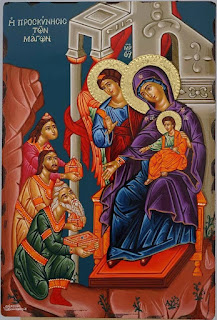
The purpose of the Epiphany season is to remind us, beginning with the arrival of the Magi after Jesus’ birth right up to the Transfiguration on the Mountaintop, of who Jesus is, what God is up to in the Incarnation, and how people recognize the fullness of God in the person of Jesus.

Of course, encounters with God aren’t new. Moses went up to the Mountain and received the law from God. His encounter with God literally left him aglow with the holiness of God.

The amazing thing is that these encounters go both ways. God reveals Jesus. And Jesus reveals to us the true nature of humanity—what God intends for us to be. Notice how in the Gospel today, how on the mountaintop both Moses and Elijah, who represent the fullness of the Law and the Prophets, come to Jesus.

Then in today’s Epistle, we hear Peter, one of the first apostles, talk about how his experience of meeting, knowing, and following Jesus changed him.

Sometimes, when we have these encounters, instead understanding them as the springboard they are, we want to hang on to the moment and to the feelings that come with it. I remember hearing about a man, a devout Christian, who every Sunday night for over forty years, would stand up at his Baptist Church and recount his salvation moment and quote the same passage, John 3:16. It is good to be saved, and good to give testimony, and I am convinced that God wants us to remember his saving love and grace. God also wants to grow and mature in our faith.

Jesus’ disciples also wanted to freeze their mountaintop moment in time by building booths, a kind of religious shelter, to commemorate both the moment and the spot where heaven and earth, law and prophet, God’s time and our time, came together. But just as they are ready to head to Home Depot and buy a do-it-yourself booth kit, a voice from heaven interrupts them and tells them that the way to understand and remember the moment is to listen to and follow Jesus, God’s beloved Son.

The transfiguration reveals Jesus’ true nature, that he is at once fully God and fully human, and also showed us God’s purpose to bring heaven to earth. But, camping out in a building or a shrine, Jesus’ true self is shown as he teaches, heals, and empowers ordinary people to take part in God’s work of reconciling humanity to each other, creation and to God.

In both Moses’ and Jesus’ encounters, our need for God and our need for reconciliation is put square in our faces.

As I said, crisis often reveals character, and we are seeing it again. On this celebration of the Transfiguration, I am mindful of the many people who, in the moment of decision, chose against all odds to do the right thing, for the right reason, in the right way.

One of those people was a man named Allan McDonald. You may not have heard of him, but he was an aerospace engineer for the company that built the solid rocket boosters for the space shuttle, back in the 1980s. Forty years ago, he got into trouble because he refused to certify the launch of the shuttle Challenger slated for January 27, 1986, because he knew that the unusually cold temperatures on the Space Coast that year would make the “o-rings” on the solid rocket boosters brittle and liable to fail. His bosses over-ruled him, and the launch proceeded where, as we all know, the shuttle exploded about 78 seconds into its flight killing the crew. During the investigation, McDonald did not keep silence, and was promptly demoted. It was only after members of Congress threatened to strip the company of all future space and military contracts, that they changed their mind and McDonald was put in charge of rocket engine safety protocols and engineering, and the changes he led allowed the shuttle program to resume.

In an interview after his retirement, McDonald said something which has become something of a mantra for me. He said, “always do the right thing for the right reason in the right way at the right time with the right people and you will never have regrets in your life.” He was a person whose character was revealed in a transfiguring moment.

The late Archbishop Desmond Tutu, who died four years ago at 90 years old, told the story of his own transfiguring moment. It happened when Tutu was 9 years old, while he and his mother were walking down the street at the height of the Apartheid era of his native South Africa. They were approached by tall white man dressed in a black suit. In those days in that place, when a black person and a white person met while walking on a footpath, the black person was expected to step aside, even into the gutter, to allow the white person to pass — and to bow his or her head as a gesture of respect. But that day, before unbelieving eyes of a young Tutu and his mother, it was this white man who stepped off the sidewalk. And as they passed, he tipped his hat in a gesture of respect to her!

The white man was the Rev. Trevor Huddleston, an Anglican priest (later a Bishop) who was bitterly opposed to apartheid. And that tip of the hat changed Tutu’s life. When his mother told him that Trevor Huddleston had stepped off the sidewalk because he was a “man of God,” Tutu found his calling.

“When she told me that he was an Anglican priest I decided there and then that I wanted to be an Anglican priest too,” he said. “And what is more, I wanted to be a man of God.”

Huddleston later became a mentor to Tutu; and he later said that encounter was his ‘transfiguration’ that led to the transformation of a people and eventually a nation.

In his review of Philip Yancey’s book, Rumors of Another World, Keith Parkins talks about the spirit of mercy that pervaded South Africa after Nelson Mandela was released from prison.

“As apartheid drew to an end and Nelson Mandela was released from Robben Island, Mandela could have called upon the blacks to rise up and seek vengeance on the whites,” Parkins wrote. “He did not; he showed grace and appointed Desmond Tutu to head the Truth and Reconciliation Commission. There was an understandable desire for [revenge and] retribution; instead, the path of forgiveness and reconciliation was chosen.”

South Africa’s Truth and Reconciliation Commission was a transfiguring moment for both that nation and the world. The rules were simple — the perpetrators needed to tell the truth, the whole truth; and their victims were given the opportunity to tell the truth of their experience as well. The victims would also be given the opportunity, but not be forced, to forgive. Many of the atrocities were truly horrific. A policeman called van de Broek told of how he and his fellow officers shot an 18-year-old youth, then burnt the body. Eight years later they went back, took the father and forced his wife to watch as he was executed then incinerated in front of her. Many years later, she was in a courtroom and the Commission to hear van de Broek confess. After he was finished, the judge turned to the woman and was asked by the judge what she wanted. 

She said she wanted van de Broek to go to the place where they burned her husband’s body and gather up the dust so she could give him a decent burial; van de Broek agreed. She then added a further request.

“Mr. van de Broek took all my family away from me, and I still have a lot of love to give,” she said. “Twice a month I would like for him to come to the ghetto and spend a day with me so I can be a mother to him.

“And I would like Mr. van de Broek to know that he is forgiven by God, and that I forgive him too. I would like to embrace him so he can know my forgiveness is real.”

Spontaneously, some in the courtroom began singing “Amazing Grace” as the elderly woman made her way to the witness stand. But van de Broek didn’t hear the hymn; he had fainted, overwhelmed. It was a transfiguring moment, where the true character of these persons was revealed. (Read more here.)

It is in moments like these, we see God’s transforming, transfiguring, transcendent love at work infusing our lives, and healing our relationships. In these moments, we see the character of God’s people as they make room for God’s restorative justice to flourish.  

The transfiguration shows us Jesus’ true nature. Here we see the lengths that God will go to reconcile humanity to Godself and to make us the people God meant us to be. He we see Jesus—100% God and 100% humanity, in the same person, undiluted-- on that mountain top. And it here that we see God’s true intention: to restore all people to unity with God and each other and creation, which is the Mission of the Church… our mission. [Look it up! It’s in our catechism (p. 855).] Over and over again, we discover that we can daily cooperate with God’s reconciling work whether it’s a small act of kindness, or a righteous stand for reconciliation, or a bold proclamation of the Gospel. And when we do, we, God’s people the church, shine with Christ’s radiance! And we show our true nature as baptized people whenever we go into the world living practical, useful, transforming acts of justice and love.

This is how we communicate the Gospel and reveal the breadth and depth of God’s love for us and all humanity. Our encounters with the Risen Jesus, on the mountaintop or in everyday life, shows that we have met God’s beloved Son, that we are listening to him, and displays the radiance of Christ for all to see.

+ + +   + + +   + + +

Scripture for the Last Sunday after the Epiphany, Year A, February 15, 2026

Here is the bulletin for Holy Trinity Episcopal Church, Clearwater, Florida for February 15, 2026

Here is the website for Holy Trinity Episcopal Church, Clearwater, Florida 

Here are the videos of the worship services (8 am here at about 17:05 & 10 am here at about 29:28) at Holy Trinity, Clearwater, February 15, 2026

Learn more about the Diocese of Southwest Florida here


Saturday, February 08, 2025

Who will go?

A sermon for the Fifth Sunday after the Epiphany, Year C

Whenever I hear the reading from Isaiah 6 that we just heard… you know, the one beginning with the phrase “In the year that King Uzziah died…,” I can’t help but think of my ordination liturgy. Because this is one of the Old Testament lessons set aside for the ordinations of priests and it was the one read on the day of my own ordination by my dad in his best Armed Forces Radio / Mercury Theater speaking voice. 

The image is a terrific fit for ordinations, which (like my ordination to the Diaconate) often take place in Cathedrals, or in parish churches in small towns (as was my priestly ordination). Either way, it’s an occasion to haul out the best china, polish the best silver, set out the best linens and put on the very best reception that the parish can muster. And trust me… I’ve been to a lot of these, and they are always impressive feeds!

In Isaiah, the Prophet has a vision where we see the Lord, lofty and uplifted on a throne. In a scene that could been drawn by Alan Rohan Crite himself, the  angels have all opened their hymnals and are singing S124 (by David Hurd), S129 (by Robert Powell), S130 (by Shubert) or maybe my personal favorite, S114 (by Healy Willan).

The earth shakes (I’m sure with thunderous organ music, undergirded with a good 16’ subbass or maybe like the 32' Contra Violone as in the National Cathedral). 

All the while, the room is filled with fragrant smokey incense from which an angel picks up a coal from the thurible… the incense pot… and touches it to lips of the Prophet.

But that only happens after the assembly hears the thunderous voice of God asking which one of them will go out and speak the word of God to the people…. Everyone looks around until someone (only one someone, the Prophet Isaiah) waves their hand with excitement saying “Me! Me! Me!” Or in Bible-talk, “Here I am; send me!”

Now that is what I call a call! 

Well, even in the Bible, not every call is so… high church.

Sometimes Jesus’ call happens where we live and work. Take, for example, Peter and his fisherman companions Andrew, James, and John in today’s Gospel. 

Peter was a hard catch. It is clear that Jesus thought he would be a terrific disciple, but Peter was—up until now—a skeptic. When brother Andrew, who had already been following Jesus’ cousin, John the Baptist, told Peter about having seen the Messiah when he saw and then followed Jesus, Peter’s response was “nah!” Actually, it was “hah!” From Nazareth, you say? Nothing good ever comes from Nazareth! Hah!

So Jesus decides that a demonstration is in order. 

You know the story… heck, we just heard it! Peter—who isn’t Peter yet but is still known by his birth name, Simon, along with James and John are busy fishing. Notice that while they are out hauling nets, Jesus is on the shore… on their shore, no less!... preaching to a large crowd. Simon is throwing net after net and comes up empty and he comes ashore as Jesus is finishing up talking. I’ll bet he was hot, tired, and probably a little grumpy. Jesus turns to Simon and says go put out your boat and let down your nets one more time. Simon protests. While you’ve been yapping to that crowd, we’ve been out here working! Can’t you see that there’s nothing to catch? We’ve worked all night long and… Nothing! Nada! Zip! Zilch! But Peter sees Jesus giving him that “look,” so I imagine Simon sighing a sullen “oh-kay” and heading out again, if for no other reason than to prove this travelling rabbi wrong.

But when Simon throws out his net, it is filled near to bursting with fish! So much so that Simon cries for help from James, John and his other friends. They caught so many fish that they filled two boats!

This got Simon’s attention. He falls to Jesus’ knees in both awe and repentance. Jesus stands Simon up and says to him “You think that was something? You just wait! Soon, you’ll be catching people!”

When the Gospels of Mark and Matthew tell the story of how the first disciples were called, they just say that Jesus was walking by the Sea of Galilee, saw Peter, Andrew, James, and John, fishing from their boats, called out “Follow me!” and off they went. But Luke’s Gospel, tells us the rest of the story. Hmm. I wonder why?

Well, Luke’s Gospel and his sequel, the Book of Acts, talks over and over again about encounters with Jesus and his followers that changes lives! We are given a picture of a Gospel message so compelling that people literally drop everything and walk in the way of Jesus.

That call, that invitation, might seem a little overwhelming. I mean, there is so much to do. And life is just so busy. We, like those first followers, were tired, overworked, and not a little bit harried. But Jesus invites us, even in our tiredness to “put out into the deep water.” It’s crazy. But, hey, what have we got to lose? 

Now there’s a catch to this catch. If we are hearing this from the standpoint of scarcity – seeing a church that is not quite as full as we wish—or nostalgia, remembering a church that seemed so much more full once upon a time, or if we are a church committee member looking for how to “sell” our product, we might be disappointed. If that’s all we want, chances are the nets will continue to come up empty. Learning and doing the work of Jesus is the work of the church, not simply adding to the Sunday attendance.

Now don’t get me wrong. I have chaired diocesan evangelism commissions in two dioceses, and trained vestries and church members in the proven techniques of adding and incorporating people into parish communities. That being said, I believe that what’s really important is how we communicate the Gospel in all its colorful fullness to everyone everywhere as they are where they are. 

It is the Good News of Jesus that people are hungry for! And that shows up in all kinds of ways: practical, compassionate, and attentive. 

Letting people know and experience the life-changing love of God in Christ takes all kinds of forms. It might be a feeding ministry to the hungriest and poorest of our community. Or visiting the homebound or shut in or those who living out their last days in a nursing home, hospice, or group home. Or having coffee with that grumpy old widower at the corner café. Or bringing the Sacrament to people who are unable to join their sisters and brothers in Sunday worship for reasons of health, family, or work. And it might be in standing up for the people whom society wants to marginalize, blame for all our problems, or just toss aside—even if we wouldn’t normally be caught dead being seen with them, or if they come from the wrong neighborhood or from a faraway country, with our without papers-- and standing with them, standing tall and proud with them-- anyway.

A disciple is a friend and apprentice of Jesus Christ. And being a disciple of Jesus means learning and doing the work of Jesus every day.

Jesus tells his first followers that they will become fishers of people… that’s the goal of discipleship. As baptized people, you have an incredible opportunity to reach out and become fully present about your surroundings. Weatherman Al Roker always says, “Now let’s see what’s happening in your neck of the woods.” God is inviting us to learn and do the work of Jesus, to experience what’s happening in our part of God’s vineyard, our neck of the woods.

But in these harsh and divided times, who will go? 

Who will raise her or his hand and say “me! me! me!” 

Who will be the first to throw out the net? 

You know, it may be that the most important way to say “yes” to God’s invitation and Jesus’ instruction might simply to smile and to look into the eyes of your neighbor. Our Gospel moment may just be a fleeting personal, face to face connection, and not through a screen. That little I-Thou moment may be just what the doctor ordered for the weary soul of a stranger. 

Maybe the next time you are at the grocery store or waiting to be seated at a restaurant, you can communicate the Gospel simply by intentionally smiling or saying hello to that cashier, bagger, server, or someone in your orbit.  It is likely that both of you will be enriched by that activity. You may even connect with someone who will eventually join you in being a fisher of people. There is no special person assigned to this work. We are all up for the task whether we consider ourselves introverts or extroverts.

It sounds simple, but it’s a start. 

Because fishing for people is not about “selling” our Gospel message… it is about giving and showing the love of Jesus and inviting people to share, even for a moment, in the saving, hallowing presence of God. We baptized people are living Sacraments, outward and tangible signs of inward and spiritual grace. Know it or not, we all point to Jesus. 

And just as Jesus called and invited the fisherman to go into deeper water, so we are called and invited to wade in to everyday life and be the face of Christ to those who seek Him, as we look for the face of Christ in the people God gives us every day.

+ + +   + + +   + + +

Scripture for the Fifth Sunday after the Epiphany, Year C, February 9, 2025

Website for Episcopal Church of the Good Shepherd, Dunedin, Florida

Here is the bulletin for the Fifth Sunday after the Epiphany, C, Feb. 9, 2025 for the Church of the Good Shepherd, Dunedin, Florida.

Here is the livestream of the February 9, 2025 9 a.m. liturgy at Good Shepherd, Dunedin, Florida.


Saturday, February 10, 2024

The adventure of a lifetime!

Imagine the disciples of Jesus. They’ve been following Jesus all around Palestine for about a year and a half. They’ve watched his mission grow from a miracle at a family wedding into one that lavishly feeds four or five thousand people at a sitting.

In all the miles they’ve walked with Jesus, they’ve seen sick people healed, the hungry miraculously fed, witnessed personal encounters with all kinds of people, and seem large crowds come out to hear him. They’ve also seen plenty of controversy and asked plenty of questions.

They’ve heard Jesus praised by everyone from peasants to Roman soldiers, and they’ve heard him criticized—even to the point of threats—by both the rulers of occupied Israel and the religious leaders of the day.

And yet, for all that, this small band of apostles and disciples was not yet a movement, even though people were pretty excited whenever Jesus came to town.

For those first followers of Jesus it was the adventure of a lifetime!

Well, as they say in show biz, “they ain’t seen nothin’ yet!” Because when Jesus invites three of his friends to go with him up on a mountain to pray, they are totally unprepared for what happens next!

On that mountaintop, they see Moses and Elijah talking with Jesus! And then they hear a voice from heaven saying, “This is my Son, the Beloved, listen to him!”

Astonished and afraid, they scramble to do something, anything, to mark the moment! But there is only one thing they have to do: listen to Jesus!

The Transfiguration that we celebrate today is God’s affirmation of Jesus’ humanity and his divinity. And if you want to know and follow Jesus: listen!

It’s natural to want to remember the moment. We have baby books, cherished mementos, and as a sacramental people we know that outward and visible signs points us to inward and spiritual grace… but … listen.

The end of the Epiphany season is marked by the Transfiguration because it’s the ultimate showing of who Jesus is and what he’s up to. We see all of Jesus’ humanity and all of his divinity in the very same person, undiluted, just as it was at his birth, his baptism, all the miracles, healing encounters, and teaching, and in his death and resurrection. The Reign of God has entered the world in the person of Jesus, and we are called to witness to that Good News and invite people to come along!

The Transfiguration and Resurrection both gave the disciples the will to persevere, something bestowed on all of us in our Baptisms. The same God who presides at the Transfiguration of Jesus and tells us to listen to him also promises us that one day we will be transformed into his likeness. As baptized people, that happens every day as we learn and do the work of Jesus.

In baptizing Owen, we are initiating him into the Church, into the Company of Christ’s people, and he will immediately become a full part of the whole Church … not just his family and friends but the whole household of Christ’s people in all time and in every place.

Today we are making a commitment that we… all of us, family, friends, the community of the faithful… will do everything we can to help him come to know God in Jesus so that he will take his place as a follower of Jesus and become a disciple… a friend and apprentice of Jesus Christ!

And that’s why we baptize babies like Owen because we know that Christian people are raised up in Christian households all the time!

It’s definitely a learn-as-you-go process, but Christian formation is not a do-it-yourself project. Raising up a Christian kid requires Christian community in addition to a faithful household. So, just as you will trust teachers to teach, and coaches to coach, and doctors and nurses to do their thing, you will also take part in a Christian community who will accompany you, support you, guide you, and show you the practical nuts and bolts of how to be a follower of Jesus.

So, I say to Owen, what I said to his sister when it was her turn at the baptismal font… welcome to the Jesus Movement! To paraphrase our Presiding Bishop, Michael Curry, Welcome to the Episcopal branch of the Jesus Movement!

Welcome to the Movement that saw in Jesus the fullness of God and humanity in the same person and who listened and followed him and shared the Good News of Jesus with people who were far off and those who were near.

Owen, today is your first trip to the mountaintop with Jesus, the start of an amazing journey of faith that will require time, attention, and intention.

And I also say to Mom and Dad, grands and cousins, sponsors and siblings, help him along the way: take the time to pray with Owen, from grace at the table to nighttime prayers. Share the stories of faith, not only from the Bible or a book of saints, but also from your own journeys (including those pesky questions) and stories of the people you admire. Teach him to hang in there, even when things get rough, confusing, or are not going according to plan.

And as you teach Owen about respect, reliability, doing his chores, good manners, showing up for practice, doing his scales, and all the rest, don’t forget to show him also the rituals of the life of faith, and how to look for God in the everyday and in the people he will meet.

The good news is that you won’t have or need all the answers, because, by God’s grace, you’ll be learning and doing the work of Jesus right there alongside Owen. You’ll be developing with him those seven-fold gifts of the Spirit that we will soon be praying for. So don’t be afraid to show him your own inquiring and discerning heart; show him the courage to will and to persevere; take the time to share the gift of joy and wonder in all God’s works, especially as you see it unfold in this little human whom you present today for baptism.

The Transfiguration is like every mountain top experience… we might like to remain there, but our real task—Owen’s and ours! – is to continue the journey as we go learning and doing the work of Jesus every day.


+ + +   + + +   + + +

Here are the Scripture Lessons for the Last Sunday after Epiphany, February 11, 2024

Here is a video of the Sermon at St. John's, Clearwater, Florida on February 11, 2024.

Here is a video of the Liturgy at St. John's, Clearwater, Florida on February 11, 2024

Saturday, February 18, 2023

When 100 + 100 = 100

How many of you did (or do) photography? I don’t mean the stuff we do today with our phones. While I am not thinkingabout Matthew Brady, glass plates, or "watch the birdie!", I am remembering the stuff done with film and paper and acetate, with chemicals and light. I know I am showing my age, but when I learned this stuff I didn’t know a pixel from little magical creatures with wings.  

But boy it was a whole lot of fun... what great images that technology produced! I still look at the work of Ansell Adams, Margaret Bourke-White, Dianne Arbus, not to mention Nat Geo, Life, Look, and all those great magazines with real appreciation.

I remember one January I took an intensive class in photography that involved everything from snapping the shutter to working in the dark room. After a blizzard, our professor assigned us to take photographs outdoors…when everything was covered with snow. I remember standing still, to let my eyes adjust, I saw footsteps in the snow that covered the steps in front of my college’s library. It was intriguing, and I tried to photograph that. But everything I shot came out, well, white! No detail, no subtleties, no gradation. Just white. 

Nothing I tried could bring out anything except stark differences between what was covered with snow and what was not.  I was ready to throw the negatives out because I was sure I overexposed them.

But my instructor stopped me and suggested two things: first, use very “slow” film and shoot with a very small aperture—the smallest possible opening in the camera lens on the most sensitive film possible. So back I went, this time with a tripod and I stood there in the cold with my thumb on a cable attached to the shutter, to let this very small opening allow the light in through this very small hole for a very long time.

Second, after I developed the negative in the dark room, she suggested that I also do the same thing when I used the enlarger to make the print. She said to use the most sensitive paper possible with the smallest possible opening on the enlarger for a longer time.

It required a lot of patience, but it was worth it!

Instead of the brilliant white blur that came from following the standard settings, less light for longer time produced all kinds of detail.  In fact, more subtlety and detail was revealed than even my eye noticed before I took the picture!

And there they were: footsteps in the snow! It was awesome!

When we hear today’s Gospel story of transfiguration, we tend focus on Jesus on the mountain.  But it’s awe, wonder and mystery of what the disciples saw that holds my attention. 

The thing that catches my eye is not just that Jesus’ glory is revealed—no small thing, to be sure— but how the disciples were changed by the experience.  In other words, Jesus is transfigured so that we may become like him and show him off to others.

To appreciate what God is doing with Jesus and his disciples, and with us in our lives, a different application of light and time is required.

In today’s Gospel we see Jesus standing at the boundaries between heaven and earth, between now and eternity, revealing God’s glory. He is transfigured. He is changed. His countenance glowed, and his clothes were dazzling white.

The disciples experienced both awe and fear at the very same time. They were made helpless, and in their fear and awe they do what people under stress do all the time: they fell back on what they knew. When we are overwhelmed with stress and fear and even trauma, it is like a flashbulb has gone off in our brains, objectivity and rationality are blinded, and we either freeze, flee, or we fall back on what we know.

Peter, James, and John fell back on what they knew. When they experienced a dazzlingly bright Jesus speaking with Moses and Elijah, they decided to freeze the moment. They didn’t have cameras so they did the next best thing: they began to build booths, or little local shrines, to commemorate the moment.

But their plan is stopped dead in the water: God gives them instructions as to how they are to remember the moment. A voice from heaven speaks to them and says: “this is my beloved Son, with whom I am well please. Listen to Him!”

Again, the flashbulb effect in the brain; but this time unable to even go through the motions of the familiar, they just fall to the ground, even more awed, even more fearful.  Jesus comes to them, out of the vision and raises them up out of their fear and leads them back to the daily work following and learning from Jesus. In Mark’s Gospel, the writer wants us to reserve judgment on what glory means until we contemplate the cross and resurrection. Matthew’s Gospel that we heard today sets out some interesting parallels between the mountaintop experience of transfiguration and the crucifixion.

Jesus stops them from making shrines or even talking about what they’ve witnessed because as awesome and as fearful as this glorious moment was, what they will witness in Jerusalem at the cross will be much more fearful and even more awesome.

On the mountain, Jesus garments shine with glory. On the cross, soldiers will gamble over his cloak.

On the mountain, Jesus is met by Moses and Elijah. On the cross, Jesus is crucified with two criminals.

On the mountain, God declares Jesus is God’s son. On the cross, passerby and witnesses will mock and taunt him with these very words.

On the mountain, there are three witnesses: Peter, James and John. On the cross, there are also three witnesses: Mary Magdalene, the other Mary, and Salome, the mother of James and John.

This is why Jesus tells the disciples to hold on to their experience, to keep it to themselves because they won’t get it until after they know the cross and the resurrection. They are to tone down the light and give their exposure more time.

The same is true for us. If we are to understand how we are to know God’s glory, we can’t just focus on the mountain top. There is too much light and not enough time to work it through. We are tempted to look only at or seek only the peak experiences that we forget to look for the holy in the everyday.  The transfiguration points us to the cross and passion of Jesus, yes, but also the everyday, walk on the road, eat with his friends, teaching the stories Jesus.

Our glory, our stepping across threshold from earth to heaven, comes as we contemplate the incarnation, cross and resurrection, and in how we reflect Christ’s glory to the world.

So… how do we reflect Christ’s glory to the world?

There’s a lot of buzz in the Christian (and some secular) media about an ad campaign called “He Gets Us.” Apparently there were two ads put together by group of evangelical Christian churches and business leaders talking about how Jesus “gets us” in all of life’s travails. I missed the ads when they aired during the Super Bowl but took a look on-line. On the whole, I have no particular quibble with them either theologically or stylistically. Yeah, I wish that the folks who funded this weren’t so fervently homophobic—denying the obvious and strong faith of so many LGBT Christians—and also so committed to the rather modern (which is to say inherently unbiblical) concept of complementarianism (you know that male-female relationships are not equal but complimentary… which is a drastic over-simplification, I know, but we don’t have all day….!) So… alright, I don’t agree with some of their theological premises and their ethical implications. So, what else is new? The basic truth in the ads is still right, as far as I can tell.

But the Incarnation and the Transfiguration of Jesus reminds us it’s no longer a one-way street. The basic truth of Jesus’ incarnation is the fullness of God and the fullness of humanity is found undiminished in the person Jesus. The formula that the Church has always understood is that 100% human + 100% divine = 100% Jesus. He is the fullness of God and the fullness of humanity in one person, undiluted. All so we could access God and so that we know that in Christ, God knows the fullness of what it is to be human. In short, “he gets us” so that we may “get” (really “get” in our hearts, minds, and souls) the love of God.

And that’s what we celebrate today. All through Epiphany, we’ve been hearing about and celebrating how Jesus reveals himself as God Incarnate, the Messiah, our Savior and Redeemer. And today, we get a glimpse of the glory that will be revealed again in the cross and resurrection.

So what does show off Christ’s glory? Our compassion shows off Christ’s glory. Our service shows off Christ’s glory. Our worship shows off Christ’s glory. How we are with one another, especially when times are tough, shows off Christ’s glory. Remaining faithful even when don’t have all the answers shows off Christ’s glory. How we work and serve and pray with others, especially when they differ from us, shows off Christ’s glory. How we give of ourselves so that others might be healed, fed, educated, and helped through life’s difficulties, shows off Christ’s glory.

The remarkable thing is that when faithfulness becomes an ordinary part of who we are; when simplicity becomes a normal part of how we live and what we do then Christ’s glory becomes the most apparent. Christ shines through us very often when we are looking the other way. When we look at another, and see nothing but a person that Jesus cares about, then that is when that person is most likely to see the face of Christ and his glory.

When we meet Christ not just on the mountain but at the foot of the cross, we are changed. But how we are changed often shows itself in little ways that we overlook and cannot force. The glory of God is revealed in us but in ways that often surprise us.

It’s just like that darkroom lesson of years ago: The temptation will be to turn up the light, and so overexpose and then wash out the beautiful detail. But a little less brilliance and a little more time will reveal the rich detail and hidden beauty of living as a follower of Christ in ways that we never knew was possible before. 

+ + +   + + +   + + +

Bulletin for Worship for the Last Sunday after Epiphany February 19, 2023 at St. John's, Clearwater, Florida.


Here is a video of the Sermon at St. John's Clearwater, Florida on February 19, 2023.

Here is a video of the Liturgy at St. John's, Clearwater, Florida on February 19, 2023.

Sunday, February 27, 2022

Moments of transfiguration

Sometimes crisis has this way of revealing our true character. When things are moving so quickly that all we can do is react, our true selves sometimes come to light. While sometimes we are shocked and disappointed by what we see, there are other moments when we discover depths of strength and character that we never knew we had.

On this last Sunday of the Epiphany season, we see that happen for Moses, the newly liberated people of Israel fresh from their exodus out of slavery in Egypt, and in Jesus and his disciples who witness his Transfiguration.

Moses went up to the Mountain and received the law from God. His encounter with God literally left him aglow with the holiness of God.

And in the Gospel, we hear today how Jesus encountered on the mountaintop both Moses and Elijah, who represent the fullness of the Law and the Prophets.

Jesus’ disciples want to freeze the moment in time by building booths, a kind of religious shelter, to commemorate both the moment and the spot where heaven and earth, law and prophet, God’s time and our time, came together. But a voice from heaven interrupts them and tells them that the way to understand and remember the moment is to listen to and follow the teachings of Jesus, God’s beloved Son.

The transfiguration revealed Jesus’ true nature, that he is at once fully God and fully human, and also showed us God’s purpose to bring heaven to earth. So, instead of building a shrine, Jesus’ true self is shown as he teaches, heals, and empowers ordinary people to take part in God’s work of reconciling humanity to each other, creation and to God.

In both these encounters, our need for God and our need for reconciliation is put square in our faces.

I’m sure that you have been as shocked and as captivated by the events unfolding in Ukraine as I have. We’re witnessing in real time an autocratic ruler, defined by his own fear-filled, self-serving view of history and surrounded only by people who dare not caution or correct him, brazenly invade a neighboring country whose land, people, and resources he covets. And in the process, we discover in this moment of crisis how character shows itself.

In contrast to the conqueror’s greed, we have seen numerous reports and images of people gathering in prayer both in Ukrainian Orthodox and Ukrainian Catholic churches, as well as in public parks and streets. The Ukrainian people, even those who did not vote for him, have been amazed at the leadership of the former stand-up comic, Volodymyr Zelenskyy. As I write this, his capital city is under attack, but he has not cut and run and neither has he hidden. I suspect that many people felt that he would be a light-weight, who would fold under pressure. Instead, the crisis of the invasion has revealed his true nature and inner character, and that of the Ukrainian people..

As I said, crisis often reveals character, and we are seeing it again. On this celebration of the Transfiguration, I am mindful of the many people who, in the moment of decision, chose against all odds to do the right thing, for the right reason, in the right way.

One of those people was a man named Allan McDonald. You may not have heard of him, but he was an aerospace engineer for the company that built the solid rocket boosters for the space shuttle, back in the 1980s. And he refused to certify the launch of the shuttle Challenger on January 27, 1986, because he knew that the unusually cold temperatures experienced on the Space Coast that year would make the “o-rings” on the booster brittle and liable to fail. His bosses over-ruled him, and the launch proceeded where, as we all know, the shuttle exploded about 78 seconds into its flight killing the crew. During the investigation, McDonald did not keep silence and was demoted. But after members of Congress threatened to strip the company of all future space and military contracts, they changed their mind and was put in charge of rocket engine safety protocols and engineering, and the changes he led allowed the shuttle program to resume.

In an interview after his retirement, McDonald said something which has become something of a mantra for me: he said, “always do the right thing for the right reason in the right way at the right time with the right people and you will never have regrets in your life.” He was a person whose character was revealed in a transfiguring moment.

The late Archbishop Desmond Tutu, who died recently at 90 years old, told the story of his own transfiguring moment. It happened when Tutu was 9 years old, while he and his mother were walking down the street at the height of the Apartheid era of his native South Africa. They were approached by tall white man dressed in a black suit. In those days in that place, when a black person and a white person met while walking on a footpath, the black person was expected to step aside, even into the gutter, to allow the white person to pass — and to nod his or her head as a gesture of respect. But that day, before a young Tutu and his mother unbelieving eyes, it was this white man who stepped off the sidewalk. And as they passed, he tipped his hat in a gesture of respect to her!

The white man was the Rev. Trevor Huddleston, an Anglican priest who was bitterly opposed to apartheid. And that tip of the hat changed Tutu’s life. When his mother told him that Trevor Huddleston had stepped off the sidewalk because he was a “man of God,” Tutu found his calling.

“When she told me that he was an Anglican priest I decided there and then that I wanted to be an Anglican priest too,” he said. “And what is more, I wanted to be a man of God.”

Huddleston later became a mentor to Tutu; and he later said that encounter was his ‘transfiguration’ that led to the transformation of a people and eventually a nation.

In his review of Philip Yancey’s book, Rumors of Another World, Keith Parkins talks about the spirit of mercy that pervaded South Africa after Nelson Mandela was released from prison.

“As apartheid drew to an end and Nelson Mandela was released from Robben Island, Mandela could have called upon the blacks to rise up and seek vengeance on the whites,” Parkins wrote. “He did not; he showed grace and appointed Desmond Tutu to head the Truth and Reconciliation Commission. There was an understandable desire for [revenge and] retribution; instead, the path of forgiveness and reconciliation was chosen.”

South Africa’s Truth and Reconciliation Commission was a transfiguring moment for both that nation and the world. The rules were simple — the perpetrators needed to tell the truth, the whole truth; and their victims were given the opportunity, but not be forced, to forgive. Many of the atrocities were truly horrific. A policeman called van de Broek told of how he and his fellow officers shot an 18-year-old youth, then burnt the body. Eight years later they went back, took the father and forced his wife to watch as he was incinerated in front of her. She was in court to hear that confession and was asked by the judge what she wanted.

She said she wanted van de Broek to go to the place where they burned her husband’s body and gather up the dust so she could give him a decent burial; van de Broek agreed. She then added a further request.

“Mr. van de Broek took all my family away from me, and I still have a lot of love to give,” she said. “Twice a month I would like for him to come to the ghetto and spend a day with me so I can be a mother to him.

“And I would like Mr. van de Broek to know that he is forgiven by God, and that I forgive him too. I would like to embrace him so he can know my forgiveness is real.”

Spontaneously, some in the courtroom began singing “Amazing Grace” as the elderly woman made her way to the witness stand. But van de Broek didn’t hear the hymn; he had fainted, overwhelmed. It was a transfiguring moment, where the true character of these persons was revealed.

Pastor and activist Jim Wallis tells about a time the South African government blocked a demonstration against apartheid during a worship service at St. George’s Cathedral.

“The walls were lined with soldiers and riot police carrying guns and bayonets, ready to close it down,” Wallis said. “Bishop Tutu began to speak of the evils of the apartheid system—how the rulers and authorities that propped it up were doomed to fail. He pointed a finger at the police who were there to record his words.

“‘You may be powerful — very powerful — but you are not God! God cannot be mocked! You have already lost!’ Then in that moment of unbearable tension, the bishop seemed to soften. Coming out from behind the pulpit, he flashed that radiant Tutu smile and began to bounce up and down with glee. ‘Therefore, since you have already lost, we are inviting you to join the winning side.’ The crowd roared. The police melted away and the people began to dance.”

Those of us who love Jesus and who work for God’s justice will carry on that dance in many ways, but let’s be clear: at this moment, there is no dancing in Ukraine. But that same holy defiance and transfiguring power is seen both in the people of Ukraine who gather and pray in parks and streets, and also in the Russian citizens who have bucked their government (and, I am sad to say, their church) in lining the streets in protest, prayer, and candlelight vigils.

It is moments like these, we see God’s transforming, transfiguring, transcendent love at work infusing our lives, and healing our relationships. In these moments, we see the character of God’s people as they make room for God’s restorative justice to flourish.  

The transfiguration shows us Jesus’ true nature. Through it we see God’s true intention, when we cooperate with God’s reconciling work, we—God’s people the church—shine with Christ’s radiance! And we show our true nature as baptized people when we go into the world living practical, useful, transforming acts of justice and love.

+ + +   + + +   + + +

Here is a link to the bulletin for the Last Sunday after the Epiphany.

Here is a link to a video of the liturgy at St. John's Episcopal Church, Clearwater

Here is a link to a video of the sermon.


Sunday, January 09, 2022

Living into our baptismal identity

“You Episcopalians sure do talk about baptism a lot!”

I have heard this comment from some of my Protestant minister friends and colleagues. My best friend from high school, Chuck (who, I am sad to say, died from cancer last year) who a Baptist pastor and dyed-in-the-wool evangelical if ever there was one once told me the same thing.  He commented that we Episcopalians talk about baptism more often that most Baptists! He was raised in the Episcopal Church but his move to the Baptist tradition happened before we Episcopalians fully recovered our baptismal theology with the advent of our present Prayer Book over forty-six years ago.

And he was not alone. Once, a member of my former parish who was getting ready for her confirmation as an adult said the very same thing to me. “You sure do talk about baptism a lot!”

And, you know what? They are right! We Episcopalians do talk about Baptism... a lot!

I don’t remember my own baptism. I bet most of you don’t, either. There are a few of you here who were baptized as adults, but as strange as it sounds that is actually the exception, although it is the norm! If you look closely at the Baptismal rite in our Prayer Book, you’ll find that it is actually designed for adults… so the norm is that we baptize adults, and yet our most common practice is to baptize infants.

I can only guess, but I imagine that my baptism was a quiet affair: just my family, the godparents and the priest at the font of their parish church, which in my case was a place called Truro Church in Fairfax, Virginia. After the quiet Saturday morning or Sunday afternoon baptism, there were probably a feed at the house and lots of baby talk or talk about babies.

Even today, people will still ask me about “christening” their baby. Well, okay, but to me we “christen” ships, and we baptize people. Besides, the image of applying a champagne bottle to a baby is enough to get one turned into the proper authorities!

A strange thing happened in my Christian story that drove home the importance of my own baptismal identity. When I was twenty, I was a student at Drew University in New Jersey and studying religion that was part of the University. During the first week of Michaelmas term (i.e., the fall semester), I was sitting in the refectory across from an older American, an Episcopal priest who was doing his pre-retirement sabbatical studies at the same place. We were chatting about this and that, when I asked him his name. He said “Raymond Davis.” I was stunned! And after a moment, I blurted out “Sir! I believe that you baptized me!” The ordinary meal became a joyous reunion. He remembered my parents and my brothers, and that my dad was his senior warden when they built their new church that opened in 1959 and that I was baptized in the original colonial church that would become their chapel before my family moved to New England when I was toddler.

Our encounter in that Oxford refectory was a startling reminder that we are not baptized to save babies from fiery furnaces. We are initiated into a community of followers, friends, and apprentices of Jesus Christ.

In the first decades of the Church, the earliest Christians changed their understanding of baptism from what John the Baptist did to something entirely new. Jesus’ incarnation, passion, death and resurrection changed how they saw God at work.  And their understanding of themselves as the church, as the Body of Christ, changed, too.

John the Baptist, as we see in Luke, was like an Old Testament-style prophet, telling people to straighten up and fly right. When he baptized it was a kind of an object lesson meant to drive home a point and move people to action. It was a way for a person to demonstrate publicly that they were ready and willing to sign on the prophet’s agenda—which, of course, is God’s agenda. John’s baptism was a sign of repentance, an outward sign of the intention to live life in a new way.

When Jesus asked to be baptized by his cousin John protested. By taking on a baptism of repentance (that John said he didn't need), Jesus proclaimed that not only was he going to set us right with God, but that he was going to take on all the things that separate us from God. It was all apart of Jesus' divine work of setting us right with God, and a sign that Jesus walks with us in our pilgrimage towards wholeness, justice, healing, and peace. 

The earliest Christians understood baptism differently that John. Yes, repentance was a part of it, but the context changed. Instead of simply renouncing something, baptism became a sign that we are putting on Christ. In Baptism, the Apostle Paul would write, we participate in Christ’s death and resurrection, and literally are changed, and we become part of a new community! Think of it this way: in the early Church, Baptism changed from being something very much like an earnest New Year’s resolution into a change of identity and purpose-- a change of our very being!

It didn’t last long. Well before the middle ages, even up to our own day, baptism became a combination of a thanksgiving rite for a safe delivery, and a rite of dedication of sorts. Any talk of conversion, communion, and participation was put off until confirmation. On top of that, until a couple of generations ago, it was simply assumed that being a part of a church was part of what it meant to be in this culture.

Despite some folks who would conflate Christian living and our western or American culture, we live in a world that has largely given up on the need for a common religion and everyone is on their own, in it for themselves. Today baptism, whether for ourselves or our kiddos, is something we choose.

The good news is that this has helped us recover some of the radical implications of baptism: that in baptism we are adopted into Christ’s family the church; that in baptism we put on Christ and seek to imitate him in our ethics and our relationships; and that because of our faith in Christ and because of our baptismal promises we are now taking part in His ongoing work of reconciling humanity and creation to God.

And we have begun to look again at the idea that Christian families in Christian communities can raise up and nurture Christian children.

So that’s why we Episcopalians end up talking about baptism a lot!

You know every year, all of us have birthdays. We generally make a big deal about it. And even people who don’t like to celebrate their age, still mark the day by their studious avoidance of the subject. We don’t remember our births—at least I don’t! — but we need the birthdays to remind us that we are not only alive, but have an identity, a history and that we are important.

We Episcopalians renew our baptismal vows four or five times a year, plus every time we baptize someone new, to remind us that we have a new identity. We are marked as Christ’s own forever. We are his ambassadors of reconciliation. We are members of the Body of Christ. We are a community of baptized people.

All around us in this church are symbols that remind us of this: the font placed in full view in front of the altar reminds us that we come to the Eucharistic feast and the fellowship of Christ’s people through baptism. The “stoups” (that’s what those little fonts by the doors are called) are filled with baptismal water to remind us, as we enter church (and for some, as we go back into the world) that we can carry out the ministries we do precisely because we are adopted daughters and sons of God.

If you have any doubt that we are talking part in God’s work of reconciliation and hope, if you have any doubt that our identity as baptized followers of Jesus makes a difference, then look at this parish: at our outreach, at our Thrift Store, at our worship and music, our Bible Study, and care for each other.

When we renew our baptismal vows, and whenever we baptize a new Christian, we remind ourselves that we have the job of upholding each other in our lives in Christ, and to remind ourselves that we are, in our baptisms, marked as Christ’s own forever.

And that is why we talk about Baptism all the time. We can’t help it. It is who we are.

+ + +   + + +   + + +

Here is the bulletin for St. John's Episcopal Church, Clearwater, FL for Sunday, 1/9/2022

Here is the video of the liturgy.

Here is the video of the sermon.

Tuesday, January 04, 2022

Life in the Big Polis

Updated January 4, 2022.

I have mostly kept my feelings to myself, but I must admit that I am very sad and disappointed that the date January 6th will forever be a date that will live in infamy. 

January 6, 2021 was a Wednesday, and in my former parish, we had a mid-week Noon Eucharist to celebrate the Feast of the Epiphany. Even though it was mainly live-streamed and “You Tubed” because of the pandemic, there were two or three other people besides me taking part in person, we celebrated the last day of the Christmas season by recounting the story of the Magi and the recognition of Jesus as Messiah by representatives of the Gentile world beyond first century Judaism in Roman-occupied Palestine.

The message in Matthew’s Gospel is that Jesus is the Messiah for all people! The Epiphany story of the foreign astrologers who come to worship a new-born king in Bethlehem is nicely bookended at the end of Matthew when Jesus sends out his followers into the all the world to proclaim, baptize, and teach the Gospel.

See the symmetry? The world comes to the infant Jesus to proclaim him king at the start of the Gospel of Matthew; and at the end when the risen Jesus, whose kingship was proclaimed on the cross, is about to ascend to heaven, we, his followers, are sent into the world.

The Season of Epiphany, starting with the visit of the Magi, is all about Jesus being revealed to the world as Messiah and Lord and in every Gospel story at every Eucharist in the coming weeks, we will again experience Jesus being made known as Messiah and Lord.

And then there was Washington, a year ago.

That was a kind of epiphany, too, I suppose. A revealing moment. And just as the Epiphany season will show us God’s true nature in Jesus Christ, the uprising a year ago showed us something of our true nature.

Part of my reaction comes from shock and grief. You see, I am a native of Washington, DC, and it is where “my people” (as my mother used to say) came from. Both my parents and one of my brothers are also natives of The District. I also spent a bit of my childhood in Concord, Massachusetts, where “the shot heard round the world” was fired. I was a Scout, as my father was, when he ushered at one of FDR’s inaugurations. My family story is filled with people who served our country in military and civil service: from soldiers and sailors to librarians of Congress to engineers who built both civic projects and moon rockets. And while I never served in the military, as my Dad and others in my family have, and have never run for elected office, I did my civic turn in volunteer fire and EMS corps, serving on local boards, registering voters, community organizing, and mostly by never, ever, missing an election since the day I registered at 18 years old.

For me, patriotism is not merely a feeling, it’s practical. It is the practical work of the people for the common good of the “polis,” “the city”, which is the root of the word “politics.” I can still recite that part of John F. Kennedy’s inaugural speech in 1961: “Ask not what your country can do for you, ask what you can do for your country.”

One of the people who came to that Epiphany Eucharist was a friend of mine, a Lutheran pastor, who was one of my favorite theological sparring partners. We agreed on much, but we disagreed on plenty, and our plan was to go to lunch after that Noon Eucharist and kibbitz over one thing or another. Ironically, we were reminiscing about my roots in The District, when we first heard of the violence in the Capital.

As we processed the news, we asked the question “where would Jesus be in all this mess?”

The epiphany of January 6, 2021 was that our common life is fragile, and it is all too easy to be given over to fear. Fear is all to easy to be manipulated by selfish ambition. Useful, functional, politics can be easily manipulated by the unscrupulous into corrupt ends or mob rule.

It fascinates me that when Jesus taught, he used the image of “the Kingdom of God” so often. Twenty-seven times, in fact, in the Gospels of Mark, Matthew, and Luke. But instead of talking about an earthly political rule, he was talking about life in the “polis” or “city” of God… about our life together as people of faith. Jesus’ parables typically reflected the surprise of discovering the work of God in the most unexpected places: like yeast in a loaf, like fish in a net, or like mercy coming from a neighbor we were taught to fear and hate.

In the collision between these two epiphanies, the one that shows off who Jesus is, and the one that shows off who we are (or can be, if left to our own impulses), we discover that our life together both as a church and as a nation is at once an act of grace and an act of the will.

We can choose to participate in our common life, where there will be give and take, advances and set-backs, where we will sometimes get our way and sometimes not. We can choose to act as faithful participants or as aggrieved victims. We can tally up our wins and losses, seeking to “get even” or we can choose to learn as we go. We can choose to seek the destruction of others, or we can choose to work together in our common life. It boils down to the lesson many of us learned in Little League, as I did from a wise volunteer coach: A sore loser will never win graciously.

It is perhaps a strange grace that just ahead of this sorrowful civic anniversary, this sad epiphany into the dark corners of our civic life, that we heard all these remembrances after the death of Archbishop Desmond Tutu, who, needless to say, undertook his own struggle against an unjust political system. One thing he said was this:

“My father always used to say, ‘Don't raise your voice. Improve your argument.’ Good sense does not always lie with the loudest shouters, nor can we say that a large, unruly crowd is always the best arbiter of what is right.”

One key to understanding how Jesus understood God’s “polis” is found in the Lord’s Prayer, where we daily pray that God’s will be done on earth as it is in heaven. We pray that heaven will come to earth; and we pray that our life together will in some way mirror what God’s ideal community might be.

My hope and prayer for us is that the Epiphany of Jesus as Messiah and Lord this coming January 6th, will overshadow and leaven the anniversary of that angry insurrection. That instead will come the epiphany that we friends and apprentices of Jesus can in fact live lives of grace, conviction, love, and justice– where our life together is a living parable of what real life is like in the “polis of God!"