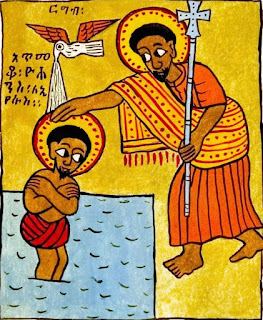
Showing posts with label Baptism. Show all posts

Saturday, January 07, 2023

Believing is seeing

You’ve heard it is said that seeing is believing? Well, I’m here to tell you that believing is seeing.

John the Baptist believed that people were far away from God and needed to repent. John the Baptist saw exactly what the world needed. What the world needed, John saw, was to turn around— people needed a change in direction—away from error, inattention, and imperfection and towards an intentional, deliberate, following of the commandments and traditions of the Law.

Now St. John Baptist was an innovator—he understood that people needed to begin where they were, not where they were not. And for John, the starting place was our sin, our brokenness, and our need for God at the very deepest, most practical level.

He came out from the wilderness and began baptizing people—a strange ritual to be sure, but actually one that was really quite familiar to Jews of 1st Century Palestine. Part of the process for a Gentile convert to become a Jew was, in addition to learning the Torah and being circumcised, was to be ritually cleansed. But John’s innovation was that instead of going to the temple or the synagogue, he baptized in the river. 

To be baptized is to be “dipped.” Have you ever made a tie-dye a t-shirt? Right! You dip it, submerge it, into the tub of dye to make it color you want. The word for baptism is the same word used to describe this process. In first century Palestine, after wool was shaved off the sheep, it was combed out and but before it be turned into thread for fabric, the wool was  dipped into a tub or a vat of bleach. It is immersed and came out changed: all the dirt and all the various shades of brown and gray in the wool came out, ready to be turned into cloth.

John took the somewhat arcane ritual of conversion to Judaism—something an ordinary Jews may have known about but probably never seen—and combined with something a lot of people knew about in their daily lives. He is saying that if you want to get right with God, you had better be converted in your heart and that is a lot like being dipped and made clean.

Believing is seeing. And for John, seeing meant looking at oneself as needed to be made right, cleaned up, fixed up.

Now when Jesus comes along things get interesting. We know that Jesus is the Messiah, but they don’t know that yet! So Jesus when is baptized, some strange things happen. Matthew describes the heavens opening up and the Holy Spirit visibly descending on Jesus. He also describes that the audible voice of God is heard by everyone there, saying about Jesus “This is my Son, the Beloved, with whom I am well pleased.” The voice of God is a word of blessing, not of judgment.

In the process the fullness of the Triune God in the person of the man Jesus is made known for the first time in public.

Now Jesus and John share a mission. Like John, Jesus is aware of how broken, how cynical, how willful, how blind, how prideful all of us are. He knows that we are broken and need to be healed. He knows we need to be in relationship to God.

Jesus sees us differently than John does. John brings a word of judgment because John believes that we are obstinate, stubborn people who need to straighten up and fly right. Jesus brings a word of blessing. Both know we need fixing, but Jesus starts with the truth that God created us and blessed us with an essential dignity that we all carry around and that Jesus’ redeeming work is going to reclaim that dignity for everyone everywhere.

John saw us exactly as we are, and he was not wrong. He followed the model of the Prophets of the Hebrew Scriptures. He thunders at the corrupt leaders and practices around him; he tells us the truth about ourselves and our sin, and John gives us a prophetic sign—baptism—to show us the seriousness of the call to turn around and be renewed.

But Jesus is taking a new, different way. One that begins by his voluntary submission to John’s baptism. He changes John’s baptism from a turning away from sin into a turning towards God. Jesus shows us that God is joining with us: he is walking the way of humanity, he is taking seriously our struggles to lives whole, complete, healthy lives, following the way of the law to love God with our whole being and to love our neighbors as ourselves.

Like John, Jesus sees exactly what we needed. But he sees us through the eyes of the Messiah, not a prophet of the old covenant. Jesus believes that we are made by God with dignity, with creativity and power, and he sees that we are a people who are lovely and worthy of redeeming. So, instead of zeroing in on what is wrong with us; Jesus sees us through the eyes of God’s love.

Believing is seeing. That pretty well describes Epiphany season. Believing is seeing.

Epiphany, from last Friday with the gifts of the Magi, through Jesus’ baptism, and all the way up to the start of Lent on Ash Wednesday, is the season of Jesus showing himself for who he really is. Believing is seeing.

There is an old joke: the optimist sees the glass as half-full, the pessimist sees the glass as half-empty, and the engineer sees a glass that is a little too big for its specified use. We see what we believe.

I believe that God sees us with clear-eyed, unfiltered realism. God sees us for all our foibles, follies, and foolishness and God sees us as God made us to be, with all our potential, all our possibility, and all our power. God sees both our sin and our dignity.

During this Epiphany season, we are invited to see Jesus more and more and to encounter him in word, in sacrament, in scripture, and in Christian community. In the Gospels in these next six and a half weeks, we’ll see again and again the ways that Jesus showed himself. But most of all we will see in Christ how God sees us. As a people who are broken, yes, and as a people who also are lovely, made in the very image of God.

Believing is seeing. Look deep inside and you will, with God’s grace, see yourself just a bit as how God sees you. You will see obstacles and you will see potential. You will see what could be as well as what is. You will know the sin and take it seriously, and you, I pray, accept the forgiveness of the cross and the new life of the resurrection that we took on in our baptisms.

Believing is indeed seeing. It is important that we trust in God with all our being, and love the people God gives us with all our heart because these will change and inform what we see. And, never, ever forget that from the beginning, God always believes in us, and that drives how we are seen. 

+ + +   + + +   + + +

Bulletin for Worship on January 8, 2023 at St. John's, Clearwater, Florida.

Scripture Lessons for the First Sunday after Epiphany: The Baptism of Our Lord

Here is a video of the Sermon at St. John's Clearwater, Florida on January 8, 2023

Here is a video of the Liturgy at St. John's, Clearwater, Florida on January 8, 2023

Saturday, November 05, 2022

Welcome to the club!

If you were to draw up a list of Saints who would you include? Let’s name a few of our favorites: There is St. Nicholas, who is jolly and cuddly and Christmassy. There is St. Anthony, who specializes in helping us find things (and people) who get lost. There is St. Christopher, who protects us from harm. Have a lost cause? There’s a saint for that: St. Jude. And there is St. Valentine, the bearer of romance. Let's lift a pint to St. Patrick, missionary, Irishman (at least by adoption) and football mascot. And let’s not forget our own patron, St. John the Evangelist.

I hate to burst your bubble, but despite the over 12,700 references on Google, there is no “St. Arbucks,” patron Saint of Coffee (Think about it). Sorry.

Well today, I want to add a new name to your list of Saints: Saint Samuel, our candidate for holy baptism today.

You may laugh, but I am not kidding.

When we talk about saints, we might talk about what makes a saint, well, famous. What gets a college or city named after one? We could talk about their sacrifices, their perfection, their witness, and their selfless deeds. Last Friday, one of my spiritual heroes, Dorothy Day, got the newest Staten Island Ferry named after her. How cool is that?

Today we hold up the “rank and file” saints, the ones who don’t necessarily get a day set a aside for them. But like the more famous capital “S” saints they all communicated Jesus to others, often one relationship at a time. These saints exhibited Christ even when they didn’t feel like it, know it, nor even understand it. Most of these saints don’t have a name or a date, but I think you may know one or two.

Christianity is passed along by word of mouth, by example, and through relationship. No one ever comes to faith entirely by themselves. We are all brought to and sustained in our faith, because someone or some people, brought us and nurtured us. These people were and are God’s ambassadors of reconciliation—showing off Jesus—and inviting those around them to come along.

Which is why Episcopalians, like a lot of other Christians in other traditions, baptize babies like Samuel. We believe that Christian households can and do raise up Christian children into active, productive, friends and apprentices of Jesus Christ.

One of the things that Samuel will learn is that saints are by definition imperfect. They will have live breathing examples of that, and probably in about twelve to fourteen years from now they will let you know. But that’s okay. No one is totally pure and no one is above corruption in thought, word and deed. Not one has ever completely put aside any one or all of the seven deadly sins. If you talk to a person whom you or I might consider saintly, they would probably be startled and think you were making mountains out of molehills.

I’ve never met a firefighter who was a hero. Not one. When you tell them they are heroic, which is especially fashionable these days, they will deny it and tell you that they are only doing their job. Most saints are just the same way.

Remember, in the early Church, “saint” was the term used to describe all followers of Jesus. All of us who live attempting to imitate Christ get the title “saint.” The first step to sainthood is to decide to follow Jesus. The entry point is baptism.

At the same time, saints are made not just born(-again!). Ask Saint Paul about the saints with whom he dealt through his correspondences we call Epistles. The saints in Corinth were willful and quarrelsome and others were sexually irresponsible. There were saints in Philippi who used their position in church for purely selfish ends. Even big-shots like Peter and Barnabas could act like hypocrites. And Paul himself admitted to the saints in Rome that even he did not understand his own actions—he did things he did not want to do, the very things he hated.

Sainthood should not be confused with being “nice.” Even Mother Teresa was known not to be nice all the time. But that’s no surprise because if you’re focused on caring for the poorest of the poor you might end up ruffling a few feathers.

Living into our saintliness is not about niceness but about newness. I remember a lesson from a priest when I was a boy, who pointed to all the pictures of saints around my home parish rendered in brightly colored stained glass. I remember him saying that we are all like those saints because saints are people the Light shines through.

As we welcome young Samuel into the fellowship of the Church and into the company of saints, I won’t need to tell experienced parents like Kimberly and Garret that there will be days when your little saint will seem like an angel, and days when he will be… well… won't. And that’s okay, because you know that’s already true about yourselves and all the others of Jesus’ people in your life and in this parish community.

In today’s Gospel, Jesus describes what it means to be blessed before God. He is also talking about what it means to be a saint—to be a regular, ordinary, everyday follower, friend, and apprentice of Jesus.

“Blessed are you who are poor,” Jesus says, “for yours is the kingdom of God.”
“Blessed are you who are hungry now, for you will be filled.”
“Blessed are you who weep now, for you will laugh.”
“Blessed are you when people hate you, and when they exclude you, revile you, and defame you on account of the Son of Man. Rejoice on that day and leap for joy, for surely your reward is great in heaven.”

Being blessed, Jesus says, comes from finding our focus just a bit more, day by day, on what God would have us be. And as we listen to God’s voice, and respond to God’s grace, we find that walking the way of Jesus touches lives in ways we can hardly imagine. The late pastor and writer Frederick Buechner wrote:

As we move around this world and as we act with kindness perhaps, or with indifference or with hostility toward the people we meet, we are setting the great spider web atremble. The life I touch for good or ill will touch and other life, and that in turn another, until who knows where the trembling stops or in what place my touch will be felt.

You are here, and you have brought Samuel and his siblings with you, because some place, somewhere, a saint touched you. Somewhere, sometime, you have touched another human being with grace. Somewhere someone cut you a break, told you the truth in love, or cared for you in a moment of crisis. Somewhere someone showed you what it was like to be touched by God. And, having been touched by the holy, you said “I want to do that, too” and that’s when you took another step towards your own saintliness. And now you want to communicate that ineffable quality and that eternal truth to your children and through them to your children’s children. God’s love touched you. You became a follower of Jesus. And you want that for your kids as well.

Saintliness is about newness--choosing to live this one day in one new way--choosing compassion over selfishness, mercy over revenge, kindness over disregard. Choosing just for this moment to serve God in the people God gives us and to look right now for Christ in the people we are given. 

As Saints go, you may think we have a way to go. When Samuel doesn’t pay attention to his feeding or sleeping schedule or as he touches things, and plays with Olivia’s and Hunter’s things, or he discovers new ways to go his own way, you may wonder about Samuel’s saintliness. But you have brought him here anyway.

Well, welcome to the Club, Samuel… the Communion of Saints, the fellowship of Christ’s body, the People of God. You will discover that we Jesus People are a strange lot. We may at times be quarrelsome, strident, short-sighted and at times ignorant or hypocritical, that’s for sure.

It’s true. We are not perfect, we saints; but we are everyday discovering newness. For all our foibles (and yours yet to be revealed) we are together learning and doing the work of Jesus, and just like all those other saints, we learning to let the light shine through.

+ + +   + + +   + + +

Here is a link to the bulletin for the Sunday after All Saints  at St. John's Episcopal ChurchClearwater

Saturday, August 06, 2022

On not being defined by fear

Have you ever collected fortunes? You know, those little paper sayings that come inside of cookies at Chinese restaurants? Every now and then one will come along and I will stick in my wallet or pin it to my bulletin board.

Sometimes I will look at the bulletin board, read a fortune and wonder what possessed me to keep it. Surely it was not how to learn how to say “cat” in Chinese. It must have spoken to me somehow!

One I found didn’t sound very Chinese but did sound very much like Jesus, so I kept it. It says: Your faith will overcome your fear. 

Today, in the Gospel, we have also have a collection. Not of fortunes, but sayings of Jesus.

First, Jesus reminds us not to be afraid. “Do not be afraid, little flock, for it is your Father’s good pleasure to give you the kingdom” (12:32).  

Next, we he exhorts us to make treasure for ourselves in heaven that no thief or moth can steal or destroy.

Then we hear Jesus spin a scenario where he talks about the blessedness of the servants who are dressed and ready for action with their lamps lit when their master returns. How pleased is the master? He is so pleased that master serves the servants dinner!

Finally Jesus tells us to be watchful and ready. As ready as a homeowner keeping an eye out for burglars.

It sounds reasonable, doesn’t it? We make indestructible treasures for ourselves and making them is what the master should find us doing when he returns. It is how we stay ready for his imminent arrival.

Except that we are distractible, afraid and anxious. Like the urge to touch a wall when the sign says, “wet paint”, when we are told not to be anxious, that’s all we can think about. You parents know this: there is always someone out there, on television, social media, the internet, even friends and family who are always telling us to “look out!”, “be careful!”, or sharing some story of a disaster that has befallen another family with another baby or child.

It’s true, we always want to be ready, just in case! I carry an umbrella in my car. Just in case it rains. And guess what happens: when I am in the office and it starts to rain, I will get wet running to my car to get that umbrella!

We human are funny critters! Try as we might, sometimes even those of us with the deepest faith will choose to look at life through the lens of our fears. And I don’t mean the fear of the Lord (the deep awe and reverence for God) that the Bible tells us repeatedly is the beginning of wisdom. I mean the mis-placed faith that, so long as we are anxious, chaos will be kept at bay from our personal cosmos. I mean the faith that our anxiety forms a protective shield around our life. It results in the fear that, if I feel a moment of peace, must be because there is something I’ve overlooked. This is what turns faith into superstition!

In today’s passage from Luke, Jesus tells us not to be afraid, but that doesn’t mean we are to be passive or asleep at the switch. We are instructed to be dressed for action, to have our lamps lit, to be prepared for the return of the master, to make purses for ourselves that do not wear out, to place our trust in an unfailing heavenly treasure that no thief can steal, and no moth can consume (12:33).

We are all wrong about fear. We think it is our protective shield. But it turns out that fear is the thief. When we dwell on our fears and our anxieties, they become our treasures. Jesus says, “Where your treasure is, there will your heart be also” (12:35). Faith is the genuine treasure we are to be accumulating, but we get it backwards when our fears fill our hearts and faith can’t get in.

The bad news is that we are householders whose homes are threatened by the fear that has come to steal our faith. 

The good news is that we do know when the thief is coming. The thief is fear and anxiety. We know it's there by our racing heart, our fitful sleep. When the "what ifs" and the "if onlys" begin to dominate our thinking, then we know the thief of anxiety is trying to break in! So how can we keep our house of faith from being broken into by fear and anxiety?

Jesus tells us that if the householder had known at what hour the thief was coming, he would not have let his house be broken into. Well, we do know! And Jesus promising us the resources to keep fear from stealing our faith. He is promising to turn the tables and to empower our faith to counter-act our surplus of anxiety and fear.

When I was a Chaplain, I knew a doctor who was Hindu. He talked once about how to cope with the stress of modern life, “Live in the past and you will be depressed. Live in the future and you will be anxious. Live in the present with gratitude and you will be at peace.” For the Christian the message is that that we need to be preoccupied, but not with fear and anxiety. We are invited to be preoccupied in the present looking forward with Christ into God’s hope-filled future.

As we learn to pray and discover that even the most mundane, everyday chore is also a prayer—both a gift from God and a gift to God—then we find our orientation changing from fear and towards faith. From scarcity into abundance.

In baptizing AJ today, you are introducing him to the rhythm of sacramental living—of Eucharistic community, daily prayer, and studying and meditating on God’s word together in church and as family and even by yourselves—and are also  inviting him to join you—the parents, sponsors, friends, family, and this Christian community—into a lifelong process of immersing yourselves in God’s time, into God’s always unfolding present!

The last time I cleaned out my wallet, I found two old fortunes:

“An unexpected event will bring you wealth,” and “If you put up with small annoyances you will gain great results.”

Who knows why I kept them? Who knows if they will come true?  But move over fear and anxiety, here are some promises of Jesus that are far more reliable than any fortune cookie fortune! Jesus’ promises, which are about to renew and take on with AJ, answers the fears beats in our hearts and breathes in our communities:

Strive for God’s kingdom and these things (food, drink, clothing) will be given to you as well.” (Luke 12:31)

“Do not be afraid…, for it is God’s good pleasure to give you the kingdom.“ (Luke 12:32)

+ + +   + + +   + + +

Here is a link to the bulletin for the Ninth Sunday after Pentecost  at St. John's Episcopal Church, Clearwater

Here is a link to a video of the sermon.


Here is a link to a video of the liturgy.

Saturday, June 04, 2022

Baptized into Christian Community

A few years back, a Christian cartoonist named Cuyler Black came out with a line of funny Christian greeting cards called “Inherit the Mirth.” The cover of each card contained one of his single panel cartoons imagining a silly (sort-of) Biblical scene, with a clever greeting on the inside. One of my favorites was titled “John the Baptist as a Kid” and it showed a boy standing next to a bathtub filled with water. He is holding a very wet cat, and next to him were a dog and a parrot, also dripping wet and looking very confused. An exasperated Elizabeth  says from another room “Honey! For the last time-- stop doing that to the pets!

I chuckle every-time I think of this cartoon because while John the Baptist appears nowhere in today’s lessons, it summarizes very nicely the challenges of living in a household, raising a child, all the while attempting to raise that child with a cogent, useful, and authentically held Christian faith.

Needless to say, I am still living in the glow of this new things called “grandparent.” And I hope I never lose that sense of awe and wonder. All it takes is a little smile from a certain little baby and I get all mushy inside. But this is not a new feeling… I’ve had it with my own children… as well as awe and pride at the people they are today. Part of the “mushy” is that I am getting to know this brand-new person who doesn’t know how to be anything but her complete, honest, direct, vulnerable self. And we are already watching Josephine grow… already a distinct personality, but how she will be in the future is a mystery still to unfold.

By bringing her to this community to be initiated into the Church, into the Company of Christ’s people, we are saying that not only will Josephine be a full part of the Church, she will be fully a part of us… not just her immediate family and friends, but the family and household of Christ’s people in all time and everywhere. We are also making a commitment that we… all of us, family, friends, congregation, the community of the faithful… will do everything we can to help her come to know God in Christ and herself as a follower of Jesus and to become a disciple… that she will live her life as a friend and apprentice of Jesus Christ.

The thing is that she will be attending the toughest, most transparent… and the most awkward… Church School there is. Not the one in this parish… although I know that Miss Mary can’t wait to have Miss Josephine join the crew! No, I mean the one in her home. It will be there that she will learn all the wonder and the love and all the possibility, hope, and security of a family daily learning how to be a family. And she will learn firsthand that Jamie and Johnny, her first teachers in the faith, are imperfect, have bad days, and don’t always have all the answers. In about ten to thirteen years, you parents will be begin getting feedback on all those gaps. (Don’t ask me how I know this!).

But that’s okay because we know that by baptizing babies like Josephine that Christian people are all the time raised up in Christian households. Not perfect, but faithful in an everyday kind of way.

Now, if you parents are smart, you won’t try to do this alone or on your own. Just as you will trust teachers to teach, and coaches to coach, and doctors and nurses to do their thing, you will also take part in a community like St. John’s to accompany you, support you, guide you, and show you the practical nuts and bolts of being a person of Christ.

So Josephine… welcome to the Jesus Movement! To paraphrase our Presiding Bishop, Michael Curry, Welcome to St. John’s branch of the Episcopal branch of the Jesus Movement!

Welcome to the Movement that received the gift of the Holy Spirit as it came to Jesus’ first followers on Pentecost. That Spirit took a frightened pack of disciples and empowered them to become a brazen bunch of evangelists and ministers who shared the Good News of Jesus with people who were far off and those who were near to their Jewish faith, including people from all over the known world. People who spoke all kind of languages, had all kinds of customs, and all kinds of traditions.

As I’ve said, this baptism that we are about to do is not simply an event to be recorded in the baby book. It is the beginning of an amazing journey of faith that will require time, attention, and intention. Take the time to pray with your child, from grace at the table to nighttime prayers. Share the stories of faith, not only from the Bible or a book of saints, but from your own faith journey (including the questions you struggle with) and the people you admire. Teach her to hang in there, even when things get rough, confusing, or are not according to plan. As you teach Josephine about respect, reliability, doing her chores, manners, showing up for practice, and all the rest, don’t forget to show her also the rituals of the life of faith, and how to look for God in the everyday.

This may come as a shock to you, but as you do this work as a parent, you won’t have to have all the answers. You just have to model that you too are developing those very same seven-fold gifts of the Spirit that we will soon be praying that Josephine will experience. So, show her your own inquiring and discerning heart, take a deep breath and show what it takes to have the courage to will and to persevere, take the time every day to share the gift of joy and wonder in all God’s works, especially as you see it unfold in this little person whom you present today for baptism. Because you are—all of you—growing on your faith journeys together.

They call Pentecost "the birthday of the Church" (and I understand that there is cake after Church in coffee hour!) So imagine, the Holy Spirit saying to all of us "welcome to the Church!"

Because what we are doing today is also an object lesson for the rest of us on how to be a Christian community. No Christian is a solitary Christian. So here's what we do. We pray together. We dare to have the courage to be vulnerable. We are discovering that it is okay to trust God while not having all the answers. We show up and are together, even when things are confusing, strange, uncertain, or (gasp!) boring. Because how we choose to be a community of believers together demonstrates how to be faithful to each other, our children, our grandchildren, our neighbors, the community, and the members of our households.

Pentecost was not the only time or the only way that the Holy Spirit arrives. God’s spirit is still present in a mighty way. For when we encounter nothing less than the presence of God in the people God gives us in all their variety, we come to know that we cannot limit who God is and how God acts, no matter how we might try. We who follow Jesus and have been baptized into his Church are called to act on our love of God as much as those first disciples were called to share God’s love. We are to share the love of God freely, without trying to limit who God might love.

All of us from Josephine, our newest member, to those who remember when this congregation first gathered more than fifty years ago, and everyone in-between, we all share the same call: we are to take this Good News that God loves us, and share that gospel in our deeds as well as our words with everyone we meet, and as we leave our worship, going in peace to love and serve the Lord (Alleluia times 3!), we are empowered by nothing less than God’s Holy Spirit, who meets us where are and by grace transforms us into Christ’s people, the people God made us to be. 

+ + +   + + +   + + +

Here is a link to the bulletin for the Feast of Pentecost at St. John's Episcopal Church, Clearwater

Here is a link to the Scripture readings for Trinity Sunday

Here is a link to a video of the sermon.

Here is a link to a video of the liturgy. 

Sunday, January 09, 2022

Living into our baptismal identity

“You Episcopalians sure do talk about baptism a lot!”

I have heard this comment from some of my Protestant minister friends and colleagues. My best friend from high school, Chuck (who, I am sad to say, died from cancer last year) who a Baptist pastor and dyed-in-the-wool evangelical if ever there was one once told me the same thing.  He commented that we Episcopalians talk about baptism more often that most Baptists! He was raised in the Episcopal Church but his move to the Baptist tradition happened before we Episcopalians fully recovered our baptismal theology with the advent of our present Prayer Book over forty-six years ago.

And he was not alone. Once, a member of my former parish who was getting ready for her confirmation as an adult said the very same thing to me. “You sure do talk about baptism a lot!”

And, you know what? They are right! We Episcopalians do talk about Baptism... a lot!

I don’t remember my own baptism. I bet most of you don’t, either. There are a few of you here who were baptized as adults, but as strange as it sounds that is actually the exception, although it is the norm! If you look closely at the Baptismal rite in our Prayer Book, you’ll find that it is actually designed for adults… so the norm is that we baptize adults, and yet our most common practice is to baptize infants.

I can only guess, but I imagine that my baptism was a quiet affair: just my family, the godparents and the priest at the font of their parish church, which in my case was a place called Truro Church in Fairfax, Virginia. After the quiet Saturday morning or Sunday afternoon baptism, there were probably a feed at the house and lots of baby talk or talk about babies.

Even today, people will still ask me about “christening” their baby. Well, okay, but to me we “christen” ships, and we baptize people. Besides, the image of applying a champagne bottle to a baby is enough to get one turned into the proper authorities!

A strange thing happened in my Christian story that drove home the importance of my own baptismal identity. When I was twenty, I was a student at Drew University in New Jersey and studying religion that was part of the University. During the first week of Michaelmas term (i.e., the fall semester), I was sitting in the refectory across from an older American, an Episcopal priest who was doing his pre-retirement sabbatical studies at the same place. We were chatting about this and that, when I asked him his name. He said “Raymond Davis.” I was stunned! And after a moment, I blurted out “Sir! I believe that you baptized me!” The ordinary meal became a joyous reunion. He remembered my parents and my brothers, and that my dad was his senior warden when they built their new church that opened in 1959 and that I was baptized in the original colonial church that would become their chapel before my family moved to New England when I was toddler.

Our encounter in that Oxford refectory was a startling reminder that we are not baptized to save babies from fiery furnaces. We are initiated into a community of followers, friends, and apprentices of Jesus Christ.

In the first decades of the Church, the earliest Christians changed their understanding of baptism from what John the Baptist did to something entirely new. Jesus’ incarnation, passion, death and resurrection changed how they saw God at work.  And their understanding of themselves as the church, as the Body of Christ, changed, too.

John the Baptist, as we see in Luke, was like an Old Testament-style prophet, telling people to straighten up and fly right. When he baptized it was a kind of an object lesson meant to drive home a point and move people to action. It was a way for a person to demonstrate publicly that they were ready and willing to sign on the prophet’s agenda—which, of course, is God’s agenda. John’s baptism was a sign of repentance, an outward sign of the intention to live life in a new way.

When Jesus asked to be baptized by his cousin John protested. By taking on a baptism of repentance (that John said he didn't need), Jesus proclaimed that not only was he going to set us right with God, but that he was going to take on all the things that separate us from God. It was all apart of Jesus' divine work of setting us right with God, and a sign that Jesus walks with us in our pilgrimage towards wholeness, justice, healing, and peace. 

The earliest Christians understood baptism differently that John. Yes, repentance was a part of it, but the context changed. Instead of simply renouncing something, baptism became a sign that we are putting on Christ. In Baptism, the Apostle Paul would write, we participate in Christ’s death and resurrection, and literally are changed, and we become part of a new community! Think of it this way: in the early Church, Baptism changed from being something very much like an earnest New Year’s resolution into a change of identity and purpose-- a change of our very being!

It didn’t last long. Well before the middle ages, even up to our own day, baptism became a combination of a thanksgiving rite for a safe delivery, and a rite of dedication of sorts. Any talk of conversion, communion, and participation was put off until confirmation. On top of that, until a couple of generations ago, it was simply assumed that being a part of a church was part of what it meant to be in this culture.

Despite some folks who would conflate Christian living and our western or American culture, we live in a world that has largely given up on the need for a common religion and everyone is on their own, in it for themselves. Today baptism, whether for ourselves or our kiddos, is something we choose.

The good news is that this has helped us recover some of the radical implications of baptism: that in baptism we are adopted into Christ’s family the church; that in baptism we put on Christ and seek to imitate him in our ethics and our relationships; and that because of our faith in Christ and because of our baptismal promises we are now taking part in His ongoing work of reconciling humanity and creation to God.

And we have begun to look again at the idea that Christian families in Christian communities can raise up and nurture Christian children.

So that’s why we Episcopalians end up talking about baptism a lot!

You know every year, all of us have birthdays. We generally make a big deal about it. And even people who don’t like to celebrate their age, still mark the day by their studious avoidance of the subject. We don’t remember our births—at least I don’t! — but we need the birthdays to remind us that we are not only alive, but have an identity, a history and that we are important.

We Episcopalians renew our baptismal vows four or five times a year, plus every time we baptize someone new, to remind us that we have a new identity. We are marked as Christ’s own forever. We are his ambassadors of reconciliation. We are members of the Body of Christ. We are a community of baptized people.

All around us in this church are symbols that remind us of this: the font placed in full view in front of the altar reminds us that we come to the Eucharistic feast and the fellowship of Christ’s people through baptism. The “stoups” (that’s what those little fonts by the doors are called) are filled with baptismal water to remind us, as we enter church (and for some, as we go back into the world) that we can carry out the ministries we do precisely because we are adopted daughters and sons of God.

If you have any doubt that we are talking part in God’s work of reconciliation and hope, if you have any doubt that our identity as baptized followers of Jesus makes a difference, then look at this parish: at our outreach, at our Thrift Store, at our worship and music, our Bible Study, and care for each other.

When we renew our baptismal vows, and whenever we baptize a new Christian, we remind ourselves that we have the job of upholding each other in our lives in Christ, and to remind ourselves that we are, in our baptisms, marked as Christ’s own forever.

And that is why we talk about Baptism all the time. We can’t help it. It is who we are.

+ + +   + + +   + + +

Here is the bulletin for St. John's Episcopal Church, Clearwater, FL for Sunday, 1/9/2022

Here is the video of the liturgy.

Here is the video of the sermon.

Sunday, January 11, 2015

Can you come out and play?

At the Baptism for Daniel Kaimalino O Hawaii Hauanio - January 11, 2015

There is a great cartoon by Cuyler Black. It shows a kid holding a dripping wet cat over a washtub. Near him is an equally wet bird and a soaked dog. A voice from the other room says “Honey! For the last time, stop doing that to the pets!” The cartoon is titled: “John the Baptist as a kid.”
Sometimes I wonder what John the Baptist was like as a kid. Or for that matter Jesus? What was he like as a kid?
So was John the kid who not only played by the rules on the playground but protested when he thought the rules weren’t being followed? I wonder if he liked structured games or inventive play? Did he go off by himself in the woods for long periods of time? Did he like dressing differently than the other kids at school? When other kids had PB&J for lunch, did he eat bugs? If he had them, would John the Baptist have worn blinky shoes? Who knows?
Every Christmas and Advent, we hear a lot about Jesus’ nativity and a very little bit about John the Baptist’s. That’s because we really don’t know very much about their childhoods. Luke’s Gospel tells us that John is Jesus’ cousin and that his parents were very old. And that’s pretty much it about John. We have only two stories from Jesus’ childhood…the visitors who came when he was an infant—some scholars think he might have been as old as two when the Magi finally showed up—and we hear that he was a precocious kid who could teach experienced rabbis a thing or two.
In any event, it is easy to imagine John’s parents Elizabeth and Zechariah, and Mary and Joseph for that matter, asking themselves “how will this kid turn out?”
If you think about it, what we are doing in baptizing Daniel is nothing short of audacious and a little bit risky.
Have you ever noticed that the baptismal rite in the Book of Common Prayer is mainly for grownups?  The expectation in the Episcopal Church is that baptism is mostly for adult converts to the Christian faith. The paragraphs about infants and young children appear as exceptions—special cases. But in real life we do the exceptional thing most often and the normative thing only occasionally.
So why not wait? Why not wait until the child is old enough to decide for themselves? Why not make all baptisms adult baptisms? Some Christian traditions believe that and act on it. But they face the same challenge we face: can a Christian household raise Christian children? Can children be a complete part of Christ’s Church? And can children exhibit holiness and experience God in their lives?
We believe the answer to all those questions is an emphatic “yes!” Christian households can and do raise Christian children. Children can and do experience the holy. Children can and do take complete part in the life of Christian community.
Some people hold off any Christian or religious formation until, they think the children can decide for themselves.  God can do anything and we have here many people who were raised in non-religious households who have an amazingly energetic faith—but here’s why I think that if you have the chance to raise your kid in the faith you should go for it with gusto.
How can children decide on something like their spiritual and religious lives if they have nothing to compare it with? Teaching them from your faith tradition gives a grounding and a baseline from which they can compare experiences.
Waiting sends the message that spirituality is not very important or that at best our faith is a secondary issue, akin maybe to a hobby.
But there’s more. Do we wait to teach our children other life skills until they need them? Imagine holding off teaching arithmetic until they are old enough to have a checkbook? Or reading until they are old enough to work? Or manners and self-care until they have to live on their own and can make up their own minds?
No, the reality is that we share our experience, teach them the joy and wonder of learning early so that it is part and parcel of their lives. Children live to learn. They vacuum of knowledge like little dust-busters. This goes for things spiritual and religious as well.
Beside, like it or not, we can’t hold back from teaching our kids ethics and values—including spirituality and what we believe about our place in the universe— because we do it all the time! Every single day! Kids watch and take in everything we do—and they take from that what we believe, how judge good from evil, and what values we bring to our relationships. They see how we make rules…and break them. They see how we treat people, about listen to how we talk about those who differ from us. They know what scares us and empowers us. Your home is the most important Sunday school they will ever know. It’s built in to what it means to be family.
Here’s the rub. Along all the other things we don’t automatically know how to do when we become parents, we do not know how to enter into a spiritual journey with our children.
If I am not so hot on prayer, how can I teach my kid to pray? If my faith is sometimes shaky—sometimes I wonder if I even have faith—how then can I teach my kids about faith? If I don’t know Bible stories, how can I teach them? Wouldn’t that make me some kind of hypocrite? Actually, no. What that makes you is a fellow-traveler.
The point is not perfect mastery of the information; the point is that you and your children are walking the life of faith together. You are entering a spiritual journey together.
By bringing Daniel for baptism, just as you did when you brought Lexi, you are entering into a spiritual journey where you are not only helping them in their formation, they are forming you. And you are bringing them into a community of fellow travelers. Places like Trinity are probably one of the last places left in our culture where people of different generations and where people with and without children all willingly come together in one place, routinely. All of us--parents and singles, grandparents and couples without kids--all of us come together to do the same thing: we discover, share, and learn God’s love. Together we live Good News and tell each other—and the world—what we have seen and heard.
When John the Baptist was baptizing in the Jordan River just before Jesus came along, he was telling people that to really get the most out of their life of faith they had to get involved with their own faithfulness. He baptized because he was telling everyone that the spiritual life is not something that happens to you but something you do. God wants our participation. God wants us in the game.
As the cartoon on the back our bulletin says, Jesus was baptized so that we would know that he is taking on everything that life brings. This will eventually lead him to the wilderness for testing, into people's lives where he will meet people's suffering, to the places where he will teach and even to the cross. His baptism tells us that Jesus lived life by total immersion. Our baptisms is the beginning of life lived in total immersion! 

In bringing our children before God in the community of God’s people, we are also bringing ourselves. By participating with our kids in our mutual spiritual lives-- bringing them to church and worshiping with them, by receiving communion together, by taking time to pray before meals (even in the fast-food place), by allowing questions to be asked and, when we have to, by allowing ourselves the grace to say “I don’t know, I’m still working on that one…” and by working through the hard questions and hard choice together--we will discover that God is involved in every aspect of our living …good and bad, fun and routine, hard and easy.
Just like our children, we are on a spiritual journey of discovery. Our children invite us to take the time to play and pray so that we may discover how to follow Jesus in all that life brings.

Wednesday, April 23, 2014

Living baptism by immersion

A Sermon for the Easter Vigil, March 19, 2014
At the baptisms of Melissa Ashley Bilza and Jessica Rose Floray
Once upon a time a man walked into a small country church and asked the preacher about being baptized. After some conversation, the pastor agreed and on the following Sunday the two men along with the members of the small church gathered at the river for the big moment.
They waded into the river, and the preacher took the man by the shoulders and shouted “Do you believe?”  “Yes!” the man said, and with that the preacher pushed him way under the water until the bubbles got smaller and smaller and then after a moment pulled him up.
“Do you believe?” the preacher shouted again. Spouting water from the first question but still determined, he nodded his head and once again the preacher pushed his head under the water and then after a moment, pulled him to his feet.
A third time, the preacher shouted into the man’s face “Do you believe?”
The man pushed the preacher away and said, “Yes! I believe! I believe you’re trying to drown me!”
All of which is to say that Baptism can be a little overwhelming.
While we did not march down the Delaware and we will not dunk Melissa and Jessica in the river, and just because I am going to pour water on your heads at that font, don’t think for one minute that we Episcopalians don’t immerse.
Episcopalians live our baptisms through immersion. Every day.
Take tonight’s liturgy. What we did today was immerse ourselves in a whole lot of symbolism. We lit and blessed a brand new fire and we held candles in the darkness to remind us that in Christ, God drives away the darkness of death and sin and brings light to our lives. We steeped ourselves in Scripture, hearing again snippets of the long story of how God has never forgotten us. We heard that from the moment of our creation and all through our history God has worked to save us from the consequences of our sin…right down to this very moment. We have sung ancient and new songs of hope and worship and expectation. We have joined with Christians all over the world who tonight carry the same light and sing the same songs and tell the same story. We have joined with Christians who have been doing this for centuries.
We have engaged every sense in telling the story: sight, smell, sound, taste, and touch to remind us that God is engaging our whole being, our minds, our hearts, our imagination, and our ethics. What you two women are doing tonight, and what every Christian does in their baptisms, is to immerse yourselves in a new relationship with God in Jesus Christ.
The Apostle Paul is talking about this kind of immersion when he asks the Christians in Rome “Do you not know that all of us who have been baptized into Christ Jesus were baptized into his death?”
He is saying that when we go down into the water it is like going down into the grave. And we come up out of the water, it is like stepping back into life.  He says that we immersed in Christ’s death and in that immersion we are changed, we take on Christ’s life.
Baptism is the complete initiation into Christ’s body, the Church. But “initiation” in this case is not mere hazing, mere boot camp after which you get a medal or certificate, but “immersion” into Christ. Paul uses the word “with” six times in this short little passage. You are not just joining a club in baptism, you are being immersed into the divine and this will change you.
Have you ever tie-dyed a shirt? What do you do? You bunch up the shirt and tie the bunches together with string and then you dip—baptize!—the shirt in dye. And when you untie the strings the areas that were bunched up, voila, you have a shirt with a new design! And if you repeat the process with different colors, you can get a different funky design. The colors may fade or run or blend with each other but they won’t go back to being a white t-shirt from Target because in the dyeing process the very fabric, the very threads, have changed from their old color to the new.
In the Book of Acts, we hear of a woman named Lydia, who knew all about baptism. She did it for a living. She lived in the Greek city of Phillipi and she was, the Bible tells us, a seller of purple cloth. To make that cloth purple she had to take the wool and bleach it—baptize it in a bleach and water mixture—to get out the impurities. And then she had to baptize it again in the rare purple dye to make into a very valuable, rare and much sought after fabric that all the wealthy and fashionable people wore in Paul’s day.
Lydia, a woman who was both wealthy and the head of a household—a rare thing in the first century—heard Paul preach about Jesus and decided that she, too, wanted to be baptized, immersed into the life of Christ. And so she was, she and her whole household. Lydia was one of the earliest supporters of the brand-new church. I will bet that when she heard the Apostle Paul talk about being immersed in Christ, and coming out new and whole and changed, she knew exactly what he meant.
Being immersed in Christ will change us. As we take the plunge into baptismal living we will discover that God in Christ will have the way of getting into the secret parts ourselves, and changing us in ways we never expect. It is not that we never be without tension, or choice, or difficulty, but rather that we are being changed at the very fiber of our being into the people that God made us to be.
In the early days of the church it was a common baptismal practice for those entering the water to lay aside their old clothes, depicting their surrender of the former life of sin and death. They emerged from the water like newborn babes and then were clothed in new, white garments. According to Eugene Peterson’s version of Colossians in a version of the Bible called “The Message,” it is not just new garments that are put on. No, the newly baptized are "clad in the wardrobe God picked out for them: compassion, kindness, humility, quiet strength, discipline and the all-purpose garment of love." The symbolic garment we will put on each of you, a white stole, is more than a fashion statement. It is another reminder that you have put on Christ.
In your baptisms, you have immersed yourselves in Christ.  You choice to be baptized tonight has led you to be immersed in grace and now be filled with the life of the risen Christ. 

So as you have been immersed, immerse yourself in prayer. Take the plunge into scripture and become part of the story of God’s salvation. Steep yourselves in the rhythm of the sacraments, the church’s year, and the church’s time. Wade into the world with acts of mercy, justice and practical caring. Marinate yourself in Christian community, where you find people who far from perfect and who often stumble but who are just as immersed in this ongoing,  unfolding, joyous, spiritual experiment called baptismal living.

Sunday, March 09, 2014

Giving up caviar and other Lenten temptations

Part One
A Sermon for The First Sunday of Lent, Year A
So last, Thursday, the day after Ash Wednesday, my best friend from high school posted on Facebook the following announcement: “I am giving up caviar for Lent.”
After appropriately droll congratulations, a number of other friends jumped in with their own pronouncements:
I am not going to smoke cigars, said one woman.
I will not eat liver and onions, said someone else.
I will refrain from driving a Ferrari, I offered.
My husband will not dust this Lent, said another.
Of course, all this electronic silliness had a point. Chuck was underscoring how we can use Lent to avoid something that we’d never do anyway while sounding all righteous at the same time.
I was thinking about that as I re-read Jesus’ temptations in the wilderness. I mean I can honestly say that I can safely resist the temptation to turn a rock into raisin bread, I wouldn’t even dream of troubling an angel to act as a parachute or I know I can easily turn aside the temptation to run the universe my way.
Well…mostly!
Both the silliness on Facebook and the seriousness of the Gospel tell us a couple of things about the Christian life that become very clear if you make even a partial stab at a Lenten discipline.
First, it is tempting to turn Lenten disciplines into a show of piety designed to impress our friends and, maybe lull ourselves into thinking that we really don’t need to change anything substantial about ourselves.
Second, we forget that the real spiritual damage comes not from doing something radically out of character but from when we do the things that come very easy to us—only at a time and a place and in way that distorts our relationship with God, each other and creation.
Look at the temptations that Jesus faced:
He is tempted to turn stone into bread. Well, Jesus who fed the 5000 could do this in a heartbeat, right? The temptation was not to do something Jesus couldn’t do, but to do it at the wrong time and for the wrong reason.
He is tempted to throw himself off the temple roof and let angels bear him up for all to see. But instead, Jesus waits to slowly walk among everyday people in his ministry healing and teaching, to walk the road to Calvary and die on the cross—where he would finally defeat death. The temptation was to cut that short and avoid the cross altogether.
Jesus is tempted to earthly power, when instead, in God’s time, he will assume his place as King of Kings and Lord of Lords.
Jesus’ journey in the desert reminds us that Jesus overcame both human-scale and divine-sized temptations. These divine-sized temptations may never come our way but what does come our way is the temptation to use the gifts and abilities and opportunities we have frivolously, impulsively and selfishly. We are all the time tempted to use what God has given us not for others but instead to fritter them away in the service of self.
And we will all time be tempted to cut short what God cultivates in us will always come in a time and in a form most accessible, most attractive to us.
I wish holiness of life was something we could just do. You know snap our fingers, buy a packaged system, just re-boot ourselves. But it takes a life time and God wastes nothing.  Look at one procession we did this morning. You may have been asking yourself, why was the choir walking around and around the church this morning while Father Ray was leading us through this really long prayer called the Great Litany.
Well, I could tell you that it’s fun and you would accuse me of having a strange idea of “fun.” And you might be right.
But as we were walking around what we were doing was a kind of physical prayer. We turned this space into a kind of labyrinth and we walked in prayer around the church and past the font of baptism and then gathered around the Eucharistic table. In this way we were reminding ourselves that the Lenten journey through the desert, through the temptations of life, into the city and then the passion and to the cross and resurrection is in itself the entire journey of faith.
We walk. We work, We pray. We moved towards God. And Christ accompanies us the whole way.
(A little later we will help another member of our congregation as she starts on her spiritual journey. See Part Two below.)
The great thing about this is that God wastes nothing in this journey. The Tempter, the Deceiver, wants us false god of spiritual scarcity, wants us to think that whenever we fail at a temptation that we are done, finished, out of the game. Forever.
But as the psalm today reminds us, when we are honest about what we don’t know, where we fail, where we are distracted, we are free and healed and on the way to wholeness.
That’s because God wastes nothing in this journey. God uses all the temptations we’ve turned aside and given into, all the prayers we’ve said and neglected, all the opportunities to serve we’ve taken and the ones we’ve run away from as the raw material to shape us into the people God created us to be.
On another Facebook discussion about Lent, Mother Laura Howell of Trinity, Bethlehem asked the question “what are you giving up and what are you taking on this Lent?” One priest of our diocese offered this observation:
I was told by my long ago deceased spiritual director, the prior of Holy Cross, that he neither gave up nor took on [anything during Lent]. He used Lent to try to do what he was supposed to be doing [all along]. Since then I've [come to see that Lent is about] spiritual self-correction and challenged [my congregation] to do one exceptional deed each day during the season and tell no one about it.
Using Lent to do what we are supposed to be doing! Now there’s a radical idea! Instead of taking away something we might not miss all that much anyway, instead of giving into the temptation of thinking of Lent as time of spiritual scarcity, let's use the time we’ve set aside in Lent--this tithe of our year-- to do a little more of what we are supposed to do anyway.
And what we’ll discover is that all of life is a constant call to re-orient ourselves towards faithfulness. That every day is step on the journey to holiness. So taking on a focus on better health, or a more intentional time of prayer, or decision to do something useful for the community, or to attend worship a little more often is not about marking off a spiritual checklist but are human-sized, everyday ways that God gives us to cooperate with Him in making us into the people God created us to be.

Part Two
The following was an introduction to the enrollment of a young adult as a candidate for baptism.


Today we are doing something else that's different.
We are enrolling Melissa for baptism.
As a young adult, she is taking classes about the Christian faith. She has a sponsor, Peg , and a presenter, Dale , as well as people that she has chosen as other sponsors—godparents, if you will, to help her grow in her Christian life.
Today, we will enroll her as a candidate for baptism. And we have a book here just for that purpose.
My friend Chuck, who is the American Baptist pastor I told you about in my sermon, might – if he were to see this—think that we Episcopalians have become some sort of proto-Baptists. One of our members, Roger, has commented to me that we Episcopalians talk about baptism a whole lot more than in his former Protestant church!
But if you look closely at Book of Common Prayer, and read the rite for Baptism, you will notice something. The baptism of infants and children is the exception not the rule. The norm for baptism in this church is the baptism of adults who have come to see and know themselves as Christians, as followers of Jesus, and want to be initiated into the gathering of God’s people, the Church.
Now we baptize babies and children because we believe that Christian parents in Christian households will raise and shape Christian children.
But Christianity has always been a faith of proclamation and conversion. We communicate the Gospel and we are changed. And so, this prayer book that we have had in our pews for the last 38 years, envisions a church that proclaims the Gospel and invites adults into the life of faith. And a companion book to the Prayer Book, the Episcopal Church’s Book of Occasional Services, suggests a process of training, teaching, and publically affirming adults who seek baptism. We are following that today.
Melissa is choosing a life of faith as a follower of Jesus Christ. On April 19, the Great Vigil of Easter, she will be baptized. (This will also be her 17th birthday!) She is not the first adult or young adult we’ve baptized at Trinity, Easton in the last few years, but she is the first to walk through the Catechumenate in this parish. And we will walk with her through this process, too.
Melissa is giving us a gift. She. By her enrollment today, she reminds us that the journey of faith and the work of being formed in Christ is something we do our whole lives, every day.
Today she will be enrolled. In two weeks, we will present her with the Apostle’s Creed, the oldest creed of the church and the foundation of our baptismal covenant, and two weeks after that, we will present her with the Lord’s Prayer, the foundation of our understanding of Christian Prayer. All along the way, we will pray for her by name and uphold her as she walks the journey of faith.