Showing posts with label Church and Society. Show all posts

Sunday, September 21, 2025

So... Who's next?


Tonight, we are all Jimmy Kimmel': Late-night hosts Colbert, Fallon and  Meyers show support after ABC suspensionA person in a suit holding a book

AI-generated content may be incorrect.

The Big Story of the Past Week is how two of the main television networks just shut down two late-night comedians for doing their craft... Stephen Colbert and Jimmy Kimmel. There is a video going around of a speech by John Stewart at the Kennedy Center reminding us that comedians are the "banana peel in the coal mine" (a wonderful image!), and that those in power are particularly sensitive to being made fun of. More precisely, tyrants hate being laughed at.

So, in addition, to suggesting that now might be a very good time to revisit and watch closely the film (and play) "Cabaret," and doing all we can to support and hold up not just free expression in the arts, but also holding up it's sibling, a free and unfettered press. 

We in the work of ministry, both lay and ordained, ought to be particularly watchful. Because, make no mistake, we're next. If not next, then we're at least on the list.

It's strangely odd and ironic (not to mention moronic), that the folks cheering on the powers that shut down both Kimmel and Colbert, are often in their way super-duper religious, and not so long ago they were cheering on a movie about a pastor and theologian, Dieterich Bonhoeffer, who was not only jailed, but later executed, for talking back to (and organizing against) the German fascist regime under Adolf HitlerBut their take on Bonhoeffer is deeply flawed and distorted, because for Matraxias (and his gang of a-historical preachers) to make this work outside the cinema, they have to make the actual tyrant into the good-guy, and  make the culture into the tyrant. Sure, mentioning this might strain Godwin's Law to the breaking point, but it is nonetheless true.

So, if it's comedians today will it be clerics tomorrow?

I'm not trying to be dramatic here. I mean, I am sure that last January 20th, the President would have happily taken over and shut down the Cathedral Church of St. Peter and St. Paul in Washington, DC (aka the "National Cathedral") because the Episcopal Bishop of Washington spoke of the need for mercy and her prayer that the newly inaugurated president would exercise that cardinal virtue in his administration. 

His reaction? He said, "It was boring." Yeah, right. Sure. He always says that when the critique has hit home, except that instead of yawning theatrically during the sermon, he gets mad and stewed about it. Just replay the video and look at the people sitting around the president, who were watching him carefully, weighing his reactions as frightened children do around an abusive parent. Because the problem is that when El Jeffe gets mad, he gets even, and he will not be happy until his opponents are both humiliated and annihilated.

Just look at the recent cabinet meeting when (and not for the first time) each member of the cabinet took turns praising the president for his wit, wisdom, intelligence, and vision. No honest assessments here, and the only bad news for this crew will be whatever the boss wants to hear.

Which brings me back to my question... who's next?

Pastor Martin Niemöller's poem, "First They Came," comes to mind, and if you haven't already thought of it or don't know it, take a moment and read it here

The bottom line is that when the networks have been cowed, the comics silenced, the press shackled, and those in power even down to the most local level have all lined up in obedience, who will speak about ethics, morals, justice, and who will speak for the powerless, the imprisoned, and the silenced? 

Sure, there are plenty of clerics who are thrilled that voices that offend them (or make fun of them) are knocked off the air. But that's only biblical, just look at the all the court prophets who sidled up to the kings of Israel and Judah, while the biblical prophets were put to death or chased into the deserts. As someone once said, "they have their reward." 

We know when it will happen: when denominations are held hostage, threatened, and taken to to court for doing what faithful people do, then we'll know.

It's already been tried here and there on the micro level. Like the recent wrangle between a Christ Episcopal parish in Tom's River, New Jersey, when the local mayor tried to use eminent domain to take over the church's property because he did not want the feeding and sheltering of the homeless which would mess up his plans for an expanded park in his beach front town. He apparently wanted the church property used for pickleball. His plan didn't work, but it's a hint at things to come.

It looks like it's only a matter of time before the current administration tries to use to the power of government to regulate, reign in, and control religious expression. It probably won't happen quickly, but there will be indicators along the way. 

We'll know by the clerics who are invited into the White House and those who are not. That's already happened.

But soon it will spread in other more subtle ways. When the government starts handing money to religious service groups that they agree with, instead of ones that are simply neutral-- or who speak out against things the government might do or say. 

Or when denominations are black-balled or punished because their preachers or conventions say things they don't like or go places they don't want them to go. 

Or when the government picks and chooses for churches what ethical and moral issues they may (or may not speak to), and pressures them into how they may act on it (as when, in some states, clerics could go to jail for officiating at inter-racial marriages). 

There are plenty of examples all through history, including our own, of faith communities and their leaders jailed, run out of down, and executed for going against the prevailing faith of the moment. It's not out of the question. 

And to tell you the truth, my own denomination and it's English forebears have been down that path. My own denomination does, after all, come from a state church tradition. And our forbears have both been jailed by their religious enemies, working in cahoots-- heck! who were the government! (Remember Oliver Cromwell, as well as the New England Puritans?) My tradition also participated with the government in religious coercion (think the so-called Indian Schools in both the US and Canada run by Episcopalians and Anglicans). So we don't come to this debate either cleanly or naively.

Which bring us back to the question: if it's comics today, who's next? Artists? Musicians? Writers? Scientists? Journalists? If that's the case, then theologians, clerics, and the everyday faithful will not far behind.

Many folks say that religion enjoys a special, even a favored, space in the public square. And some don't like that. Every now and then, we'll go through a cycle where someone grouses about the tax-exemption for houses of worship and their ministries. Churches, synagogues, mosques, of all stripes and varieties can be (if they do the paperwork... it's not automatic... and mileage varies by state and municipality) tax-exempt along with charities, private schools and universities, not-for-profit hospitals, and so on. 

Despite the claim that this is an unconstitutional favoring of government towards religion, if you look closely, it's not really. The people who don't like this set up forget that the point of the charitable tax-exemption is that these institutions--both religious and secular-- do a civic good that government cannot or should not do. 

At the same time, the critics have a point, but only if the exemption went only to particular traditions or denominations leaving the rest out. But every religious group can benefit from this if they choose... which is why some unscrupulous folks sell mail order ordinations and set up religious-looking groups as they try to rake in the dough without either oversight or taxation in their desire to cash in.  

[Hey, look, I live in Clearwater, Florida, where L. Ron Hubbard set up shop, so I know how this can play out in the extreme! Keep in mind that one of the first signs of a religious charlatan is that they deliberately avoid interacting with other faith groups except when they want to cherry-pick members. They want all the perks and none of the accountability. Our local group ain't the first to play this game, but they do it on a grand scale! But I digress.]

Anyway, that's the risk you take when you treat everyone the same. Most of the folks claiming the various religious exemptions are sincere and ethical. Some are not, which gives the rest of us a bad name. But as, Uncle Ben said to Peter Parker, with great power comes great responsibility. Religious groups who claim the exemption have the responsibility to use that privilege to do social and civic good. 

One of those responsibilities means promoting civil conversations about public ethics. The government doesn't tell us what to believe, how to worship, how we organize ourselves, and whom we select as our ministers, precisely so that we can be free to talk about morals, ethics, justice, and meaning freely and without coercion.

The rub comes when people in power do things that are immoral, unethical, unjust, and coerce others into either cooperation or silence. If the government starts doing that, who will speak up? If not the faith community, then who? Naturally, there are journalists, activists, scholars, citizens, and even (occasionally) politicians. But the faith community, no matter their tradition or beliefs (even non-theistic faiths) have a particular skill set  in ethics (or they ought to!) so they have an important role in freely and firmly speaking on these issues in the public square. 

Yeah, but, I hear you say, religious groups don't not always agree... to which I say, that's kinda the point!

So when certain things happen, especially when the pace picks up, we need to pay attention.

It was not an accident the day that President Trump decided to use the power of the military and police to clear a crowd and march across the street to St. John's Episcopal Church, Lafayette Square. [Also see here.] 

Nor is it an accident that he sells Bibles interwoven with civic documents and embossed with his signature. 

And it is not happenstance when he gathers ministers and evangelists (most of whom have a television, broadcast, and internet presence) to gather around him in a show of prayer. 

Or when he goes to the Museum of the Bible and declares that the government ought to "encourage" an hour of prayer per week. Which begs the question, would that 'encouragement' look like and who would design, promulgate, and enforce it?

Then, to top it all off,  there is his strange image of Trump dressed as a Bishop on an official White House web site. He said he was only joking. As Pope Leo pointed out, he is sending a message.

The message is as clear as the recent cancelling of Stephen Colbert and Jimmy Kimmel, and the taking over of the Kennedy Center. He was crystal clear during the cabinet meeting where the time was spent lavishing praise on the President. He showed his hand in his reaction to Bishop Marianne Budde's sermon at the National Cathedral on Inauguration Day. It's very clear that as far as the White House is concerned, the only messages that should come from stages, screens, and pulpits are ones approved by the Administration... and these must always compliment the president.

Imagine! Imagine when the power of government is used to regulate what is preached, taught, and worshipped in your local congregation. Sooner or later, someone will decide that the price for the privilege of being a charity, a school, a university, or a faith community will be constant and consistent fealty to The Leader

In this kind of world, the cost of disobedience won't just be taxation... it will be regulation. And regulation requires monitoring. And monitoring means the end of the trust that is the heart of a healthy civic life. 

The question is: who's next?

Thursday, February 13, 2025

Beware the Gospel of Silence

This is an anxious time to be a preacher in the United States.

Over the past few weeks, I have been cautioned from various quarters from being too "political" in my preaching. This caution has come either directly to me or in a generalized way from colleagues, friends, and faith leaders.

Then came Bishop Marianne Budde's sermon in the Washington National Cathedral, (also here and here) where she directly asked the President, by name, to exercise mercy in the application of his administration's policies towards migrants, LGBTQ+ persons, women, and others who are frightened by the policy drift of the incoming administration. The response to her sermon was outrage

Nothing says "anxiety" to me as when a preacher in her own pulpit, a Bishop in her own diocese, gave a sermon that touched on at least five of the seven cardinal virtues (temperance, charity, justice, prudence, and patience) followed by a plea for mercy, in line with Jesus' words on the Sermon on the Mount (Matthew 5:7)-- and is blasted for it! The President and his supporters angrily dismissed her as being "mean," "aggressive" and (worst of all...) "boring." 

Even among those who agreed with her words, there was anxiety. Some have said that if only Bishop Budde had not addressed the President by name or had not spoken to him directly, then the message would have been better received. Or that this service of prayer following an inauguration was the wrong time for this message. (Uhm... have you ever heard an ordination or commissioning sermon that ends with a "charge" from the preacher to the ones being ordained or commissioned? That was what was going on here.) Others have said that she should have been praying for the President and not criticizing him... which raises the question: "praying for what?"

Now, I have never endorsed or advocated for a specific candidate for any office from the pulpit. I have prayed at civic events including city and county council meetings and taken part public civic events in my capacity as a local pastor.  In my preaching, I will focus on the ethics and morals of policy when it is called for, and will talk about justice, peacemaking, health, and poverty as moral and ethical issues and how we as Christians can address them. I also pray for every President and Governor by name when I preside at liturgies and when I say the Daily Offices everyday, regardless of how they or I vote.

The problem is, as the National Catholic Reporter noted after the sermon, the fact of the matter is that everything a preacher says or does these days is being interpreted through a partisan lens. We preachers are in a situation where saying nothing is deemed "safe." And if the preacher addresses basic ethics and morality, then they are seen as being excessively partisan. Unfortunately, the consequence of this silence is that our congregants are left without guidance or hope... which may be the whole point of the backlash.., to intimidate preachers into silence. 

I find that the urge to "tone it down" is especially troublesome when compared to other preachers who can't stop themselves from going full-on partisan when they praise the President for being God's Chosen One, or something very much like that.

But when it's our turn, we are told to "tone it down." But "tone it down" how much? What good is it to our congregations, or anyone else, when all we are preaching is a gospel of silence?

What's particularly strange is that many of the same people who attacked Bishop Budde were also lining up to see a movie about Dieterich Bonhoeffer, cheering as he opposed Hitler even to the point of participating in an assassination plot. Never mind that the film, like the book it was based on, massively distorted Bonhoeffer in order to make him into a model modern Evangelical culture warrior, these audiences cheered all the more for precisely that reason.  

To be fair, some of the folks counseling us preachers to "tone it down" are conscious of the anxiety many parishioners themselves feel in this 24/7 news cycle media barrage. Being forced to drink from a fire hose of bad, divisive, or chronically biased news--and the work of constantly sorting out the good from the bad information--is very tiring. The concern is to not add the pulpit to the list of over-stimulating and partisan media inputs. That's a fair concern... as far as it goes. 

So... what are we to make of this? And what pastoral and theological guidance shall we give?

We are not alone in our anxiety. Looking at the popular news, I wonder if those whose preaching is full-on supportive of the current administration and praising to high-heaven the person of the President, and who brush aside questions about the ethical and moral consequences of the administration's policies, are themselves experiencing their own kind of anxiety: the anxiety of not being welcomed into the halls of secular power-- or worse, the fear of being cast out for not being supportive enough! 

As I said, these are anxious times to be a preacher. Or a listener for that matter!

But this is not new territory. We've been here before. It shows up over and over again in both the Hebrew and Christian Scriptures. The tension is at least as old as the Bible itself. Think Moses and Pharoah, Nathan and King David, Amos and the High Priest Amaziah

For guidance, I found myself going to the Rev. Dr. Martin Luther King's Letter from a Birmingham jail. 

To truly understand the context of Dr. King's Letter, one must read the public appeal from the eight clergy (seven Christian-- including two Episcopal bishops-- and one Rabbi) who wrote a letter to King-- who was not addressed by name --and published it in The Birmingham News on April 13, 1963. 

Dr. King's response is a long one, but it is rich with the theological analysis that undergirded this element of the Civil Rights Movement. The most famous portion of the letter was this:

I must make two honest confessions to you, my Christian and Jewish brothers. First, I must confess that over the past few years I have been gravely disappointed with the white moderate. I have almost reached the regrettable conclusion that the Negro's great stumbling block in his stride toward freedom is not the White Citizen's Counciler or the Ku Klux Klanner, but the white moderate, who is more devoted to "order" than to justice; who prefers a negative peace which is the absence of tension to a positive peace which is the presence of justice; who constantly says: "I agree with you in the goal you seek, but I cannot agree with your methods of direct action"; who paternalistically believes he can set the timetable for another man's freedom; who lives by a mythical concept of time and who constantly advises the Negro to wait for a "more convenient season." Shallow understanding from people of good will is more frustrating than absolute misunderstanding from people of ill will. Lukewarm acceptance is much more bewildering than outright rejection.

The letter is worth meditating on in it's entirety, especially in the discussion of just versus unjust laws, the refutation of the plea from white moderates for "patience" even after a (then) 340 year history of slavery and oppression, and his discussion of the legal means established to maintain that history and the structures that supported and benefited from it. 

That was an anxious time to be preacher of the Gospel, too. And we've had others. It was only five years ago when we endured an on-going controversy over The 1619 Project.  Of course, preachers were anxious throughout the entire period of the Civil Rights Movement, and since then we've had to contend with the ongoing domestication of the Rev. Dr. King by emphasizing one line in one speech ("I Have a Dream") but ignoring the theology and analysis that went before it and undergirded the March on Washington where that speech was given. 

And while nearly every big city has a Martin Luther King Street, Boulevard, or Avenue, we forget that that very same 1963 March on Washington was about both civil and economic rights: the plea for jobs and economic empowerment was central to the event. Recall that at the time of King's assassination in 1968, he was in Memphis to support striking sanitation workers. 

One only has to read the sermons and essays coming from Christian preachers in the period leading up to the Civil War to see that very same anxiety at work. 

Which leads us to the pastoral rub... one that our anxiety prevents us preachers from addressing: our congregants are both spiritually hungry for a Gospel that informs our experience, and also turn to us preachers and pastors for guidance as to how to navigate these times. 

And did I mention that some of us are afraid of the backlash, no matter which way we go? (I know I am!)

Sure, some of our hearers want us to bless what is. And others want us only to keep our spirituality very personal and friendly. But many others are itching to participate in God's work in their lives, in their homes, their workplaces and their schools. Preachers can lead without haranguing and can care for our members without platitudes. 

And if the purveyors of blessing the status quo can speak openly, then why must the preachers of a Gospel honoring our whole baptismal covenant or preachers who call us to act  in Christ's name for justice, equality, and inclusion, "tone it down?" 

But you think we're anxious? Read again the Rev. Dr. King's words in his letter to the Birmingham clergy when he compares their apparent anxiety to the lived experience of African- Americans in their city, and in the nation.

We have waited for more than 340 years for our constitutional and God given rights. The nations of Asia and Africa are moving with jetlike speed toward gaining political independence, but we still creep at horse and buggy pace toward gaining a cup of coffee at a lunch counter. Perhaps it is easy for those who have never felt the stinging darts of segregation to say, "Wait." But when you have seen vicious mobs lynch your mothers and fathers at will and drown your sisters and brothers at whim; when you have seen hate filled policemen curse, kick and even kill your black brothers and sisters; when you see the vast majority of your twenty million Negro brothers smothering in an airtight cage of poverty in the midst of an affluent society; when you suddenly find your tongue twisted and your speech stammering as you seek to explain to your six year old daughter why she can't go to the public amusement park that has just been advertised on television, and see tears welling up in her eyes when she is told that Funtown is closed to colored children, and see ominous clouds of inferiority beginning to form in her little mental sky, and see her beginning to distort her personality by developing an unconscious bitterness toward white people; when you have to concoct an answer for a five year old son who is asking: "Daddy, why do white people treat colored people so mean?"; when you take a cross county drive and find it necessary to sleep night after night in the uncomfortable corners of your automobile because no motel will accept you; when you are humiliated day in and day out by nagging signs reading "white" and "colored"; when your first name becomes "nigger," your middle name becomes "boy" (however old you are) and your last name becomes "John," and your wife and mother are never given the respected title "Mrs."; when you are harried by day and haunted by night by the fact that you are a Negro, living constantly at tiptoe stance, never quite knowing what to expect next, and are plagued with inner fears and outer resentments; when you are forever fighting a degenerating sense of "nobodiness"--then you will understand why we find it difficult to wait. There comes a time when the cup of endurance runs over, and men are no longer willing to be plunged into the abyss of despair. I hope, sirs, you can understand our legitimate and unavoidable impatience.

No doubt about it. This is another anxious time for preachers! 

But do you want to know where the real anxiety resides? It lives in the hearts of people who must daily decide how to faithfully live the Gospel without shame, code-switching, or fear. Our anxiety pales by comparison and as pastors we must be ready to address that. Our congregants cry out for both pastoral leadership and compassion. Our congregants yearn for our support and practical guidance. They seek sermons and pastoral leadership without slogans or platitudes. We owe it to our communities to present a practical, living, Gospel where we can together learn and do the work of Jesus everyday with hope, courage, and power.

These are anxious times for preachers, and this is no time to preach a gospel of silence.

+ + +   + + +   + + +

Here is a sermon for the Sixth Sunday after the Epiphany by the Rev. Kevin Mort, Deacon, of St. John's Episcopal Church, Clearwater

Saturday, November 12, 2022

More than a building

A few years ago, my family and I took a trip to Ireland and Wales before I did my last Sabbatical in London, Oxford, and Glasgow. While in Dublin, we stayed in a bed and breakfast and had a marvelous time touring the city, listening to churches across the city ringing the changes before evening prayer, and learning the history of that ancient place.

At the B&B, we asked where a good place to eat and where we might hear some Irish music and see some Irish dancing. We were directed to an unusual (to me anyway) restaurant. It is called “The Church” and that’s exactly what it is. Built in 1702 and consecrated as St. Mary’s, it continued as a Church of Ireland (Anglican) parish until it closed in 1964.

The organ in the church was used by George Fredrich Handel as he worked out the details and kinks in his oratorio, The Messiah, which premiered in Dublin in 1742.  Jonathan Swift, the author Gulliver’s Travels, attended the parish before he became Dean of St. Patrick’s Cathedral and took services there. John Wesley preached his first sermon in Ireland in the pulpit of St. Mary’s.

Now it may be me, but in bringing me to this place I think God was trying to teach me something. As much as much as I enjoyed the place, there was for me, a kind of poignancy about it

At first, I thought, how clever! What a nice way to use this old building! Then it struck me: everything that made this restaurant successful ought to have made the congregation once housed there a thriving one.

Yet, for some reason, the congregation disappeared. We don’t know why. The website for The Church says that the building was put to several uses since the parish closed in 1964 until the present owners bought and refurbished the place in.

I could not help but think of Jesus’ words to his disciples and followers when they finally laid eyes on the Temple in Jerusalem, some for the first time, I’d imagine!

In fact, Jesus had only been in Jerusalem a few times, too, at least once as a child, and at least once as an adult. In our Gospel today, we hear that he is in Jerusalem somewhere between the Triumphal Entry—a.k.a. Palm Sunday—and the Crucifixion—which we know as Good Friday. According to Luke, during this time he has raised a lot of Cain: he has cleansed the temple of the moneychangers; he has confronted the Pharisees and temple officials and revealed their hypocrisies; he has foretold his own death; complimented a poor widow on her generosity; and now he is talking about the destruction of the Temple.

The Gospel of Luke was written in 80 AD, plus or minus. He is recording Jesus’ words ten years after the destruction of Jerusalem including that magnificent Temple. But when Jesus is speaking about the magnificent third Temple—it was 30 years away from being completed—Herod the Great knocked down the puny and ragged second temple and his son Herod Antipas was finishing what the father began. When Jesus said that not one stone will be left on top of another, not all the stones were yet in place.

Still the Temple was a magnificent building! Sitting on top of the mountain that Jerusalem itself was built upon, it stood fifteen or more stories high. It is said that the exterior was sheathed in gold leaf so that the sun glinted off it’s sides and was visible for miles around. The complex could hold thousands of people all at once—it was the center of Israel’s political and religious life. It was the center of occupied Israel’s life. People would do anything to keep the Romans at bay, and make sure that the Temple still stood.

So when Jesus predicts the destruction of the Temple, he was saying out loud what many people feared: everyone knew that Rome had leveled many cities as their empire grew. One good siege could turn their safe walled city into a noose. Peace with the occupiers was a dangerous, tentative thing.

Jesus is saying something else, too, something that we need to hear again and again: The magnificence of the building means nothing without the faithfulness of the people inside.

It does not matter if the building is the most magnificent structure on earth—or at least in town—if the people within it do not live in faithfulness. Unless the people who stream to that building go out from it to do God’s work and God’s will in the world, why it is just a pile of stone and glass or at most a tavern.

What makes a building—be it the great Temple of Jerusalem or a neighborhood church—a place of faith is the people who make up the community within it. The building is a symbol of faith only in proportion to the sense of blessing, the awareness of joy, the consciousness of holiness and the commitment to mission of the people housed in that building! The building does not need us to give to it; the building reflects the faithfulness of the people inside.

The people in Jerusalem thought the temple would last forever. The people of that congregation in New Orleans did not have a restaurant when they built their church. The funny thing is that when you give to save the building, when the focus is on staying open, when we worry more about balancing the books than in staying faithful and doing mission—then what Jesus foresees comes true: a pile of rubble, or a pretty building suitable for renovation.

I love this place, this building, this space. We have a wonderful worship space that also houses wonderful people and has witnessed an infinite array of sacred moments—births, baptisms, marriages, healings, new ministries, burials and memorials, and everything in between. There is much to cherish in these sacred, venerable walls, this living work of sacred art. This little corner of God’s kingdom does give us a hint of what God is making us into. We might be tempted to think that the building is the beginning and the end, but there is so much going on here! What is here is a kind of sacrament in stone, brick, wood, etched glass and tile. This is the outward and visible sign. The inward and spiritual grace is all of you and all of the people who have come in and out of our lives in this community. This holy space becomes holy because the Church has set it aside to do within the sacred things that God is doing in our lives, in this neighborhood, in our towns and homes.

Yesterday, I saw this in action: we had a small class for Lay Eucharistic Visitors, other members were cleaning and tidying up the vesting room in the back, the chapel, the narthex, and the patio. Meanwhile, the Thrift Store was busy, crafters were in the parish hall making fabric art, a large twelve-step group was meeting and Good Neighbor’s was both taking in food and getting ready for the Great Turkey Delivery—a 1000 turkeys and all the fixin’s that will arrive tomorrow for distribution next weekend (as Marti Moore described in our announcements).

We are a vital, dynamic community of faithful people because we are aware of God’s blessings in all our lives. Every week, we come to this table, and lay before God our whole selves, our souls and bodies, and we have discovered time and again that God’s gives back—over and over again-- more than we can ever hope for or imagine.

Jesus warned his disciples that temples are brought down, and that Christians will face hard times. Jesus assures us that no matter what happens, we will do more than survive, we will conquer and thrive because while human temples are made with stone and steel and glass. Jesus’ temple is us—the Church—and we are built with nothing less than the power of the Holy Spirit!

We are not a restaurant, like “The Church” in Dublin, but people are certainly fed here! Notice that in our tradition, we never call our churches “temples.” This building is not a temple. That’s because we are! We are the adopted members of God’s household; we are the Body of Christ; we are the temple of the Holy Spirit! We are a gathered community of faith that is learning how to pray, how to worship, how to serve our neighbor, how to be friends and apprentices of Jesus. And we are doing the work of Jesus in our care for our community, our neighbors, and each other. We are doing something greater than just taking care of a nice building on the corner. Together we are bringing the love and the power and the healing and the welcome of God to a hurting, needy world.

And that is something that can never be torn down or taken away.

+ + +   + + +   + + +

Here is a link to a video of the sermon.
Here is a link to a video of the liturgy.

Tuesday, January 04, 2022

Life in the Big Polis

Updated January 4, 2022.

I have mostly kept my feelings to myself, but I must admit that I am very sad and disappointed that the date January 6th will forever be a date that will live in infamy. 

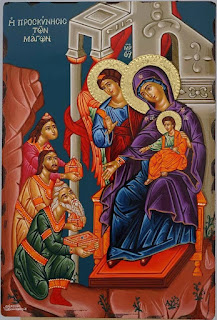
January 6, 2021 was a Wednesday, and in my former parish, we had a mid-week Noon Eucharist to celebrate the Feast of the Epiphany. Even though it was mainly live-streamed and “You Tubed” because of the pandemic, there were two or three other people besides me taking part in person, we celebrated the last day of the Christmas season by recounting the story of the Magi and the recognition of Jesus as Messiah by representatives of the Gentile world beyond first century Judaism in Roman-occupied Palestine.

The message in Matthew’s Gospel is that Jesus is the Messiah for all people! The Epiphany story of the foreign astrologers who come to worship a new-born king in Bethlehem is nicely bookended at the end of Matthew when Jesus sends out his followers into the all the world to proclaim, baptize, and teach the Gospel.

See the symmetry? The world comes to the infant Jesus to proclaim him king at the start of the Gospel of Matthew; and at the end when the risen Jesus, whose kingship was proclaimed on the cross, is about to ascend to heaven, we, his followers, are sent into the world.

The Season of Epiphany, starting with the visit of the Magi, is all about Jesus being revealed to the world as Messiah and Lord and in every Gospel story at every Eucharist in the coming weeks, we will again experience Jesus being made known as Messiah and Lord.

And then there was Washington, a year ago.

That was a kind of epiphany, too, I suppose. A revealing moment. And just as the Epiphany season will show us God’s true nature in Jesus Christ, the uprising a year ago showed us something of our true nature.

Part of my reaction comes from shock and grief. You see, I am a native of Washington, DC, and it is where “my people” (as my mother used to say) came from. Both my parents and one of my brothers are also natives of The District. I also spent a bit of my childhood in Concord, Massachusetts, where “the shot heard round the world” was fired. I was a Scout, as my father was, when he ushered at one of FDR’s inaugurations. My family story is filled with people who served our country in military and civil service: from soldiers and sailors to librarians of Congress to engineers who built both civic projects and moon rockets. And while I never served in the military, as my Dad and others in my family have, and have never run for elected office, I did my civic turn in volunteer fire and EMS corps, serving on local boards, registering voters, community organizing, and mostly by never, ever, missing an election since the day I registered at 18 years old.

For me, patriotism is not merely a feeling, it’s practical. It is the practical work of the people for the common good of the “polis,” “the city”, which is the root of the word “politics.” I can still recite that part of John F. Kennedy’s inaugural speech in 1961: “Ask not what your country can do for you, ask what you can do for your country.”

One of the people who came to that Epiphany Eucharist was a friend of mine, a Lutheran pastor, who was one of my favorite theological sparring partners. We agreed on much, but we disagreed on plenty, and our plan was to go to lunch after that Noon Eucharist and kibbitz over one thing or another. Ironically, we were reminiscing about my roots in The District, when we first heard of the violence in the Capital.

As we processed the news, we asked the question “where would Jesus be in all this mess?”

The epiphany of January 6, 2021 was that our common life is fragile, and it is all too easy to be given over to fear. Fear is all to easy to be manipulated by selfish ambition. Useful, functional, politics can be easily manipulated by the unscrupulous into corrupt ends or mob rule.

It fascinates me that when Jesus taught, he used the image of “the Kingdom of God” so often. Twenty-seven times, in fact, in the Gospels of Mark, Matthew, and Luke. But instead of talking about an earthly political rule, he was talking about life in the “polis” or “city” of God… about our life together as people of faith. Jesus’ parables typically reflected the surprise of discovering the work of God in the most unexpected places: like yeast in a loaf, like fish in a net, or like mercy coming from a neighbor we were taught to fear and hate.

In the collision between these two epiphanies, the one that shows off who Jesus is, and the one that shows off who we are (or can be, if left to our own impulses), we discover that our life together both as a church and as a nation is at once an act of grace and an act of the will.

We can choose to participate in our common life, where there will be give and take, advances and set-backs, where we will sometimes get our way and sometimes not. We can choose to act as faithful participants or as aggrieved victims. We can tally up our wins and losses, seeking to “get even” or we can choose to learn as we go. We can choose to seek the destruction of others, or we can choose to work together in our common life. It boils down to the lesson many of us learned in Little League, as I did from a wise volunteer coach: A sore loser will never win graciously.

It is perhaps a strange grace that just ahead of this sorrowful civic anniversary, this sad epiphany into the dark corners of our civic life, that we heard all these remembrances after the death of Archbishop Desmond Tutu, who, needless to say, undertook his own struggle against an unjust political system. One thing he said was this:

“My father always used to say, ‘Don't raise your voice. Improve your argument.’ Good sense does not always lie with the loudest shouters, nor can we say that a large, unruly crowd is always the best arbiter of what is right.”

One key to understanding how Jesus understood God’s “polis” is found in the Lord’s Prayer, where we daily pray that God’s will be done on earth as it is in heaven. We pray that heaven will come to earth; and we pray that our life together will in some way mirror what God’s ideal community might be.

My hope and prayer for us is that the Epiphany of Jesus as Messiah and Lord this coming January 6th, will overshadow and leaven the anniversary of that angry insurrection. That instead will come the epiphany that we friends and apprentices of Jesus can in fact live lives of grace, conviction, love, and justice– where our life together is a living parable of what real life is like in the “polis of God!"

Saturday, July 24, 2021

From Scarcity to Abundance

Pop Quiz: There is only one miracle of Jesus that appears in all four Gospels. Can you guess what it is? Is it Jesus walking on the water or the feeding of the 5000? 

Yes! That’s right! The feeding of the 5000 is the only miracle of Jesus that appears in all four gospels.  Which may not be what you might expect: there are lots of cartoons, songs, poems, and paintings about Jesus walking on the water, and while the miraculous feeding is very well known, it’s not something that appears in very many stained glass windows.

But the fact that all four Gospels remember this incident four—maybe five – times tells us something: it says that among the very earliest Christian communities they all remembered that miraculous feeding and considered it very important!

It might not be so surprising that Matthew, Mark, and Luke’s churches remembered it in common… they, after all shared both the Gospel of Mark and some other Gospel material that would end up in the other two books…. But John’s community remembered it, too; and except for the Passion, Cross, Resurrection and Ascension, this is one of the few things Jesus did that all four of these widely diverse communities remembered in their Gospels.

So, what gives? What makes this miracle stand out?

I have two theories:

For one thing, I believe that Jesus did this miracle more than once. I think the Gospels point this way because not only does it appear twice in the Gospel of Luke… one time feeding 4000 and another 5000, perhaps because it happened in at least two different places which might explain how multiple oral traditions existed and how it ends up in all four Gospels.

If Jesus did do this more than once, as I think he did, we can guess that the miracles were also a prophetic act, a sign, that told the people both who he was and what God was up to.

Now there’s a common theory out there, that the feeding of the 5000 was a kind of stone soup moment: you know the story, right? Where the traveling teacher (rabbi, magician… take your pick) turns stones and water into soup by coaxing the starving townspeople to give up the vegetables they were hoarding and to create a soup that fed them all with lots left over. In this approach to the story, Jesus got everyone to contribute their sack lunches so that all were fed.

Well, I don’t buy it. Not in this case. It’s not that I am against stone soup— over the years, I’ve seen how God’s grace and power works that way all the time! It’s just that this not what is happening here.

And this is where my second theory comes in: For Jesus, these loaves of bread and these dried fish where not just a kid’s lunch multiplied; but was instead food given by God… any Jew of that era would have understood immediately the reference to manna, the food that God sent the Hebrews as they wandered in the desert after they cross the Red Sea during the Exodus!

Oddly, the miracle of Jesus walking on the sea only appears in three of the four Gospels--Luke doesn't include it. But John’s Gospel pairs the feeding of the 5000 with Jesus walking on the sea precisely to make us think of the Exodus. 

There diverse witness of both these events not only make a strong case that these miracles happened, it’s also why both the feeding of the 5000 and Jesus crossing the sea on foot meant so much to the people of the early Church!

Bishop Nick Knisely of Rhode Island commented about this in his blog yesterday, asking the question “how would people know that Jesus was the Messiah? What was the sign they were looking for?”

“We tend to imagine that in a time of military occupation, the people of Israel were looking for a messiah that would deliver them from that bondage – but we don’t remember what … would signal that the Messiah had [indeed] come. In reading through the literature of that time, the defining sign was supposed to be the return of the Manna….”

So in the earliest Christian communities, the miraculous feedings stand right alongside the Passion, the Resurrection, and the Last Supper, as signs that God’s anointed Messiah has come to restore God’s people.

And just as these early communities compared the feeding of the 5000 with the manna of the desert, they also compared Jesus' walking on the water with Moses parting the Red Sea. They were thinking of Exodus and linking it both to Jesus' actions, and to baptism and Eucharist.

This has a bunch of implications for us today:

First, we are tangibly connected to God’s covenant given in the Exodus: The Sacrament of Christ’s body and blood, Holy Communion, is not only how we participate in Christ’s death and resurrection until He comes again; it also links us with the Passover. The miraculous feedings remind us how God tended, cared for, guided, and fed his people in a time of exile and journey. As God cared for those pilgrim people, so God cares for us!

Second, we are reminded that we God’s way is one of abundance. When Jesus tells the disciples to feed the people, all they can see is scarcity: they say, “all we have are five barely loaves and two fish but what is that among so many?” But look how Jesus accepts that seemingly meager gift from the young boy and turned the everyday food of the poor and working people of the day, barley loaves and dried fish, into an abundant banquet! Jesus demonstrates to us that God’s reign has begun and that all of God’s people are welcomed, fed, and cared for in abundance through the grace of God.

Of course, there are times when we don’t see Jesus coming and when we do, we don’t believe it. Just as the disciples were startled and frightened to see Jesus coming to them, walking on the sea, we are often unprepared for God at work among us. This is why we need a regular rhythm of prayer and spiritual nurture. A regular pattern of daily prayer, meditation on scripture, Eucharistic living not just alone but together, prepares us to walk with Jesus and to see God at work in abundance where before we only found scarcity.

One of my favorite examples of how this came to life in a practical, yet profoundly spiritual way is how, in 1976, Millard and Linda Fuller began Habitat for Humanity. It was a time where there was a great need for affordable, decent housing for the working poor, and where society was exhausted by war, scandal, and upheaval. With a few tools and a small group of volunteers, who never asked “what is that among so many?” as they turned a small community church project into a worldwide ministry. In Habitat, local volunteers and the working poor themselves work together to create homes.  demonstrating God’s love and grace along the way.

And that is only one example.

Time and again, small bands of faithful people show off God’s generous love in tangible ways from feeding the hungry, to visiting and bringing the sacrament to the sick, to finding new ways to be the church in a time of pandemic, war, and global disruption. And it happens over and over again in congregations with seemingly limited resources and not enough hands, who in the hands of Jesus, discover how little becomes much, the few become many, and the weak become the strong. But remember… it’s not stone soup… it’s Exodus.

It’s Exodus because every day, God leads faithful people through the desert of their worry, fear, and doubt towards the Promised Land. God’s abundance always builds on even the simplest of our gifts.

+ + +   + + +   + + +

A sermon given at St. John's Episcopal Church, Clearwater, Florida on Sunday, July 24, 2021

Proper 13B - Track 1 - John 6:1-21

A video of the sermon may be found here.

A video of the entire liturgy may be found here.

Here is a copy of the bulletin for the day.